


This article was automatically translated from the original Turkish version.
+2 More
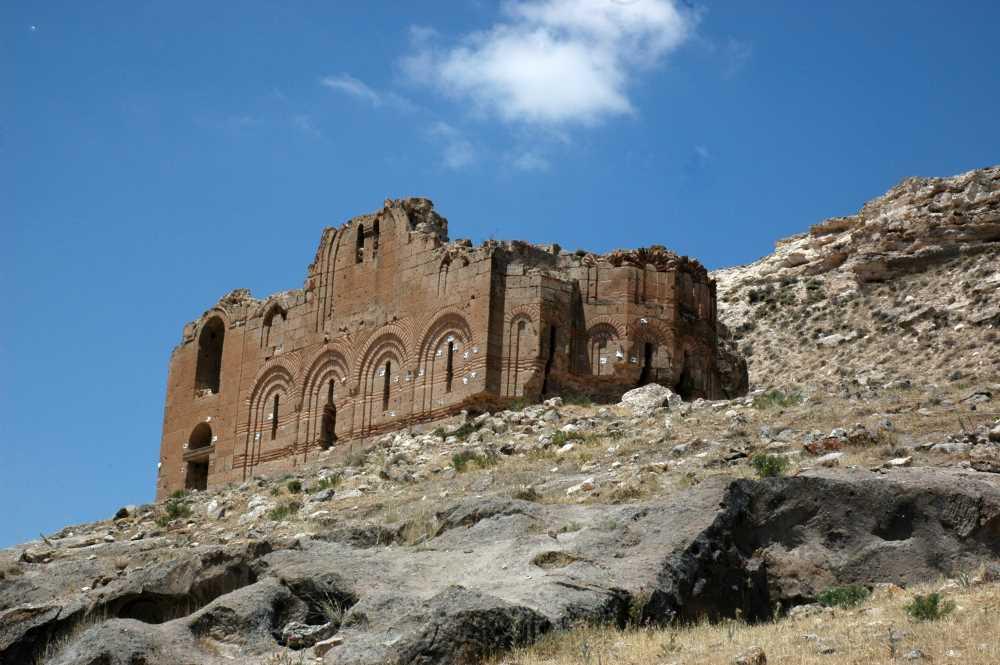
Church with Bells
Coordinate(s) | 38.35°N 34.03°E | ||||||||
|---|---|---|---|---|---|---|---|---|---|
Elevation(s) | 1300 m | ||||||||
Region(s) | Cappadocia (Western Cappadocia) | ||||||||
Period(s) | Byzantine Period (10th–11th centuries) | ||||||||
Construction Technique | Stone and Brick Composite Wall Technique | ||||||||
Building Materials | Regularly Cut Stone, Brick, Fresco Cladding | ||||||||
Units | Naos, Narthex, Chapel, Pareklesion | ||||||||
Çanlı Kilise is located on a dominant hill approximately 12–17 kilometres southeast of the city centre of Aksaray in the Central Anatolia Region, and about 4–5 kilometres northeast of Akhisar village. The church faces the landscape of Hasan Dağı. The structure was built using a composite wall technique that combines brick and cut stone. It forms part of an extensive settlement pattern that includes dwellings carved into the rock.

Çanlı Kilise (Anadolu Agency)
The region where Çanlı Kilise is situated entered a rapid phase of religious architectural development following the Roman Empire’s official adoption of Christianity as its state religion in 313 CE. From the 10th century onward, the church came under the influence of Byzantine Christian art, during which time churches and monasteries in the classical Byzantine style were constructed throughout the area. Aksaray and its surroundings came under Seljuk control in 1080, and during the Seljuk period, Christian settlements were treated with tolerance, allowing their religious structures to persist.
Architecturally, Çanlı Kilise resembles the rock-cut structures typical of the Cappadocia region, but it stands out due to its unique elements and construction technique. The church was built in a free-cross plan shaped like a “T”, with arms supporting a central dome, reflecting the centralised influences of Byzantine church architecture.
The church consists of four main components: a square-plan naos (main worship space), a narthex (entrance hall) to the west, a chapel to the north, and a pareklesion (side worship space). The ceiling of the naos was likely covered by barrel vaults or small domes; however, the upper structure of the building has been largely destroyed over time.
The walls were constructed using a composite technique combining stone and brick. Regular cut stone was predominantly used in load-bearing walls, while brick was extensively employed for decorative elements and transitions in upper structures. This construction method represents a transitional feature between the imperial Byzantine architecture centred in Istanbul and the regional Cappadocian style.
The frescoes within the interior depict figures such as Jesus Christ and the Apostles. The scenes follow classical Byzantine iconography and were executed with colour schemes and compositional principles consistent with the period’s aesthetics. However, the majority of these frescoes have been lost over time, with only partial traces remaining on certain surfaces.
Anadolu Ajansı. "Kapadokya'nın saklı hazinesi Çanlı Kilise." Accessed June 13, 2025. https://www.aa.com.tr/tr/kultur-sanat/kapadokyanin-sakli-hazinesi-canli-kilise/110908
Bozdoğan, Ömer. *Tarihi ve Kültürel Miraslardaki Aşınma:Aksaray Üniversitesi Kilise Örneği*. Master's thesis, Aksaray University Institute of Natural Sciences, 2019. Accessed June 13, 2025. https://tez.yok.gov.tr/UlusalTezMerkezi/tezDetay.jsp?id=0upqPuXLEBvjJ_jU_wOUTw&no=gEBOpM2-vnVPjpctG1h_cw
Türkiye Kültür Portalı. *Çanlı Kilise – Aksaray*. Ministry of Culture and Tourism. Accessed June 13, 2025. https://www.kulturportali.gov.tr/turkiye/aksaray/gezilecekyer/canli-kilise

Church with Bells
Coordinate(s) | 38.35°N 34.03°E | ||||||||
|---|---|---|---|---|---|---|---|---|---|
Elevation(s) | 1300 m | ||||||||
Region(s) | Cappadocia (Western Cappadocia) | ||||||||
Period(s) | Byzantine Period (10th–11th centuries) | ||||||||
Construction Technique | Stone and Brick Composite Wall Technique | ||||||||
Building Materials | Regularly Cut Stone, Brick, Fresco Cladding | ||||||||
Units | Naos, Narthex, Chapel, Pareklesion | ||||||||
Historical Development
Architectural Features