

This article was automatically translated from the original Turkish version.
+2 More
Main Component(s) | Sucrose Natural Flavors Citric Acid | ||||||||
|---|---|---|---|---|---|---|---|---|---|
Etymology(s) | Arabic Akit Word (Agreement / Loyalty) | ||||||||
Production Technique | Hacıbekir Cut (Marble Counter and Wick Method) | ||||||||
Physical Structure | Glassy and Non-crystallized Saturation Structure | ||||||||
Ritual Use | Janissary Allowance Ceremonies, Tokat Akit Sherbet | ||||||||
Important Figures | Şekercibaşı Hacı Bekir Efendi | ||||||||
Symbolic Meaning | Loyalty Agreement Between the State and the Soldier | ||||||||
Golden Age | 18th Century (Gedik System and Guild Organization) | ||||||||
Emergence | 14th–15th Century (Early Ottoman Period) | ||||||||
Varieties | Cinnamon-flavored, Rose-flavored, Lemon-flavored, Sesame-flavored, Hazelnut-flavored | ||||||||
Kitchen | Ottoman/Turkish Cuisine | ||||||||
Door | Hard Candy | ||||||||
One of the most deeply rooted and nostalgic confections in Ottoman culinary culture, akide şekeri is not merely a sweet but a symbolic value where state tradition and popular belief intertwine. Classified among hard candies, akide has historically been regarded as a symbol of social trust, political loyalty, and craft aesthetics.
The term “akide” is derived from the Arabic root “akit” (contract) or “akid” (bound). 【1】 This naming refers both to the physical structure of the candy and its historical function as a “contract of allegiance.” 【2】 According to the definitions of the Turkish Standards Institute (TSE), akide şeker is a traditional product obtained by inverting sucrose with appropriate acids, optionally adding glucose syrup, cooking it to a specific consistency, and shaping it with natural flavoring agents.【3】
It is estimated that the history of confectionery in Türkiye extends back to the 14th and 15th centuries.【4】 In early periods, honey and grape molasses were used as sweeteners, but from the late 18th century, the introduction of European "kelle şekeri" accelerated the modern production of akide.【5】 In the Ottoman Palace, this production was carried out by the Matbah-ı Amire’s subsidiary Helvahâne-i Hassa Ocağı.【6】 By the mid-17th century, the Palace’s annual sugar consumption had reached 65 tons, demonstrating the growing importance of these products in the imperial kitchen.【7】
In Istanbul, the tradespeople supplying the public with sweets were divided into two main groups: akideci and şeker şerbetçi.【8】
In Ottoman political history, akide şeker served as a “contract of loyalty.”【15】 During the ulufe ceremonies, in which janissaries received their salaries, these candies were used to measure the soldiers’ allegiance to the sultan.【16】
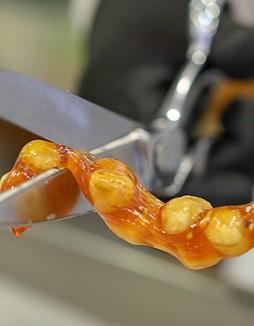
By the mid-19th century, a new style emerged in which akide was stretched on marble countertops and cut into bars, known as the "Hacıbekir kesimi" style.【20】 Begun by Bekir Efendi in 1777 in Bahçekapı,【21】 this tradition introduced angular, round, or oval aesthetic forms to akide and earned him the imperial title of “Şekercibaşılık.”【22】

Akide Şekeri (Anadolu Ajansı)
Physically, akide şeker has a glassy, non-crystalline structure.【23】
In the Tokat region, akide forms the basis of “akit şerbeti,” consumed in postpartum rituals and commercial agreements.【29】
In the Ottoman period, during ceremonies such as circumcision and marriage (sûr-i hümayun), statues made from akide şeker were displayed in “Şeker Alayları” (Sugar Parades).【33】 In the 1582 festivities, enormous sugar sculptures were presented to the public.【34】 During Ramazan Bayramı, akide şeker always headed the list of gifts sent by the Grand Vizier to palace personnel.【35】
Anadolu Ajansı. "211 yıllık tarifiyle bayramın tadı: Akide şekeri." Accessed March 30, 2026. https://www.aa.com.tr/tr/ramazan-2018/211-yillik-tarifiyle-bayramin-tadi-akide-sekeri/1171400
Demir, Mustafa Kürşat, Adem Elgün, and Ahmet Avci. "Klasik ve Vakum Altında Spreylenerek Pişirme Yöntemlerinin Akide Şekerinin Bazı Kalite Kriterleri ve Raf Ömrü Üzerine Etkisi." *GIDA* 35, no. 6 (2010): 431-438. Accessed March 30, 2026. https://dergipark.org.tr/tr/pub/gida/article/92220
Uluskan, Murat. "İstanbul’da Akideci ve Şeker Şerbetçi Esnafı (18. Yüzyıl)." *VII. Uluslararası Osmanlı İstanbulu Sempozyumu Bildirileri.* Istanbul 2021: 293-309. Accessed March 30, 2026. https://hdl.handle.net/20.500.12723/3799
Yılmaz, Fatih Mehmet, Ebru Yıldırım, and Merve Karakuş. "Doğal Renk Maddesi Katkılı Sert Şekerleme Üretimi: Farklı Karbonhidrat Formülasyonlarının Renk, Camsı Geçiş, Higroskopite, Karbonhidrat Kompozisyonu ve Duyusal Özellikler Üzerine Etkileri." *GIDA* 44, no. 2 (2019): 357-368. Accessed March 30, 2026. https://dergipark.org.tr/tr/pub/gida/article/492316
Özgen, Mutlu. "Akide Şekerinden Doğan Bir Gelenek: Tokat'ta Akit Şerbeti ve Etrafında Oluşan Ritüeller." *Uluslararası Dil, Edebiyat ve Kültür Araştırmaları Dergisi (UDEKAD)* 7, no. 4 (2024): 948-959. Accessed March 30, 2026. https://izlik.org/JA97CP22KW
Özlü, Zeynel. "Osmanlı Saray Şekerleme ve Şekerlemecileri ile İlgili Notlar." *Türk Kültürü ve Hacı Bektaş Veli Araştırma Dergisi*, no. 58 (2011): 171-190. Accessed March 30, 2026. https://izlik.org/JA84JZ29TK
[1]
Mutlu Özgen, "Akide Şekerinden Doğan Bir Gelenek: Tokat'ta Akit Şerbeti ve Etrafında Oluşan Ritüeller"Mutlu Özgen, "Akide Şekerinden Doğan Bir Gelenek: Tokat'ta Akit Şerbeti ve Etrafında Oluşan Ritüeller", UDEKAD, 7 (4), 2024, s. 949. https://doi.org/10.37999/udekad.1553608
[2]
Mustafa Kürşat Demir vd., "Klasik ve Vakum Altında Spreylenerek Pişirme Yöntemlerinin Akide Şekerinin Bazı Kalite Kriterleri Üzerine Etkisi", GIDA, 35 (6), 2010, s. 432. https://dergipark.org.tr/en/download/article-file/78508
[3]
M. K. Demir vd., a.e., s. 432.
[4]
Zeynel Özlü, "Osmanlı Saray Şekerleme ve Şekerlemecileri ile İlgili Notlar", Hacı Bektaş Veli Araştırma Dergisi, 58, 2011, s. 171. https://izlik.org/JA84JZ29TK
[5]
M. K. Demir vd., a.e., s. 432.
[6]
Z. Özlü, a.e., s. 171-172.
[7]
Z. Özlü, a.e., s. 173.
[8]
Murat Uluskan, "İstanbul'da Akideci ve Şeker Şerbetçi Esnafı (18. Yüzyıl)", VII. Uluslararası Osmanlı İstanbulu Sempozyumu Bildirileri, 2021, s. 293-294. https://hdl.handle.net/20.500.12723/3799
[9]
M. Uluskan, a.e., s. 295.
[10]
M. Uluskan, a.e., s. 295.
[11]
M. Uluskan, a.e., s. 298.
[12]
M. Uluskan, a.e., s. 302.
[13]
Z. Özlü, a.e., s. 171.
[14]
M. Uluskan, a.e., s. 305.
[15]
M. Özgen, a.e., s. 949.
[16]
Z. Özlü, a.e., s. 181.
[17]
M. Özgen, a.e., s. 950.
[18]
M. Özgen, a.e., s. 950.
[19]
M. Özgen, a.e., s. 950.
[20]
M. Özgen, a.e., s. 950.
[21]
Z. Özlü, a.e., s. 175.
[22]
Z. Özlü, a.e., s. 175.
[23]
Fatih Mehmet Yılmaz vd., "Doğal Renk Maddesi Katkılı Sert Şekerleme Üretimi: Farklı Karbonhidrat Formülasyonlarının Renk, Camsı Geçiş, Higroskopite, Karbonhidrat Kompozisyonu ve Duyusal Özellikler Üzerine Etkileri," GIDA 44, sy. 2, 2019, s. 358. https://dergipark.org.tr/tr/pub/gida/article/492316
[24]
F. M. Yılmaz vd., a.e., s. 359.
[25]
F. M. Yılmaz vd., a.e., s. 361.
[26]
M. K. Demir vd., a.e., s. 432.
[27]
M. K. Demir vd., a.e., s. 433.
[28]
F. M. Yılmaz vd., a.e., s. 365.
[29]
M. Özgen, a.e., s. 951.
[30]
M. Özgen, a.e., s. 952.
[31]
M. Özgen, a.e., s. 954.
[32]
M. Özgen, a.e., s. 950.
[33]
Z. Özlü, a.e., s. 171.
[34]
Z. Özlü, a.e., s. 176.
[35]
Z. Özlü, a.e., s. 177.

Main Component(s) | Sucrose Natural Flavors Citric Acid | ||||||||
|---|---|---|---|---|---|---|---|---|---|
Etymology(s) | Arabic Akit Word (Agreement / Loyalty) | ||||||||
Production Technique | Hacıbekir Cut (Marble Counter and Wick Method) | ||||||||
Physical Structure | Glassy and Non-crystallized Saturation Structure | ||||||||
Ritual Use | Janissary Allowance Ceremonies, Tokat Akit Sherbet | ||||||||
Important Figures | Şekercibaşı Hacı Bekir Efendi | ||||||||
Symbolic Meaning | Loyalty Agreement Between the State and the Soldier | ||||||||
Golden Age | 18th Century (Gedik System and Guild Organization) | ||||||||
Emergence | 14th–15th Century (Early Ottoman Period) | ||||||||
Varieties | Cinnamon-flavored, Rose-flavored, Lemon-flavored, Sesame-flavored, Hazelnut-flavored | ||||||||
Kitchen | Ottoman/Turkish Cuisine | ||||||||
Door | Hard Candy | ||||||||
Etymology and Basic Definition
Historical Development
The Akideci Craft Guild
Political Symbolism
The Hacıbekir Cut
Technical Production Processes and Quality Criteria
Akide Şekeri in Tokat
Role in Festivals and Celebrations