This article was automatically translated from the original Turkish version.
+1 More
Location | Aksaray Türkiye | ||||||||
|---|---|---|---|---|---|---|---|---|---|
Construction Date(s) | 12th century | ||||||||
Patron | Rukn al-Din Masud (son of II. Kilij Arslan) | ||||||||
Architect(s) | Mimar Firuz | ||||||||
Architectural Style(s) | Anatolian Seljuk architecture | ||||||||
Material(s) | Regularly cut stone | ||||||||
Aksaray Ulu Camii was constructed in the 12th century as one of the examples of Anatolian Seljuk architecture. The founder of the mosque is Rükneddin Mesud, son of Seljuk Sultan II. Kılıçarslan. The construction of the building reflects the political and cultural atmosphere of the Seljuk period and has survived to the present day as an important structure in the development of religious architecture.
By the 15th century, the mosque had been repaired and expanded by the Karamanid Beylik. Information from this period is documented in inscriptions on the northern facade of the mosque. The inscription reads:
“The construction and renewal of this structure were ordered in the year 811 by the revered Sultan Mehmed, son of the late and forgiven Ala-ed-din Bey.”
This inscription reveals both the ruler of the period and the importance he accorded to the mosque. The name of the architect, Mimar Firuz, is also recorded on the same inscription. In Ottoman archives, the mosque is referred to as the Karamanoğlu Mehmed Bey Camii. This demonstrates that the building was adopted and preserved by different political authorities throughout its historical trajectory.
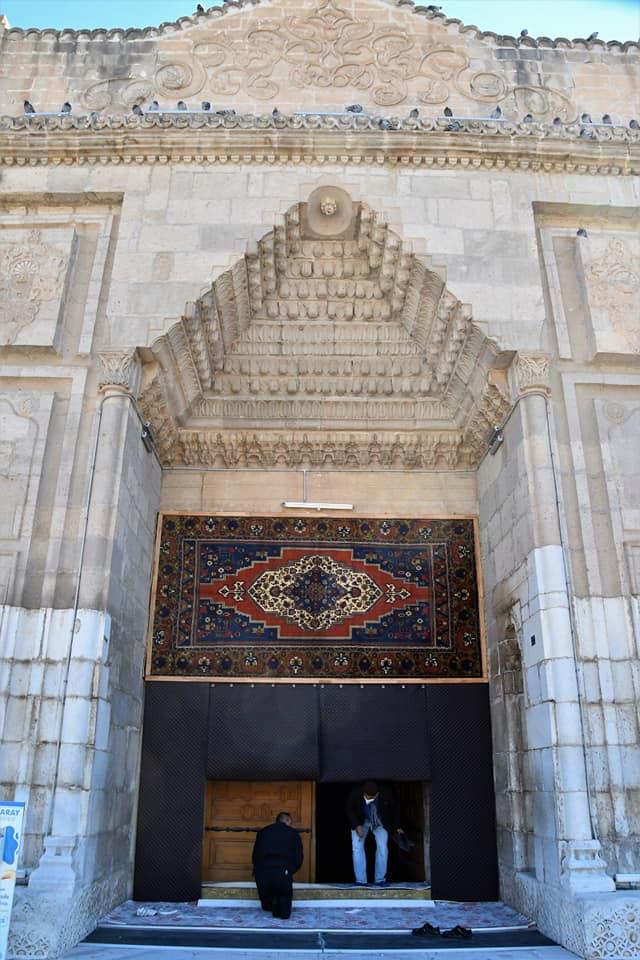
Aksaray Ulu Camii is built on a near-square rectangular plan and constructed entirely of finely cut stone. The grand portal on the western facade reflects the typical architectural and decorative sensibilities of the Anatolian Seljuk principalities. Entry to the mosque is made through this portal.
Inside the space, there are four columns aligned toward the qibla and three perpendicular to it, totaling twelve columns, all connected by arches. These arches provide both structural stability and aesthetic unity. The women’s gallery, accessible via a staircase to the left of the portal, is notable for its cross-vaulted architecture.
One of the most important elements of the mosque is its minbar from the Seljuk period. This minbar was crafted by the renowned artisan Nüştekin’ül Cemali using ebony wood. The master artisan successfully combined numerous craft techniques including wood carving, mother-of-pearl inlay, and penwork decoration.
The minbar is adorned with verses from the Qur’an, eulogies addressed to Seljuk sultans, and ornamental motifs of floral and geometric patterns. In this regard, the minbar is not only a religious object but also regarded as an exemplary work of woodcraft.
Many rugs, kilims, and prayer mats from both the Seljuk and Ottoman periods located within the mosque are now preserved by the Aksaray Museum. Some of these historical textile items are displayed in the museum for visitors, thereby safeguarding not only the mosque’s interior decoration but also the region’s weaving culture.
Aksaray Ulu Camii continues to serve as an important structure for both worship and tourism today. Recent restoration works carried out by the Aksaray Municipality have renewed certain sections of the mosque. In particular, the lighting system has been modernized, and the degraded carpet at the mosque entrance has been replaced with the Taşpınar carpet, one of Aksaray’s cultural symbols.
Aksaray Belediyesi. "ULU CAMİ GİRİŞİNE TAŞPINAR HALISI ASILDI." Aksaray Municipality Official Website. Accessed July 14, 2025. https://aksaray.bel.tr/HaberDetay.aspx?icerikId=2031&ULU-CAMI-GIRISINE-TASPINAR-HALISI-ASILDI.
Ministry of Culture and Tourism of the Republic of Türkiye. "Ulu Camii (Karamanoğlu Mehmed Bey Camii)." *Kültür Portalı*, Accessed July 14, 2025. https://www.kulturportali.gov.tr/turkiye/aksaray/gezilecekyer/ulu-camii-karamanoglu-mehmed-bey-camii.
T.C. Ministry of Culture and Tourism. "Ulu Camii." T.C.Aksaray İl Directorate of Culture and Tourism, Accessed July 14, 2025. https://aksaray.ktb.gov.tr/TR-232488/ulu-camii.html.
Location | Aksaray Türkiye | ||||||||
|---|---|---|---|---|---|---|---|---|---|
Construction Date(s) | 12th century | ||||||||
Patron | Rukn al-Din Masud (son of II. Kilij Arslan) | ||||||||
Architect(s) | Mimar Firuz | ||||||||
Architectural Style(s) | Anatolian Seljuk architecture | ||||||||
Material(s) | Regularly cut stone | ||||||||
No Discussion Added Yet
Start discussion for "Aksaray Ulu Camii (Karamanoğlu Mehmed Bey Camii)" article
Restoration During the Karamanid Period
Architectural Structure and Features
Minbar and Woodwork
Rugs and Museum Preservation
Contemporary Restoration Efforts