


This article was automatically translated from the original Turkish version.
+2 More
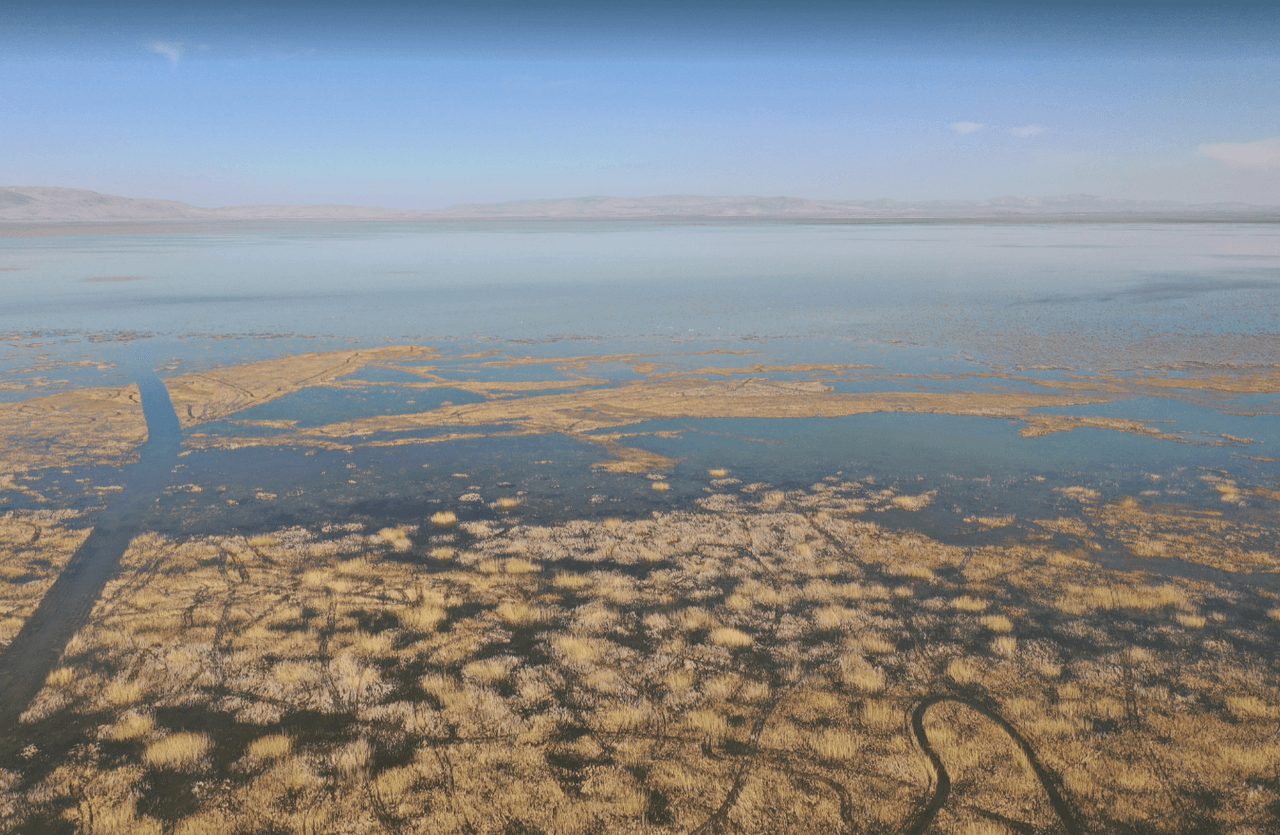
Akşehir Lake is a tectonic origin closed basin lake located between the provinces of Konya and Afyonkarahisir in Türkiye’s Central Anatolia Region, situated between the Sultan Mountains and Emir Mountain. The lake lies in the southeastern part of the Akarçay Closed Basin, within the approximately 2,237 km² Akşehir Sub-Basin. Although its surface area has undergone significant fluctuations over time, it was historically recorded as Türkiye’s fifth largest lake. During its fullest periods, its surface area reached up to 360–367 km².

Akşehir Lake Map (Akşehir Subgovernorship)
Akşehir Lake is bordered by the Emirdağ Mountains to the north and the Sultan Mountains to the south. The area where the lake is located forms a graben structure shaped by tectonic activity in the region. The Sultan Mountains Fault is the dominant tectonic element in the formation of this structure. The lake’s surroundings are generally composed of Neogene-Quaternary units characterized by alluvial deposits and alluvial fans.
The hydrological budget of Akşehir Lake is sustained by precipitation, groundwater flow, snowmelt, and streams feeding the lake. These include rivers such as Adıyan Suyu, Engilli Deresi, and Tekke Deresi. As a closed system with no outflow, the lake loses water solely through evaporation and water extraction for irrigation. The saline and locally polluted nature of the lake waters has rendered them unsuitable for drinking water use.
Until the 1980s, the lake maintained a sustainable structure under natural balance. Starting in 1984, it began experiencing severe water level declines. This decline was accelerated by human-induced interventions including climatic drought, increased evaporation, intensive water abstraction for agricultural irrigation, unauthorized well drilling, and the construction of dams and reservoirs. The lake’s surface area, which was 367 km² in 1985, decreased to 113 km² by 2005 and further declined to only 36.9 km² by 2020.
Akşehir Lake (YouTube)
Akşehir Lake, together with Eber Lake, forms an important wetland complex. These two lakes, periodically connected via the Eber Canal (Taşköprü Çayı), provide habitat for numerous endemic and threatened species. Important species observed in the area include the Dalmatian pelican (Pelecanus onocrotalus), glossy ibis (Plegadis falcinellus), lesser white-fronted goose (Anser albifrons), and the endemic freshwater fish species Alburnus nasreddini and Leuciscus anatolicus.
The extensive reed beds and seasonal grasslands surrounding the lake are critically important for bird migration routes and breeding grounds. Additionally, rare plant species found only in this region, such as Thermopsis turcica and Eber yellow (piyan sarısı), also thrive here. The removal or transplantation of these plants is subject to legal penalties.
Changes in the lake’s area have been meticulously monitored using remote sensing techniques. Studies employing spectral indices such as NDWI (Normalized Difference Water Index) and NDVI (Normalized Difference Vegetation Index), along with Landsat satellite imagery, have revealed a dramatic reduction in the lake’s surface area. The surface area, which was 366.6 km² in 1985, declined to only 36.9 km² by 2020. During this period, significant agricultural use also began on the lakebed.
Historically, fishing was a vital source of livelihood for the local economy, but this activity has completely ceased due to the decline in the lake’s water level. Traditional harvesting of reeds and rushes around the lake continues on a limited scale. Agricultural irrigation using lake water is widespread, particularly along the southern shores. In recent years, cherry production and fruit cultivation have increased around the lake, further raising water demand.
Akşehir Lake and its surroundings were declared a Class I Natural Site in 1992. In 2006, under the leadership of the Ministry of Environment and Forestry, the “Akşehir-Eber Lakes Wetland Management Plan” was initiated, developing strategies focused on water balance, biological diversity, water pollution, and alternative livelihood sources. At the local level, projects such as wastewater treatment plants and sewerage infrastructure are being implemented.
Akşehir Kaymakamlığı. "Akşehir Gölü." Akşehir Kaymakamlığı Resmî Web Sitesi. Accessed May 31, 2025. http://aksehir.gov.tr/aksehir-golu.
Bahadır, Muhammet. “Akşehir Gölü’nde Alansal Değişimlerin Uzaktan Algılama Teknikleri ile Belirlenmesi.” *Marmara Coğrafya Dergisi*, no. 28 (2013): 246–275. Accessed May 31, 2025. https://dergipark.org.tr/tr/download/article-file/3355.
Doğa Derneği. “Akşehir ve Eber Gölleri.” dogadernegi.org. Accessed May 31, 2025. https://dogadernegi.org/aksehir-ve-eber-golleri/.
Doğan, Abdullah. “Kuruyan Akşehir Gölü Kıyısındaki 150 Dekarlık Alanda 'Eber Sarısı' Çiçek Açtı.” Anadolu Ajansı, May 10, 2025. Updated May 11, 2025. https://www.aa.com.tr/tr/yasam/kuruyan-aksehir-golu-kiyisindaki-150-dekarlik-alanda-eber-sarisi-cicek-acti/3562889.
Çatal, Ali, and Orhan Dengiz. “Akşehir Gölünün Akşehir Çölüne Dönüşü Süreci ve Etki Eden Faktörler.” *Toprak Su Dergisi* 4, no. 1 (2015): 18–26. Accessed May 31, 2025. https://www.researchgate.net/publication/307803615.
Çağlayan, Elif Büşra, Furkan Erel, Emre Batuhan Samur, Metin Deniz, Mohammad Asef Mobariz, and Gordana Kaplan. “Uzaktan Algılama Teknikler ile Akşehir Gölü’ndeki Alansal Değişiminin İzlenmesi.” *Türkiye Uzaktan Algılama Dergisi* 2, no. 2 (2020): 70–76. Accessed May 31, 2025. https://dergipark.org.tr/en/download/article-file/1182775.

Geographical and Geological Characteristics
Hydrological Characteristics and Lake Regime
Ecological and Biological Significance
Area Changes and Remote Sensing Findings
Socioeconomic Impacts and Usage Patterns
Conservation and Management Initiatives