


This article was automatically translated from the original Turkish version.
+2 More
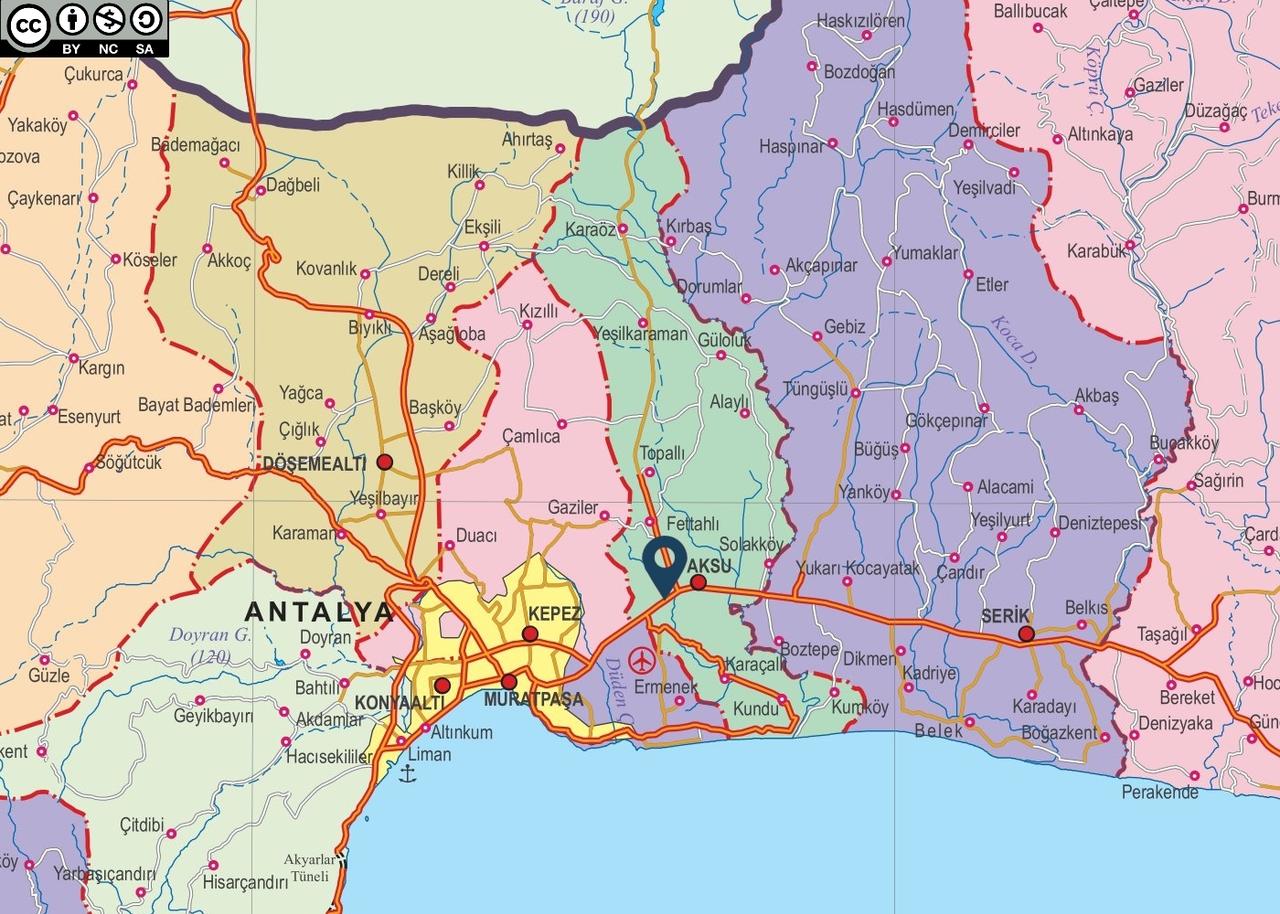
Aksu
Aksu
Province(s) | Antalya | ||||||||
|---|---|---|---|---|---|---|---|---|---|
Area(s) | 406 km² | ||||||||
Number of Neighborhoods | 35 | ||||||||
Population (2023) | 77.623 | ||||||||
Aksu district, located approximately 15 kilometers from the city center of Antalya, lies along the Mediterranean coast. It is bordered by Serik to the east, Muratpaşa to the west, Döşemealtı to the north, and the Mediterranean Sea to the south. The district derives its name from the Aksu Çayı, a river that flows through it and empties into the Mediterranean.
Aksu covers an area of 406 km² and generally features a flat, alluvial topography. This landscape facilitates intensive agricultural activity. The district experiences a Mediterranean climate with hot, dry summers and mild, rainy winters. The annual average temperature ranges between 18–20 °C.
The Aksu Çayı is vital for the district, serving as a critical resource for agricultural irrigation and shaping the surrounding ecological environment. The wetlands formed by the river are natural resting points along migratory routes of various bird species.

Aksu (Aksu Municipality)
Aksu district is an important settlement area within the historical region of Pamphylia, which has hosted numerous civilizations throughout history. In this context, the Perge Ancient City stands as one of the key symbols reflecting the region’s historical depth and cultural richness.
The earliest known settlement traces in Perge date back to the 12th century BCE. According to ancient sources, Perge was established by Greek migrants who arrived in the region after the Trojan War. It developed into a significant urban center during the Hellenistic, Roman, and Byzantine periods. Archaeological excavations in the city have uncovered structures such as a theater, stadium, agora, bathhouse, colonnaded street, and temples.
Perge also holds significance in the history of Christianity. It is known that Saint Paul preached in this city, as mentioned in the Bible. This feature makes the ancient city important both for archaeological and religious tourism.

Perge Ancient City (Antalya Provincial Directorate of Culture and Tourism)
Aksu gained district status in 2008 under Law No. 5747, when it was separated from Kepez district. The administrative center of the district is Aksu Mahallesi, which consists of 35 neighborhoods. As of 2023, the population of the district is 77,623.
Due to its proximity to the city center of Antalya, the settlement pattern exhibits both rural and urban characteristics. Its location along the route of Antalya Airport and the D-400 highway is directly linked to the district’s rapid population growth and urbanization dynamics.
The primary economic activity in Aksu district is agriculture. Its fertile alluvial soils make the region particularly suitable for protected cultivation. In addition to vegetables such as tomatoes, peppers, and cucumbers, fruits including citrus, pomegranate, and banana are widely produced.
Greenhouse farming has become an integral part of high-tech agricultural production, and the number of enterprises engaged in export-oriented agriculture is increasing. The agricultural sector provides significant employment within the district.
Limited-scale animal husbandry and beekeeping activities are also carried out within the district boundaries. Moreover, its proximity to Antalya Airport offers logistical advantages, facilitating the efficient delivery of products to markets.
Aksu district possesses significant tourism potential due to its cultural heritage and natural environment. The Perge Ancient City is visited annually by thousands of domestic and international tourists. This ancient city, listed on UNESCO’s Tentative World Heritage List, is distinguished by its architectural integrity and state of preservation.
Beyond Perge, the natural landscapes along the Aksu Çayı offer opportunities for nature tourism. The area is suitable for birdwatching, hiking, and ecotourism activities.

Deliklitaş Cave (Aksu Municipality)
Aksu district benefits from a strategically advantageous location in terms of road, air, and sea transportation. Its inclusion within the boundaries of Antalya Airport positions it as a strategic hub for tourism and trade. The Antalya-Alanya D-400 highway passes through the district, facilitating east-west connectivity.
The district has a basic public infrastructure for education, health, security, and municipal services. Aksu Municipality and the district governor’s office provide services to rural neighborhoods, and infrastructure projects are carried out in coordination with the Antalya Metropolitan Municipality.
“Aksu İlçesi.” Aksu Kaymakamlığı. Accessed July 18, 2025. http://www.aksu.gov.tr/aksu-ilcesi
“Aksu.” *Aksu Kaymakamlığı*. Accessed July 18, 2025. http://www.aksu.gov.tr/aksu
“Aksu.” *Antalya Valiliği*. Accessed July 18, 2025. http://www.antalya.gov.tr/aksu
“Aksu’da Turizm.” Aksu Belediyesi. Accessed July 18, 2025. http://www.antalyaaksu.gov.tr/aksuda-turizm
“Doğa.” Aksu Belediyesi. Accessed July 18, 2025. http://www.antalyaaksu.gov.tr/doga
“Perge Ören Yeri.” Aksu Belediyesi. Accessed July 18, 2025. http://www.antalyaaksu.gov.tr/perge-oren-yeri
“İlçenin Tarihi.” Aksu Kaymakamlığı. Accessed July 18, 2025. http://www.aksu.gov.tr/ilcenin-tarihi

Aksu
Aksu
Province(s) | Antalya | ||||||||
|---|---|---|---|---|---|---|---|---|---|
Area(s) | 406 km² | ||||||||
Number of Neighborhoods | 35 | ||||||||
Population (2023) | 77.623 | ||||||||
Historical Development and Ancient Period Remains
Administrative Structure and Population Characteristics
Economic Structure and Agricultural Production
Tourism Potential and Cultural Assets
Infrastructure, Transportation, and Public Services