

This article was automatically translated from the original Turkish version.
+2 More
Original Name(s) | Al-Khazneh (The Treasury) | ||||||||
|---|---|---|---|---|---|---|---|---|---|
Construction Date(s) | 1st century BCE – 1st century CE | ||||||||
Architectural Style(s) | A mixture of Hellenistic (Greek) and Nabataean influences Egyptian | ||||||||
Location | Jordan Petra Ancient City | ||||||||
Original Function | Royal Monumental Tomb (Mausoleum) or Crypt | ||||||||
Important Figures | Dioscuri, Amazons, Nike, Eagles | ||||||||
Building Material | Sandstone carved into a natural rock formation | ||||||||
Civilization | Nabataeans | ||||||||
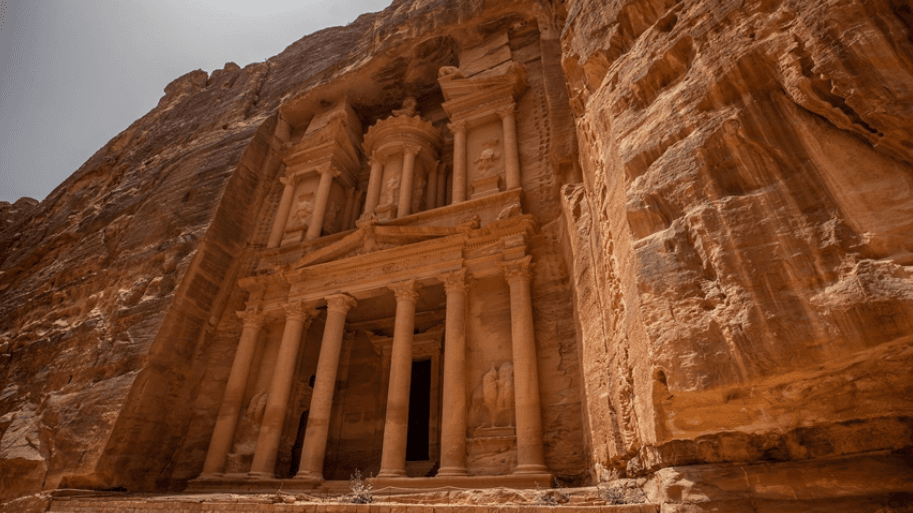
Al-Khazneh (Arabic: Al-Khazneh) is the most famous monumental structure in the ancient city of Petra in southern Jordan, also known as "The Treasury." Carved directly into the rock by the Nabataeans, it is located at the end of the Siq, the main entrance to the city, and is widely regarded as Petra’s most iconic symbol.
Although the exact date of construction remains uncertain, architectural style and archaeological evidence point to a period between the 1st century BCE and the 1st century CE, particularly during the reign of Nabataean King Aretas IV (9 BCE – 40 CE). It is generally believed to have been originally constructed as a funerary monument or crypt. Some scholars suggest it may have served as a temple dedicated to the god Dushara or as an administrative center.
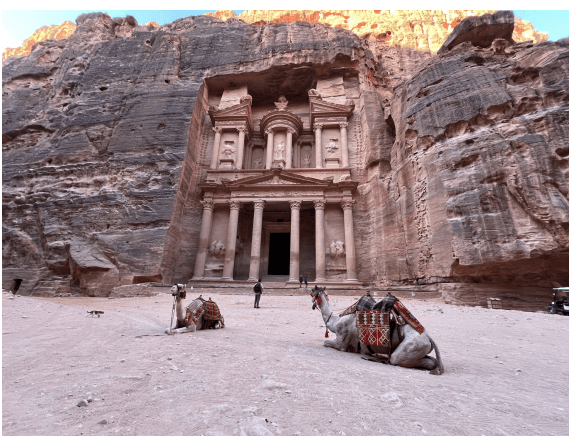
Petra Treasury (al-khazneh)- (Globaldigitalheritage)
Standing approximately 40 meters high and 28 meters wide, Al-Khazneh is carved into rose-colored sandstone cliffs. Its façade reflects an eclectic style that blends Nabataean art with Hellenistic (Greek) and Egyptian influences. The structure is adorned with Corinthian-columned capitals, friezes, and various mythological figures. Among the sculptures on the façade are the Dioscuri (Castor and Pollux), Amazons, Nike (the goddess of victory), and eagles; most of these figures are associated with the afterlife and life beyond death.
The name "The Treasury" (Al-Khazneh) derives from local Bedouin legends. According to tradition, the treasure of an Egyptian pharaoh is hidden inside the stone urn at the very top of the façade, known as a tholos. Because of this legend, bullet marks from treasure hunters firing at the urn can still be seen today. In reality, the urn is carved from solid sandstone and contains no hidden treasure.
Archaeological investigations in the region continue to shed light on the historical context of the structure. Drawings and records by 19th-century travelers such as Leon de Laborde provide important insights into its condition at that time. More recently, excavations conducted in 2003 by Jordan’s Department of Antiquities in the courtyard of Al-Khazneh uncovered three royal tombs and human remains dating to the 1st century BCE, buried approximately six meters below the ground in front of the structure. Digital documentation and academic research are ongoing to ensure the preservation of this World Heritage site and to enhance understanding of Nabataean civilization.
Accettola, Anna. UBC Library Open Collections. "Khazneh (Petra) also known as 'Al-Khazneh', 'The Treasury', 'Al Khazna'." University of British Columbia. Accessed February 9, 2026. https://open.library.ubc.ca/cIRcle/collections/ubccommunityandpartnerspublicati/52387/items/1.0422034
Global Digital Heritage. "Digital Heritage File: mid=28958." Global Digital Heritage. Accessed February 9, 2026. https://globaldigitalheritage.org/download-pdf/?mid=28958.
Kelpetin, Mahmut. "Nabatî Uygarlığı: Petra Şehri Üzerine Bir İnceleme." *Akademik Siyer Dergisi* 5, Özel Sayı: Cahiliye (2024): 49-75. https://isamveri.org/pdfdrg/D04453/2024/2024_KELPETIN.pdf
Universes in Universe. "Al-Khazneh – The Treasury." Art Destinations Jordan. Accessed February 9, 2026. https://universes.art/en/art-destinations/jordan/petra/al-khazneh
Visit Petra. "Al Khazna (The Treasury)." The Petra Development and Tourism Region Authority. Accessed February 9, 2026. https://www.visitpetra.jo/en/Location/2
Zayadine, Fawzi. "Al-Khazna, the Treasury Re-Visited: A Forgotten Document of Leon de Laborde." *Annual of the Department of Antiquities of Jordan (ADAJ)* 49 (2005): 395-401. https://publication.doa.gov.jo/uploads/publications/70/ADAJ_2005_49-395-401.pdf

Original Name(s) | Al-Khazneh (The Treasury) | ||||||||
|---|---|---|---|---|---|---|---|---|---|
Construction Date(s) | 1st century BCE – 1st century CE | ||||||||
Architectural Style(s) | A mixture of Hellenistic (Greek) and Nabataean influences Egyptian | ||||||||
Location | Jordan Petra Ancient City | ||||||||
Original Function | Royal Monumental Tomb (Mausoleum) or Crypt | ||||||||
Important Figures | Dioscuri, Amazons, Nike, Eagles | ||||||||
Building Material | Sandstone carved into a natural rock formation | ||||||||
Civilization | Nabataeans | ||||||||
History and Function
Architectural Features
Naming and Legends
Archaeological Research and Conservation