

This article was automatically translated from the original Turkish version.
Discoverer(s) | Rashi Jain Yogesh Wadadekar | ||||||||
|---|---|---|---|---|---|---|---|---|---|
Discovery Process | Completion of Scientific Study: 2024, Publication: 2025 | ||||||||
Type(s) | Spiral Disk Galaxy | ||||||||
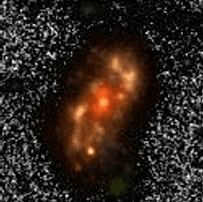
Alaknanda is a galaxy identified through analysis of data from the James Webb Space Telescope (JWST), dated to the early universe and notable for its prominent spiral structure. The galaxy has been observed at a high redshift value corresponding to a time when the universe was approximately 1.5 billion years old. Its structure provides an important example of the emergence of large, orderly disk galaxies in the early stages of cosmic evolution. Alaknanda is a significant example demonstrating that large galaxies with regular disk and spiral structures existed even in the early universe. The existence of such a galaxy suggests that disk formation processes may have occurred earlier than previously thought.
The galaxy was discovered by Rashi Jain and Yogesh Wadadekar at the National Centre for Radio Astrophysics – Tata Institute of Fundamental Research in India. The researchers announced their discovery of the Alaknanda galaxy in a paper published on 10 November 2025 in the journal Astronomy & Astrophysics (paper accepted: 20 August 2025).
The researchers named the galaxy “Alaknanda”, after the Alaknanda River in the Himalayas. This river is one of the tributaries of the Ganges and is culturally associated with the Milky Way Galaxy.
Alaknanda was detected as part of JWST’s wide-area data collection programs focused on the Abell 2744 galaxy cluster. Multi-layered observations obtained using JWST’s wide-band and medium-band filters enabled precise determination of the galaxy’s redshift. The researchers note that Alaknanda stood out in the UNCOVER dataset and that its redshift was measured within a narrow range using multiple photometric models.
Scientific data indicate that the galaxy has a photometric redshift of approximately z ≈ 4. Various photometric modeling techniques confirm that the galaxy lies within a narrow range around this value. Jain and Wadadekar report that similar results were obtained using different analysis codes and that the redshift has been determined with high precision.
A second small globular galaxy is located near the southern region of Alaknanda and exhibits a similar redshift value in the data. This object is thought to possibly be a satellite of the galaxy.
Measurements indicate that Alaknanda has a disk structure with a diameter of approximately 10 kpc and an estimated stellar mass of about ≈10¹⁰ M☉. These values place it among the large, orderly disk galaxies of the early universe.
The galaxy contains young stars and exhibits intense star formation. Alaknanda has a strong star formation rate, estimated at approximately 60 M☉/year. Prominent line emissions detected in medium-band filters further indicate active star formation.
The galaxy is classified as a regular disk galaxy with two prominent spiral arms, a structure that is rare in the early universe. GALFIT modeling confirms the dominance of the disk component and clearly reveals the spiral arms in the model outputs.
In multi-band JWST images, the distribution of star-forming regions along the spiral arms is clearly visible. These regions are more distinctly resolved in the galaxy’s short-wavelength images.
The galaxy displays a bright central bulge surrounded by a dominant extended disk component. The disk is the primary structural element of the galaxy.
Anadolu Ajansı. "Bilim insanları, 12 milyar yıl öncesine ait Samanyolu benzeri dev galaksi keşfetti." Accessed December 4, 2025. https://www.aa.com.tr/tr/bilim-teknoloji/bilim-insanlari-12-milyar-yil-oncesine-ait-samanyolu-benzeri-dev-galaksi-kesfetti/3762057
BBC. "Indian scientists spot Milky Way-like galaxy from 12 billion years ago." Accessed December 4, 2025. https://www.bbc.com/news/articles/crmdk7wkmz4o
Jain, Rashi and Yogesh Wadadekar. "Agrand-design spiral galaxy 1.5 billion years after the Big Bang with JWST." *Astronomy & Astrophysics* 703, A96 (2025). Accessed December 4, 2025. https://www.aanda.org/articles/aa/abs/2025/11/aa51689-24/aa51689-24.html

Discoverer(s) | Rashi Jain Yogesh Wadadekar | ||||||||
|---|---|---|---|---|---|---|---|---|---|
Discovery Process | Completion of Scientific Study: 2024, Publication: 2025 | ||||||||
Type(s) | Spiral Disk Galaxy | ||||||||
Discovery and Observation Program
Position and Redshift
Physical Properties
Structural Properties