This article was automatically translated from the original Turkish version.
+2 More
Location | Amik Plain Türkiye Hatay | ||||||||
|---|---|---|---|---|---|---|---|---|---|
Area(s) | Approximately 22 Hectares | ||||||||
Settlement | 2200–1200 BCE (Intensive), Middle Bronze Age II, Late Bronze Age I-II, Early Iron Age | ||||||||
Sovereignty | Kingdom of Mukish under Yamhad, Mitanni Empire, Hittite Empire | ||||||||
Alalah Ancient City is an ancient settlement located within the boundaries of Hatay province, at the southern end of the Amik (Amuk) Plain, near the shore of Euphrates River. Known in modern literature as Aççana Höyüğü, this site was a major center during the Middle and Late Bronze Ages. Covering approximately 22 hectares, it is one of the largest Bronze Age settlements in the Amik Plain.
Archaeological excavations have revealed that the earliest phases of occupation at Alalah date back to the late third millennium BCE. The city’s historical development became particularly prominent during the second millennium BCE as part of the political landscape of the Near East.
In the second millennium BCE, Alalah served as the capital of the regional Kingdom of Mukish. From the 18th century BCE onward, it became a vassal kingdom under the powerful Yamhad Kingdom (capital: Halab/Aleppo) in northern Syria. During this period, monumental palaces symbolizing wealth and political power were constructed. The palace uncovered by Woolley in Level VII is attributed to King Yarim-Lim of Yamhad. The cuneiform tablet archives found in this palace contain documents belonging to Yarim-Lim and his son Nikmepa, contemporaries of the Babylonian king Hammurabi.
During the 15th and 14th centuries BCE, Alalah came under the control of the Hurrian Mitanni Empire. This period is significant for the city’s role in international political relations. Under Mitanni rule, Alalah became a strategic center on the empire’s western frontier, maintaining its position along trade routes of the Eastern Mediterranean. Archaeological layers contain a limited number of material and written records that provide information about the political and social structure of Mitanni.
From the 14th century BCE onward, Alalah came under the control of the Hittite Empire. This period represents the city’s integration into the large Anatolia-centered imperial system. Under Hittite administration, Alalah continued to fulfill regional administrative and economic functions.
The 17 occupational layers uncovered by excavations demonstrate continuous settlement at Alalah between 2200 and 1200 BCE. Following the political upheavals and destructions caused by the “Sea Peoples” in the 12th century BCE, Alalah lost its prominence and gradually diminished in size, becoming a regional settlement from the Early Iron Age onward.
Throughout the Middle and Late Bronze Ages, as the capital of the Kingdom of Mukish, Alalah played a significant role in the political and economic balance of the Eastern Mediterranean. Its historical sequence under Yamhad, Mitanni and Hittite rule highlights its strategic position within the Eastern Mediterranean trade network and its importance in the power dynamics of the Near East.
Excavations at Alalah have revealed 17 distinct architectural layers, dating from 2200 to 1200 BCE, demonstrating continuous occupation throughout the Middle and Late Bronze Ages.
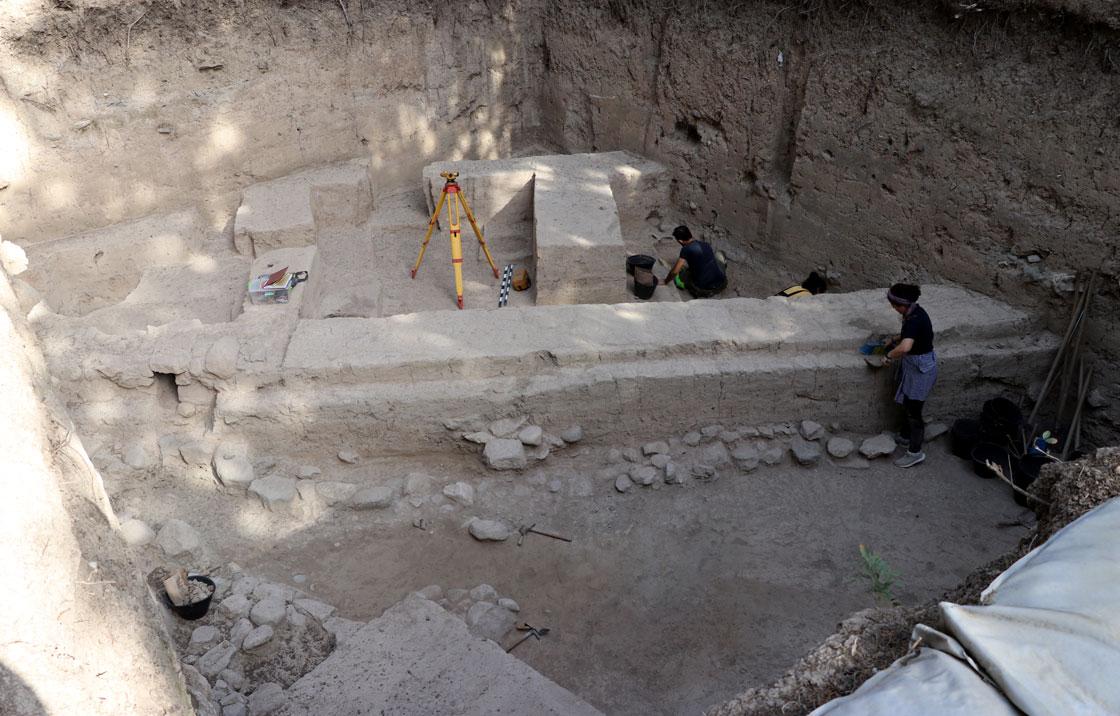
The most striking architectural remains are the palace complexes. The palace uncovered in Level VII, with its size and organization, reflects the city’s level of prosperity. This palace is attributed to King Yarim-Lim of Yamhad. Its large courtyards, rooms enclosed by mudbrick walls, and administrative functions indicate it was a central hub reflecting the political and social organization of the period.
Other structures uncovered in the city include temple buildings, administrative buildings, grain storage facilities, and workshops. Excavations in the 2000s revealed numerous floor levels, hearths, refuse pits and apsidal rooms within the palace courtyards. Some of these spaces are interpreted as kitchens while others were dedicated to production activities. Remains of ceramic kilns have also been identified.
The most significant finds from the excavations are the cuneiform tablet archives. These archives contain documents belonging to King Yarim-Lim and his son Nikmepa, as well as correspondence contemporary with the Babylonian king Hammurabi. These texts reveal Alalah’s role in the diplomatic and commercial networks of the Near East.
Among the sculptural finds, the head of the statue of Yarim-Lim stands out. This artifact is currently on display at the Hatay Archaeology Museum.
Smaller finds include ceramic vessels, hearth remains, weights, loom weights and metal objects. Painted and monochrome wheel-made vessels from the Early Iron Age layers, along with loom weights and metal tools, indicate that production activities continued in the city during later periods.

A Cuneiform Tablet Found at Alalah (Ministry of Culture and Tourism of the Republic of Türkiye)
The site was first identified in 1930 during Robert Braidwood’s surface surveys of the Amik Valley and was recorded as Site 136.
Excavations began in 1936 under the direction of Sir Leonard Woolley. Woolley conducted fieldwork between 1936 and 1939, resumed excavations in 1946 after a pause due to the Second World War, and completed a total of seven excavation seasons by 1949.
Woolley’s excavations uncovered 17 architectural layers, bringing to light palaces, temples and tablet archives dating from 2200 to 1200 BCE. These investigations confirmed that Aççana Höyüğü was the capital of the Kingdom of Mukish, known as Alalah. Among Woolley’s most significant discoveries were the palace of Yarim-Lim and its associated tablet archives.
A new phase of research began at the mound in the 1990s. Excavations led by Prof. Dr. K. Aslıhan Yener continued regularly through the 2000s. The aim of these campaigns was to examine stratigraphically the transition between Middle Bronze Age II and the Late Bronze Age.
In the 2004 excavations, workshops dating to the Middle Hittite Period and grain storage facilities (silo structures) dated to the beginning of the Hittite Imperial Period were uncovered. A temple-palace enclosure wall was also identified during this period.
In the 2011 excavations, floor levels, hearths, apsidal rooms, refuse pits and remains of ceramic kilns were found within the palace courtyards. These discoveries illustrate the architectural changes and production activities of the city across different periods.
The excavation results demonstrate that Alalah was not merely a local center but played a significant role in regional and international relations. Due to its strategic position on the western frontier of the Mitanni Empire, excavations at the site provide primary sources for understanding the political and social structure of Mitanni.
Akar, Murat. "Arkeolojik ve Tarihsel Bağlamı İçerisinde Mitanni İmparatorluğu’nun Batı Sınırı: Alalah (Aççana Höyük) Geç Tunç Çağı Tabakalarına Ait Bir Değerlendirme." *Colloquium Anatolicum* 17 (2018): 33–55. Accessed September 27, 2025. https://dergipark.org.tr/en/download/article-file/1715191
Akar, Murat. "Arkeometrik Yöntemler Işığında M.Ö. İkinci Binyılda Antik Alalah Kenti'nde Seramik ve Vitrifiye Malların Üretim Teknolojileri." Sonuç Raporu. Çanakkale, 2018. Accessed September 27, 2025. https://search.trdizin.gov.tr/tr/yayin/detay/618038
Anadolu Ajansı. "Tarihe ışık tutan Aççana Höyük'te 4 bin yıl öncesine ait kalıntılar gün yüzüne çıkarılıyor." Accessed September 27, 2025. https://www.aa.com.tr/tr/kultur-sanat/tarihe-isik-tutan-accana-hoyukte-4-bin-yil-oncesine-ait-kalintilar-gun-yuzune-cikariliyor/2305115
Kurtuluş Kıvanç, Şebnem. "Aççana (Atçana) Höyüğü/Alalakh Kazıları." *Türkiye Turizm Ansiklopedisi*, 2020. Accessed September 27, 2025. https://turkiyeturizmansiklopedisi.com/accana-atcana-hoyugualalakh-kazilari
Ministry of Culture and Tourism of the Republic of Türkiye, Advisorship for Press and Public Relations. "Binlerce Yıllık Tablet Hatay'da Gün Işığına Kavuştu." Accessed September 27, 2025. https://basin.ktb.gov.tr/TR-374689/binlerce-yillik-tablet-hatayda-gun-isigina-kavustu.html
T.C. Hatay Valiliği. "Arkeolojik Doğal ve Kentsel Sit Alanları." Accessed September 27, 2025. http://www.hatay.gov.tr/arkeolojik-dogal-ve-kentsel-sit-alanlari
Yener, K. Aslıhan, and Murat Akar. "2011 Yılı Aççana Höyük, Antik Alalakh Kenti Kazı Çalışmaları." *34. Kazı Sonuçları Toplantısı*, Volume 1, May 28–June 1, 2012, Çorum (2013): 335–348. Accessed September 27, 2025. https://www.academia.edu/4788439/2011_Y%C4%B1l%C4%B1_A%C3%A7%C3%A7ana_H%C3%B6y%C3%BCk_Antik_Alalakh_Kenti_Kaz%C4%B1_%C3%87al%C4%B1%C5%9Fmalar%C4%B1
Yener, K. Aslıhan. "Aççana Höyüğü 2004 Yılı Kazı Sonuçları." *27. Kazı Sonuçları Toplantısı*, Volume 27, May 30–June 3, 2005, Antalya: 37–46. Accessed September 27, 2025. http://www.kulturvarliklari.gov.tr/sempozyum_pdf/kazilar/27_kazi_1.pdf

Location | Amik Plain Türkiye Hatay | ||||||||
|---|---|---|---|---|---|---|---|---|---|
Area(s) | Approximately 22 Hectares | ||||||||
Settlement | 2200–1200 BCE (Intensive), Middle Bronze Age II, Late Bronze Age I-II, Early Iron Age | ||||||||
Sovereignty | Kingdom of Mukish under Yamhad, Mitanni Empire, Hittite Empire | ||||||||
No Discussion Added Yet
Start discussion for "Alalah (Aççana Höyük)" article
History
The Kingdom of Mukish and the Yamhad Period
Mitanni Rule
Hittite Domination
Decline and Aftermath
Historical Significance
Architectural Structures
Artifacts
Archaeological Research
Initial Research and the Leonard Woolley Period
Modern Excavations
Scientific Evaluations