


This article was automatically translated from the original Turkish version.
Bronze Age
Beginning | 3300 BCE | ||||||||
|---|---|---|---|---|---|---|---|---|---|
End | 1200 BCE | ||||||||
Alloy Property | Bronze = Copper + Tin | ||||||||
Periodization | Late Bronze Age (1600–1200 BCE) Middle Bronze Age (2000–1600 BCE) Early Bronze Age (3300–2000 BCE) | ||||||||
Technological Development | Specialization in mining Development of metallurgy | ||||||||
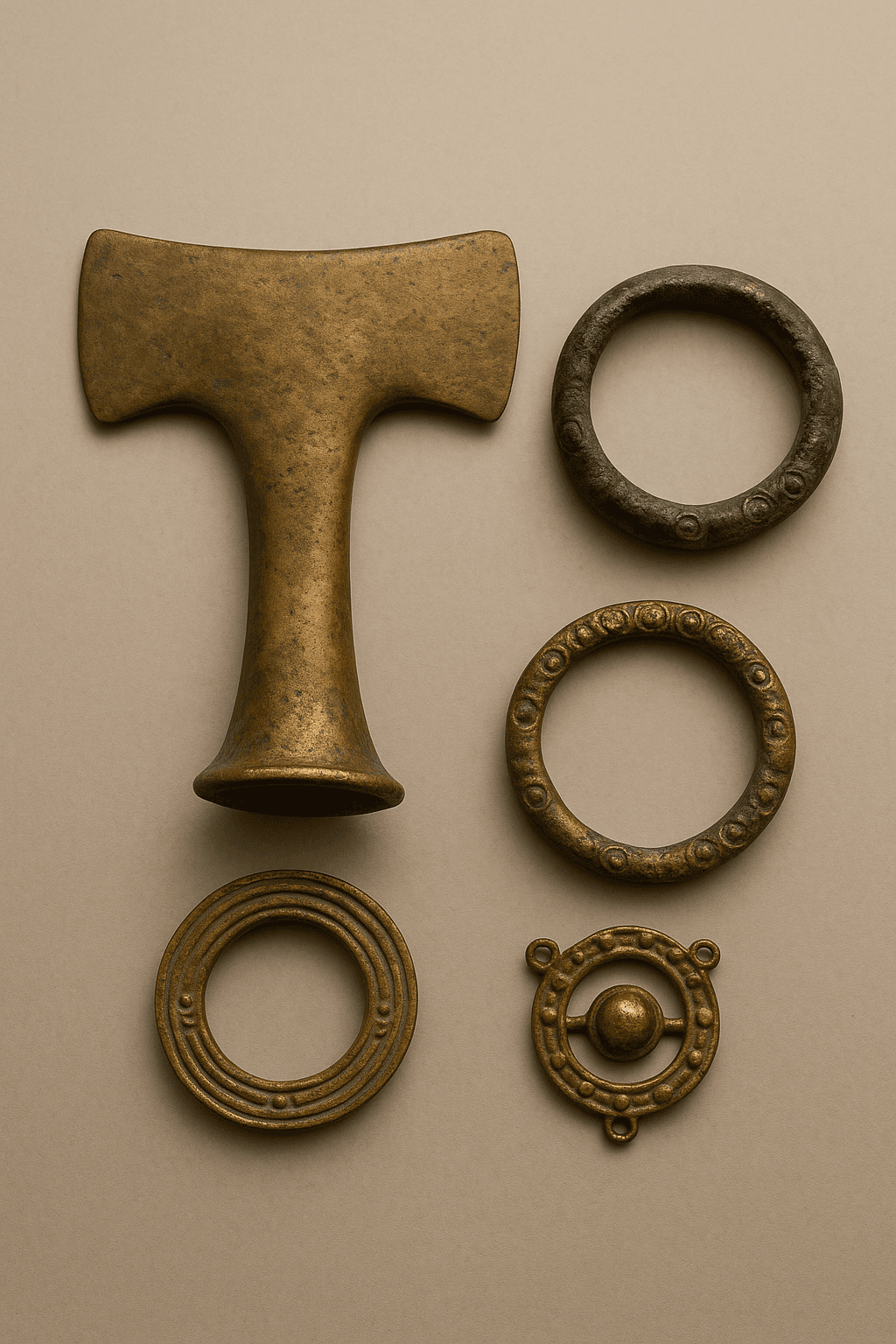
Basic Products | Ritual objects Jewelry Axes Weapons | ||||||||
Prominent Settlements | Hattusa Kültepe Limantepe Troy Arslantepe Alacahöyük | ||||||||
Architectural Elements | Multi-room public buildings Walled cities Megaron plan | ||||||||
The Bronze Age is a historical period defined by the production and use of bronze, an alloy made by combining copper and tin. This alloy is harder than pure copper and was used to manufacture weapons, tools, and other objects. The emergence of bronze production brought about not only technological advancements but also social and economic transformations.
This period first appeared in regions such as Anatolia, the Aegean, and Mesopotamia around the 3000s BCE. Initially, bronze was used by a limited segment of society and was primarily favored for weapons, ornaments, and ceremonial objects. As metallurgical techniques advanced, bronze production became more widespread and reached broader communities.
The onset of the Bronze Age is linked to the advancement of settled life and the intensification of economic activities. Developments in agriculture, animal husbandry, and craft production enabled surplus generation and trade, leading to the specialization of crafts and the increasing complexity of social structures. Advances in construction techniques, the emergence of walled settlements, and the organization of labor also became prominent during this period. While traditional tools made of stone and bone continued to be used, bronze objects were widely adopted in production, defense, and administrative domains.
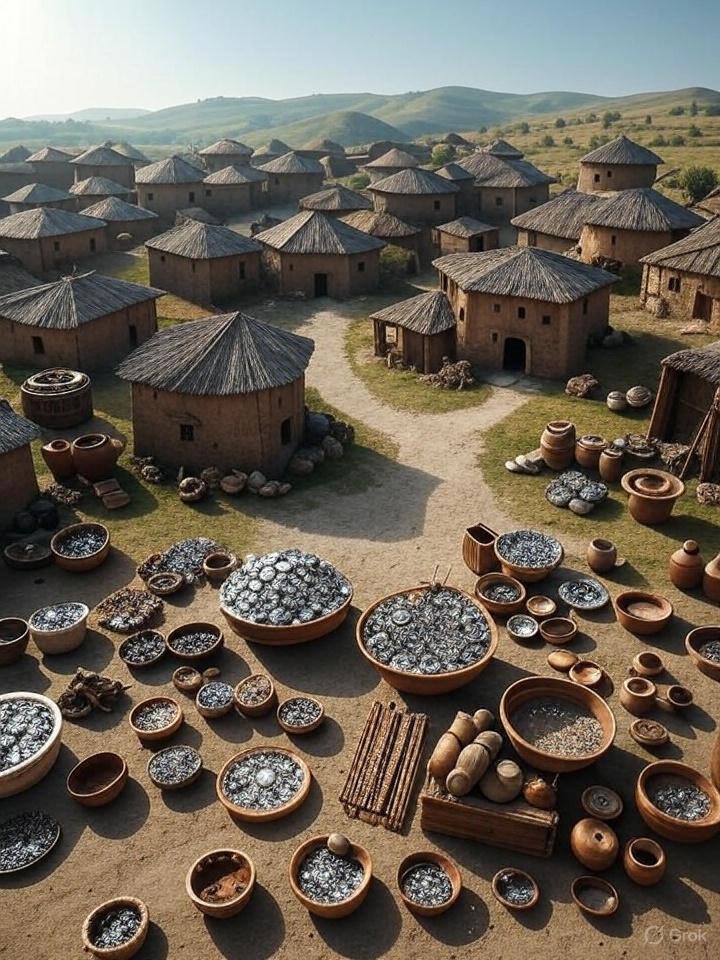
Visual Representing Megaron-Plan Structures and Walled Settlements in the Bronze Age in Anatolia (Generated by Artificial Intelligence.)
The Bronze Age in Anatolia spans approximately 3300–1200 BCE and is divided into three main phases: the Early Bronze Age (3300–2000 BCE), the Middle Bronze Age (2000–1600 BCE), and the Late Bronze Age (1600–1200 BCE).
In Western Anatolia, centers such as Troy, Limantepe, and Beycesultan feature megaron-plan structures, walled settlements, and stratified urbanization patterns. In Central Anatolia, excavations at Alişar, Alacahöyük, and Demircihöyük highlight burial finds and metalworking. In Southeastern Anatolia, sites like Arslantepe and Norşuntepe reveal both local and Mesopotamian-influenced elements. During this period, communities specialized in mining, ceramic production, and trade; walled structures served as indicators of defense and political organization.
In this phase, Assyrian trade colonies known as karum were established in Anatolia, and writing began to be used. Kaneş (Kültepe) was the most important commercial center of this period. Public buildings, storage facilities, and residential planning became widespread; social hierarchy and centralized authority strengthened.
This period is defined by the dominance of the Hittite State. The political structure centered around the capital Hattusa exerted influence across Anatolia. Relations were established with other actors such as Arzawa, Ahhiyawa, and Mitanni. In Western Anatolian centers like Çine-Tepecik, agricultural production became integrated with political economy. Toward the end of the period, social collapses and settlement destructions occurred, laying the groundwork for the Iron Age.
Western Anatolia stood out during the Bronze Age for its cultural diversity. The settlement of Troy is a key center that documents regional and external interactions through its archaeological layers. Layers Troy I–V contain examples of megaron-plan structures, wall systems, and social organization.
Archaeological finds include two-handled drinking vessels, vessels shaped like human faces, bronze axes, and ornaments. These artifacts demonstrate the region’s richness in production and ritual practices.
Other centers such as Limantepe participated in both land and sea trade with the Aegean Islands, Crete, and Central Anatolia. This underscores Western Anatolia’s role as a hub for cultural transitions and technological transfer. Troy and similar settlements developed while remaining open to external influences yet preserving their local character.
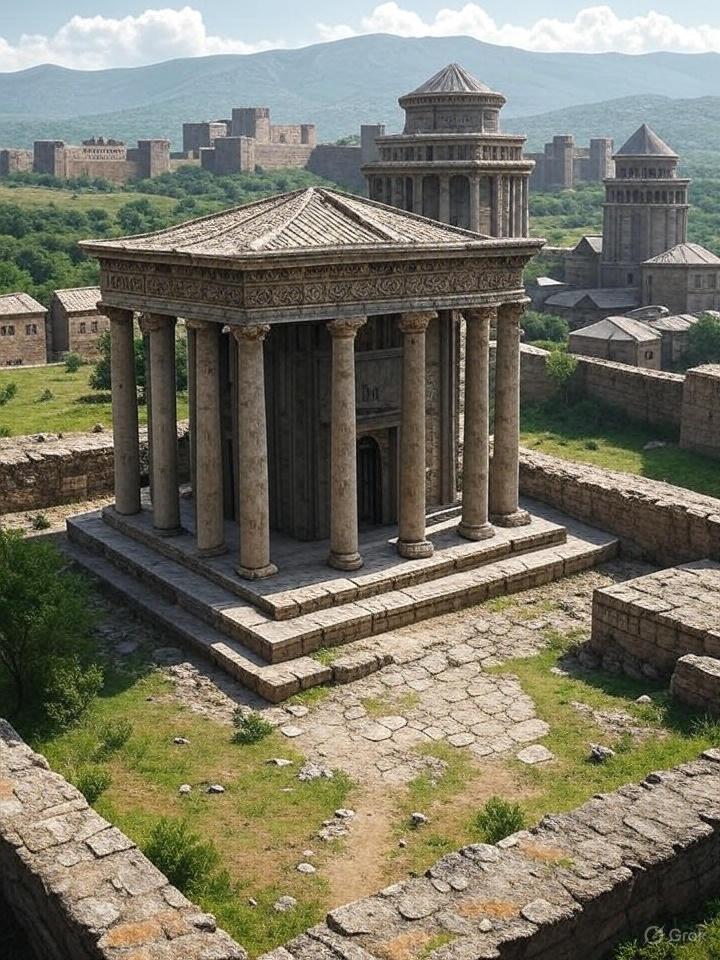
Visual Representing Monumental Architecture and Diplomatic Scenes in Anatolia (Generated by Artificial Intelligence.)
Excavations at centers in Southeastern Anatolia such as Arslantepe, Norşuntepe, Korucutepe, and Tepecik have yielded significant data on social organization. In these regions, monumental structures, temple-like areas, and administrative complexes have been identified. These structures are associated with functions such as the storage and distribution of agricultural products.
Plans typically consist of rectangular rooms, narrow corridors, and multi-room complexes. Some buildings feature plastered floors and platforms. The central storage facilities at Arslantepe indicate not only the development of material production but also the emergence of administrative systems. The placement of elite groups in separate spaces reflects the earliest signs of social stratification. Local solutions developed alongside Mesopotamian influences.
In the Late Bronze Age, agriculture transcended subsistence and became an integral component of political and economic structures. Analyses at Çine-Tepecik reveal large-scale production of cereals, legumes, and fruits. Processed forms of these products and storage structures demonstrate the integration of agriculture into the settlement economy.
Agricultural output was controlled by central authorities and redistributed through systems that maintained social order. Grain storage facilities serve as physical manifestations of this system. This practice is not only evident at Çine-Tepecik but also at other sites such as Arzawa. Agricultural production emerged as a key factor reinforcing political authority.
In the Bronze Age, writing systems served not only for communication but also for administration, record-keeping, and cultural transmission. On Crete, between 1800 and 1450 BCE, Linear A was used, dominating palace and religious archives; it remains undeciphered. After approximately 1450 BCE, the Mycenaeans gained control of Crete and developed the Linear B script, which was adopted in centers such as Mycenae and Pylos as a suitable tool for administrative and ideological records.
These writing systems are not merely technical innovations but also outcomes of cultural and political interactions. As Meissner noted, documents written in Linear B facilitated diplomatic and economic relations between Western Anatolia and the Aegean islands, constructing ideological connections between palaces. Waal, who studies interactions involving Anatolia, argues that writing systems were significant indicators of regional interactions.
During the Bronze Age, Anatolia was a conduit for the exchange of goods and culture between the Aegean, Mesopotamia, Egypt, and the Eastern Mediterranean. Centers in Anatolia became vital components of Mediterranean trade due to their metal resources and products.
The most concrete evidence of these interactions includes shipwrecks found off the coasts of Uluburun and Gelidonya. The Uluburun wreck contained tin ingots, glass, ivory, seals, lapis lazuli, and luxury imported goods. These finds demonstrate Anatolia’s connections with Mycenaean Greece, the Levant, and Egypt.
Written documents further support these relationships. The Amarna letters, written in Akkadian, document diplomatic relations between rulers of Anatolia and the Aegean and the pharaohs of Egypt. Place names such as Ahhiyawa and Millawanda mentioned in Hittite texts also reveal these interactions.
These relationships were decisive not only economically but also in the transmission of writing, architecture, and administrative practices. The interactions of the Bronze Age laid the foundation for subsequent civilizations.
Güven, Begüm. "Erken Tunç Çağı’nda Anadolu Kamusal Yapıları." Master's thesis, Hacettepe Üniversitesi, 2024. Accessed July 15, 2025.
Halilov, Toğrul. “NAHÇIVAN BÖLGESİNİN ORTA TUNÇ ÇAĞI KİL KAPLARI ÜZERİNDEKİ DESENLERİN YAYILIM ALANI VE ANLAMI HAKKINDA*.” *Karadeniz Araştırmaları Enstitüsü Dergisi* 2, no. 3 (2018): 141-154. Accessed July 15, 2025. https://www.ktu.edu.tr/dosyalar/karendergi_1b687.pdf
Koehl, Robert B. *AMILLA The Quest for Excellence*. INSTAP Academic Press, 2013. Accessed July 15, 2025. https://www.academia.edu/73386526/The_Origins_of_the_Western_Anatolian_Early_Bronze_Age
Maltas, Tom, and Sevinç Günel. “Late Bronze Age Crops from Çine-Tepecik, Western Anatolia: Insights into Farming and Political Economy in the Lands of Arzawa.” *Antiquity* 98, no. 401 (2024): 1236–51. Accessed July 15, 2025. https://www.cambridge.org/core/journals/antiquity/article/late-bronze-age-crops-from-cinetepecik-western-anatolia-insights-into-farming-and-political-economy-in-the-lands-of-arzawa/2F80D68733C557BDC2A609EC9C67CFFC
Meissner, T. “Literacy in the Late Bronze Age Aegean: Some Thoughts on the Use of Linear A and Linear B.” Fabrizio Serra editore. Accessed July 15, 2025. https://www.repository.cam.ac.uk/items/0bac3137-70f2-4f95-a91a-d51e8785a907
Salgarella, Ester. "Aegean Linear Script(s): Rethinking the Relationship between Linear A and Linear B." Cambridge University Press. Accessed July 15, 2025.
Waal, Willemijn. “Distorted Reflections? Writing in the Late Bronze Aegean in the Mirror of Anatolia.” In *Linguistic and Cultural Interactions between Greece and Anatolia*, Brill, 2021. Accessed July 15, 2025. https://brill.com/display/book/edcoll/9789004461598/BP000010.xml
Özdoğan, Mehmet. *The Making of the Early Bronze Age in Anatolia*. İstanbul Üniversitesi, 2023. Accessed July 15, 2025. https://www.researchgate.net/publication/375066361_The_Making_of_The_Early_Bronze_Age_in_Anatolia

Bronze Age
Beginning | 3300 BCE | ||||||||
|---|---|---|---|---|---|---|---|---|---|
End | 1200 BCE | ||||||||
Alloy Property | Bronze = Copper + Tin | ||||||||
Periodization | Late Bronze Age (1600–1200 BCE) Middle Bronze Age (2000–1600 BCE) Early Bronze Age (3300–2000 BCE) | ||||||||
Technological Development | Specialization in mining Development of metallurgy | ||||||||
Basic Products | Ritual objects Jewelry Axes Weapons | ||||||||
Prominent Settlements | Hattusa Kültepe Limantepe Troy Arslantepe Alacahöyük | ||||||||
Architectural Elements | Multi-room public buildings Walled cities Megaron plan | ||||||||
Chronology of the Bronze Age in Anatolia
Early Bronze Age (3300–2000 BCE)
Middle Bronze Age (2000–1600 BCE)
Late Bronze Age (1600–1200 BCE)
Western Anatolia and the Troy Culture
Southeastern Anatolia and the Development of Public Spaces
Agriculture and Economy
Writing Systems and Cultural Interactions
Trade and International Relations in the Bronze Age