This article was automatically translated from the original Turkish version.
+2 More
Material(s) | Andesite) Basalt Natural stone (Granite | ||||||||
|---|---|---|---|---|---|---|---|---|---|
Common Cities | Istanbul, Safranbolu, İznik | ||||||||
Service Life | 1000+ years | ||||||||
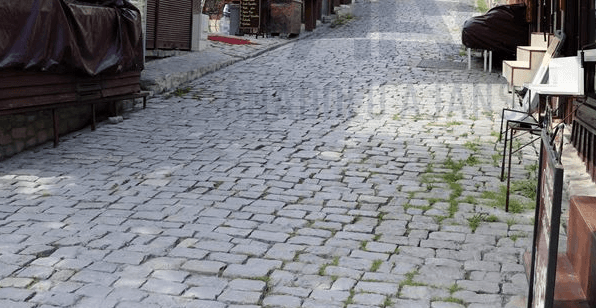
Albanian cobblestone pavement is formed by tightly laying natural stones—typically shaped by hand-breaking to create a slightly convex, dome-like surface—on compacted earth or mortar without gaps. The upper surfaces of the stones are flattened, while their edges are fractured to form polygonal shapes. This paving style facilitates efficient surface water drainage and is notable for its durability. Historically, this method, which commonly employs hard natural stones such as granite, basalt, and andesite, has been preferred for the ground surfaces of urban streets, pedestrian paths, and squares. Since the Ottoman period, it has become one of the characteristic elements of Anatolian urban fabric, valued for both its functional and aesthetic qualities.
The construction process demands significant physical labor. Stones are broken and shaped using 7-kilogram mallets. These stones are transported to historical areas such as Hasankeyf district in Batman, where they are used in local ground surface interventions. Production is entirely based on manual craftsmanship, and it is claimed that pavements made using this method have a service life exceeding 1000 years.

Albanian Cobblestone (
In cities such as Safranbolu, İznik, and Istanbul, this type of paving contributes to the urban memory as a distinctive feature of street fabric. Widely used in Ottoman urban architecture, this stone pavement was frequently chosen in inter-neighborhood spaces, around mosques, near caravanserais and bathhouses, and in narrow alleys. In addition to fulfilling functional roles such as ensuring pedestrian safety and enabling natural rainwater drainage, Albanian cobblestone pavement imparts historical continuity and aesthetic coherence to the space.
Instead of preserving the authenticity of traditional stone pavements, interventions using European-origin “interlocking concrete pavers” have led to the degradation of historical fabric. Such transformations have occurred even in settlements listed on the UNESCO World Heritage List, such as Safranbolu. Experts argue that these practices, carried out under the guise of restoration, cause more harm than protection to cultural heritage. As a result, modern materials incompatible with traditional construction techniques and craftsmanship are increasingly favored, compromising both aesthetic and historical integrity. Albanian cobblestone pavements are either entirely removed or have their original stones replaced with concrete products due to insensitive interventions.
The most conspicuous error in restoration practices is the “renovation” of pavements using contemporary building materials without adhering to conservation principles. This approach erases the cultural and documentary value of original stone pavements and blurs the historical context of the space. Restorers and art historians frequently criticize these practices and advocate for the preservation of original conditions. Stone masonry products such as Albanian cobblestone, produced through local craftsmanship, are not merely physical artifacts but also socio-cultural documents.
Accessed November 26, 2025.
Anadolu Ajansı. “Arnavut Kaldırımı Taşlarına Elleriyle Şekil Veriyorlar.” Anadolu Ajansı, July 19, 2019. . Accessed May 31, 2025.
Anadolu Ajansı. “Gözde Turizm Merkezi Safranbolu En Sessiz Günlerini Yaşıyor.” Anadolu Ajansı. Accessed May 31, 2025.
Demirtaş, Nazlı. “Kültürel Mirasın Korunması Bağlamında Arnavut Kaldırımı Taşlarının Önemi.” *International Journal of Cultural and Social Studies (IntJCSS)* 8, no. 1 (2022): 127–144. https://dergipark.org.tr/en/download/article-file/2153133. Accessed May 31, 2025.
Pexels. “Siyah Beyaz Arnavut Kaldırımı Fotoğrafı.” Photograph: Emre Can Acer. https://www.pexels.com/tr-tr/fotograf/32333226/. Accessed May 31, 2025.

Material(s) | Andesite) Basalt Natural stone (Granite | ||||||||
|---|---|---|---|---|---|---|---|---|---|
Common Cities | Istanbul, Safranbolu, İznik | ||||||||
Service Life | 1000+ years | ||||||||
Historical and Cultural Significance
Contemporary Use and Threats
Protection Issues and Implementation Errors