


This article was automatically translated from the original Turkish version.
+2 More
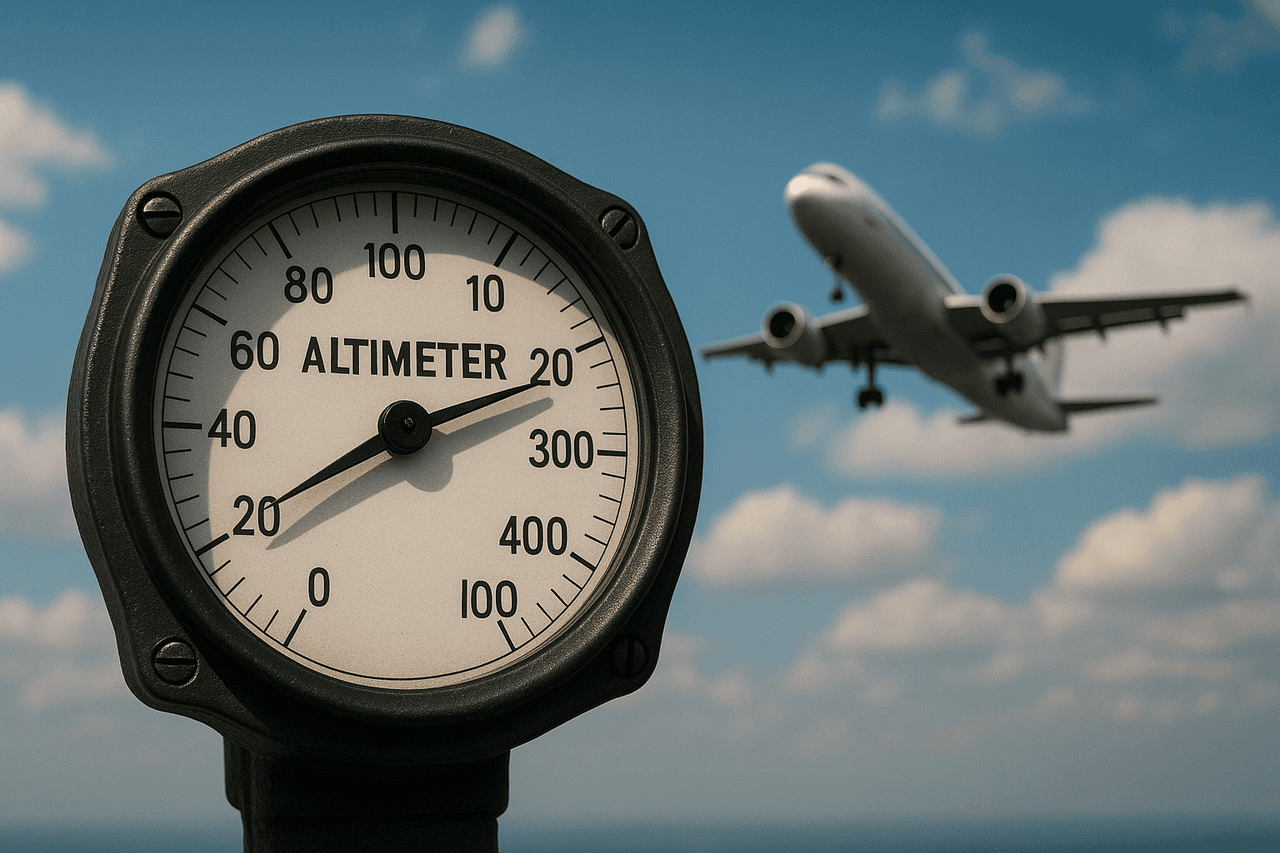
Altimeter (generated with artificial intelligence.)
Main Task | Measure the altitude of an aircraft | ||||||||
|---|---|---|---|---|---|---|---|---|---|
Working Principle | Aneroid barometer | ||||||||
Application Area(s) | Aviation | ||||||||
Base Units | feet, hPa (hectopascal) | ||||||||
An altimeter is a flight instrument that measures changes in atmospheric pressure to indicate the height of an aircraft or object above sea level or a specific reference point. These readings express the aircraft’s altitude above sea level in feet. Fundamentally operating on the principle of an aneroid barometer, the altimeter functions on the basis that altitude increases as static pressure decreases.

Altimeter (generated by artificial intelligence.)
Altimeters used in aviation measure altitude based on the static air pressure received from external static ports. The most sensitive and fundamental component of the instrument is an aneroid capsule containing a sealed standard sea-level pressure (14.7 PSI, 29.93 inHg, 1013.2 mb). This aneroid is highly sensitive to changes in external atmospheric pressure. When the aircraft is at sea level, the pressure inside the aneroid equals the external static pressure, causing the indicator needles to read 0 feet. As the aircraft gains altitude, the decrease in external static pressure causes the aneroid to expand, and this movement is transmitted through a mechanical system to rotate the indicator needles on the dial. Three separate pointers, differing in length like the hour and minute hands of a clock, indicate increasing altitude in a clockwise direction. The longest pointer indicates increments of 100 feet, the medium-length pointer indicates increments of 1000 feet, and the shortest pointer indicates increments of 10,000 feet. Additionally, the altimeter dial features a barometric pressure window, adjustable via a knob, used to input the correct pressure value.
For the altimeter to display accurate altitude information, it must be calibrated according to the barometric pressure at the point of takeoff or landing. This adjustment is made using the barometric setting knob on the altimeter dial. The purpose of this setting is to align the altimeter’s indicated altitude with current atmospheric conditions. When calibrated to standard sea-level conditions—that is, when the temperature is 15°C and the barometric pressure is 29.92 inHg (1013.2 mb)—the altimeter reads 0 feet. However, since atmospheric conditions such as temperature and pressure are constantly changing, proper adjustment of the altimeter is critical to maintaining its accuracy.
Because the altimeter operates by measuring atmospheric pressure changes, it can be affected by various factors. Variations in barometric pressure or air temperature may cause the instrument to deviate from zero. For example, when the air cools and low pressure systems move in, the altimeter may indicate a value higher than zero; when the air warms and high pressure systems prevail, it may indicate a value below zero. Therefore, to ensure accurate readings, it is essential to know the local elevation above sea level or the current barometric pressure while the aircraft is on the ground and to make the necessary adjustment.
Several types of altimeters are used in aviation. A radio altimeter measures the aircraft’s actual height above ground level (AGL) using radio waves. It operates on the principle of measuring the time it takes for a vertically transmitted radio wave to reflect off the ground and return. These altimeters typically begin functioning below 2500 feet and are vital for low-altitude flights and automatic landing systems. In contrast, a cabin altimeter is found in all pressurized aircraft and displays cabin pressure in feet as an altitude equivalent. The pilot can use this indicator to monitor whether cabin pressure remains within safe limits.
Ministry of National Education. *Alet Sistemleri-1*. Ankara: Ministry of National Education, 2011. http://megep.meb.gov.tr/mte_program_modul/moduller_pdf/Alet%20Sistemleri%201.pdf.

Altimeter (generated with artificial intelligence.)
Main Task | Measure the altitude of an aircraft | ||||||||
|---|---|---|---|---|---|---|---|---|---|
Working Principle | Aneroid barometer | ||||||||
Application Area(s) | Aviation | ||||||||
Base Units | feet, hPa (hectopascal) | ||||||||
Principle of Operation
Altimeter Settings
Sources of Error and Corrections
Types of Altimeters