


This article was automatically translated from the original Turkish version.
+1 More
Altitude in Aviation is a fundamental aerodynamic and navigation parameter that expresses the vertical distance of an aircraft relative to a specified reference plane. Altitude measurements play a critical role in every phase of flight for flight safety, navigation accuracy, performance calculations and the establishment of air traffic separation. This concept is not merely a numerical measure of height but a multidimensional system composed of variables such as atmospheric pressure, temperature, density and location.
The pressure structure of the atmosphere forms the physical basis of the altitude concept. Pressure decreases with increasing altitude from sea level. Consequently, aircraft altitude measurements are predominantly performed using pressure-based barometric systems. However, since the atmosphere does not possess a standard structure, altitude measurements are always evaluated under specific assumptions. Therefore, in aviation, “altitude” is not a single general concept but is divided into numerous subcategories defined by the measurement method and reference plane.
In aviation, altitudes are categorized into six fundamental types based on the reference plane and measurement method: Indicated Altitude, True Altitude, Absolute Altitude, Pressure Altitude, Density Altitude and Flight Level. This classification is based on ICAO standards accepted in international civil aviation literature.
Indicated altitude is the value directly read from the aircraft’s altimeter. The altimeter senses atmospheric pressure from static ports on the aircraft and compares it with the barometric reference value set by the pilot (QNH or QFE). With QNH set, the altimeter displays height relative to mean sea level; with QFE set, it is calibrated to zero at the airfield elevation.
Indicated altitude equals other altitude types only under standard atmosphere (ISA) assumptions. When temperature, humidity or pressure deviate from standard conditions, the indicated value diverges from true altitude. Therefore, pilots apply correction factors to adjust indicated altitude under specific conditions.
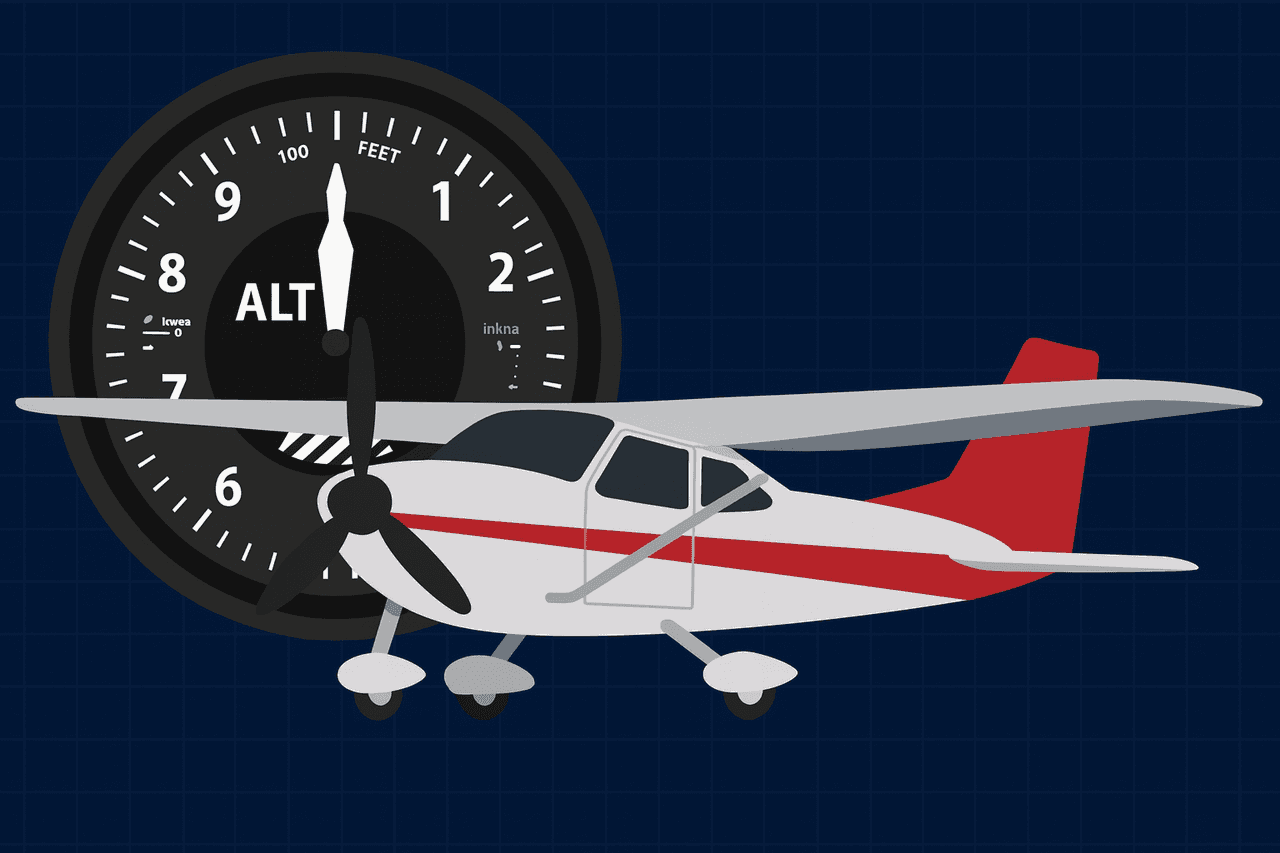
Indicated Altitude (Generated with AI Assistance)
True altitude is the actual physical height of the aircraft above mean sea level (MSL). This altitude provides the most directly measurable vertical distance for safe flight operations. All elevation data used in navigation charts and terrain databases are referenced to MSL.
True altitude is obtained by applying atmospheric corrections to indicated altitude. Temperature or pressure variations directly affect this value. For example, when temperature is lower than standard atmosphere values, the altimeter may indicate a higher altitude than the true altitude. This condition is critical for obstacle clearance, especially in mountainous regions.
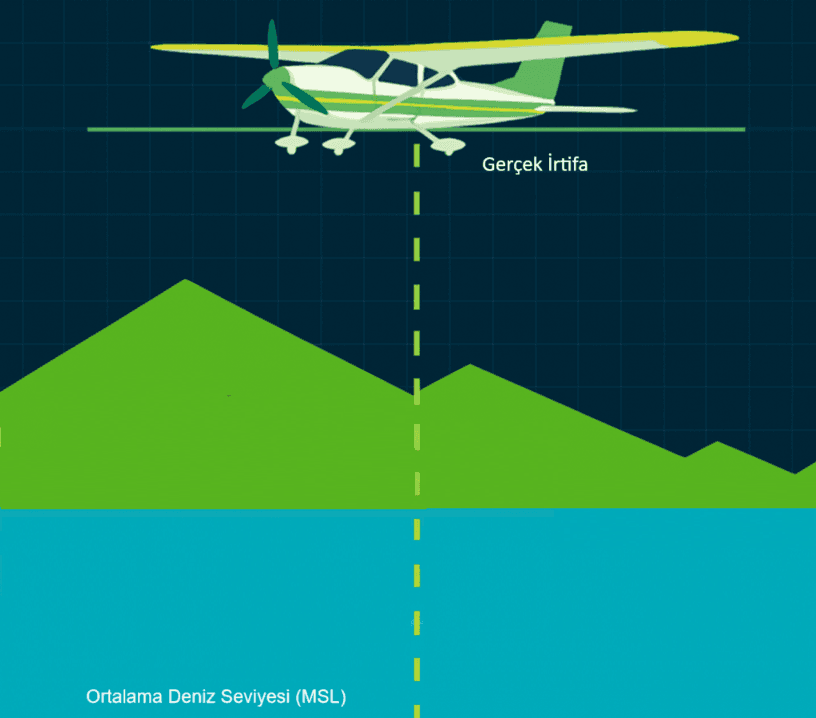
True Altitude (Generated with AI Assistance)
Absolute altitude is the vertical distance between the aircraft and the ground surface or the elevation of the terrain directly beneath it, typically expressed in “Above Ground Level (AGL)”. This type of altitude is decisive for ensuring obstacle and terrain clearance during low-altitude operations.
Absolute altitude cannot be measured directly by barometric systems; it is generally determined using radar altimeters, laser altimeters or high-resolution GNSS-based systems. Radar altimeters calculate instantaneous ground distance by analyzing the time delay of electromagnetic waves reflected from the terrain. This data, used by pilots alongside visual references during takeoff and landing, is a critical variable in automatic landing systems.
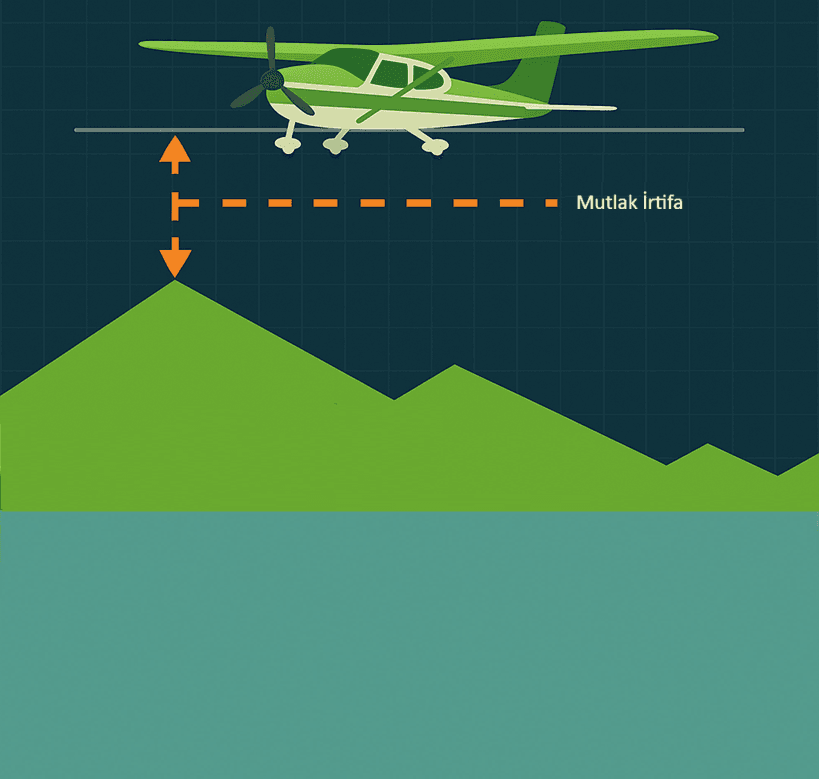
Absolute Altitude (Generated with AI Assistance)
Pressure altitude is the altitude read when the altimeter is set to the standard atmospheric pressure value of 1013.25 hPa (29.92 inHg). This value is based on the pressure-altitude relationship at sea level. Pressure altitude provides a common reference plane for defining flight levels in air traffic control.
All performance tables and flight data systems are calibrated based on pressure altitude under standard atmosphere conditions. When actual atmospheric conditions deviate from standard, pilots perform “altimeter setting” procedures before flight to minimize errors. Pressure altitude is the primary variable used in analyzing aircraft performance parameters such as climb rate, fuel consumption and engine power.
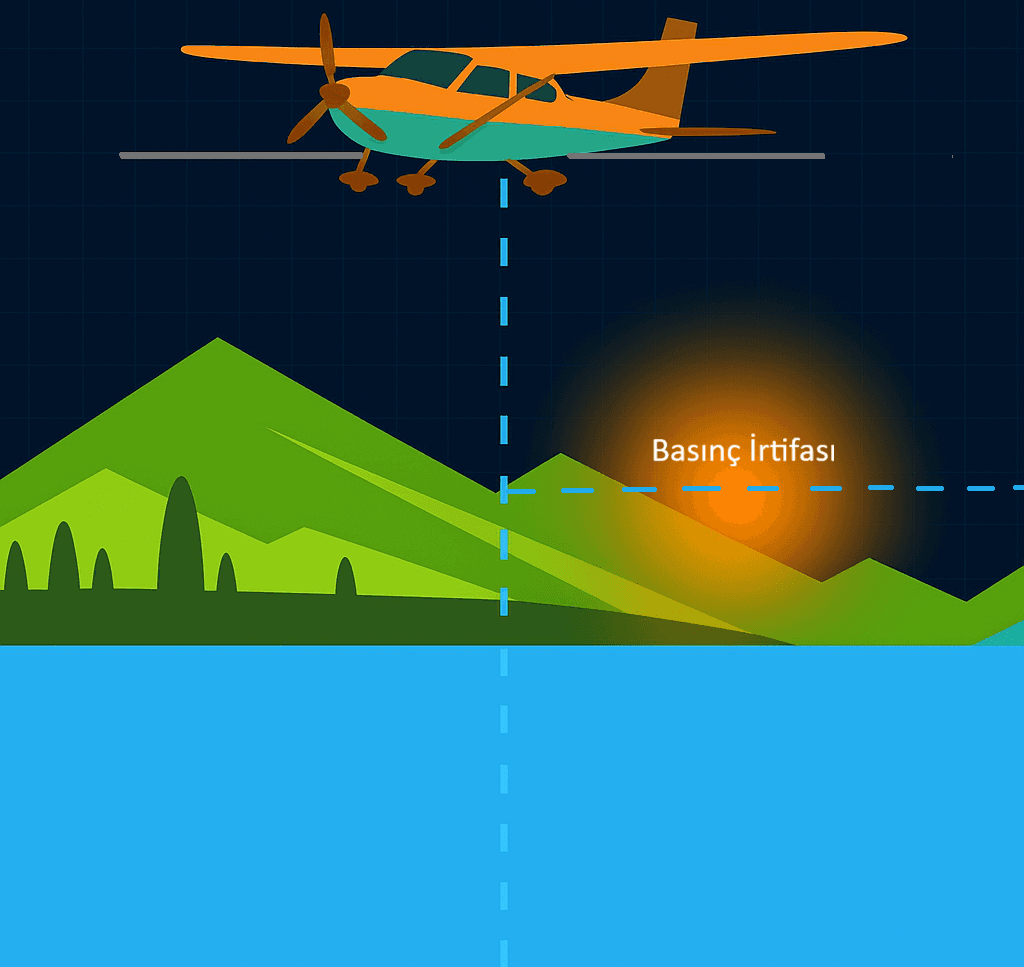
Pressure Altitude (Generated with AI Assistance)
Density altitude is the altitude at which the air density equals the density at a specific height in the standard atmosphere. It is calculated by applying temperature corrections to pressure altitude. As air density decreases (e.g., under high temperature or low pressure conditions), density altitude increases.
Density altitude directly affects aircraft performance. Warm air implies low air density, which reduces lift and engine efficiency. As a result, takeoff distance increases, climb rate decreases and fuel consumption rises. Therefore, during takeoff planning, pilots calculate density altitude based on airfield temperature to determine performance limits. Density altitude is also a fundamental control parameter for flight safety at high-elevation airfields or in hot climates.
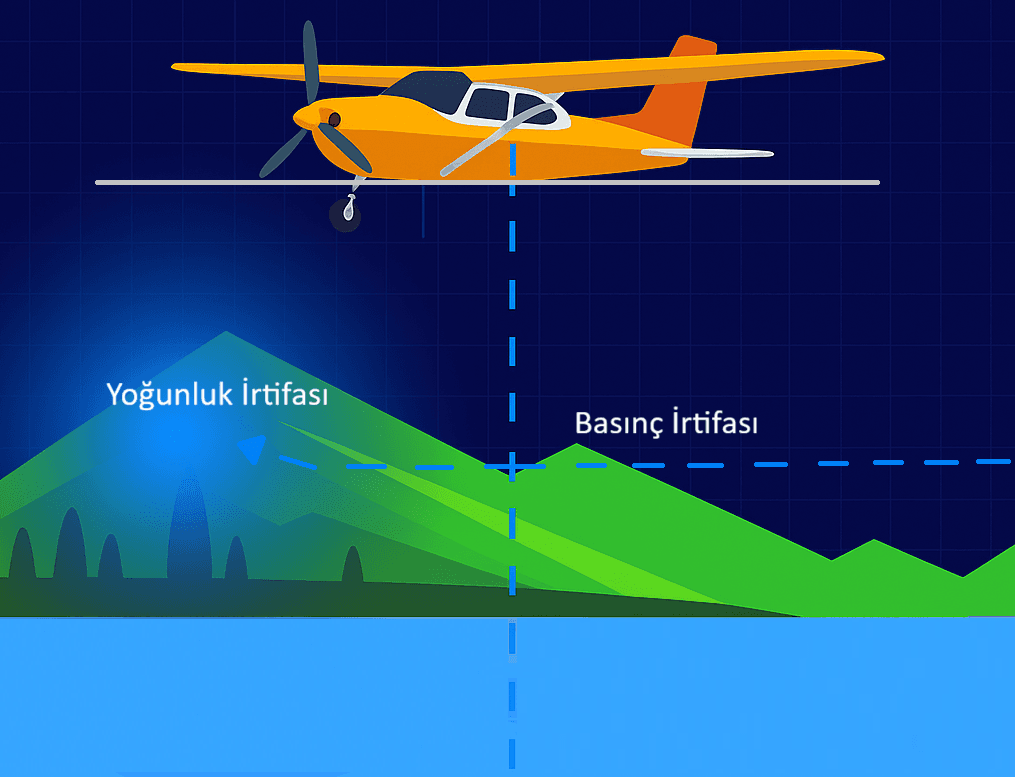
Density Altitude (Generated with AI Assistance)
Flight level is a standardized vertical position unit expressed by rounding pressure altitude to the nearest hundred feet. For example, a pressure altitude of 30,000 feet is denoted as “FL300”. Flight levels are used above a specified transition altitude.
Below the transition altitude, flights operate using local pressure reference (QNH); above it, flights use the standard pressure reference plane. This practice ensures all aircraft operate on the same reference, guaranteeing vertical separation safety.
Flight levels are organized according to vertical separation tables established by international civil aviation authorities and are typically spaced at 1,000 feet intervals (or 2,000 feet at high altitudes).
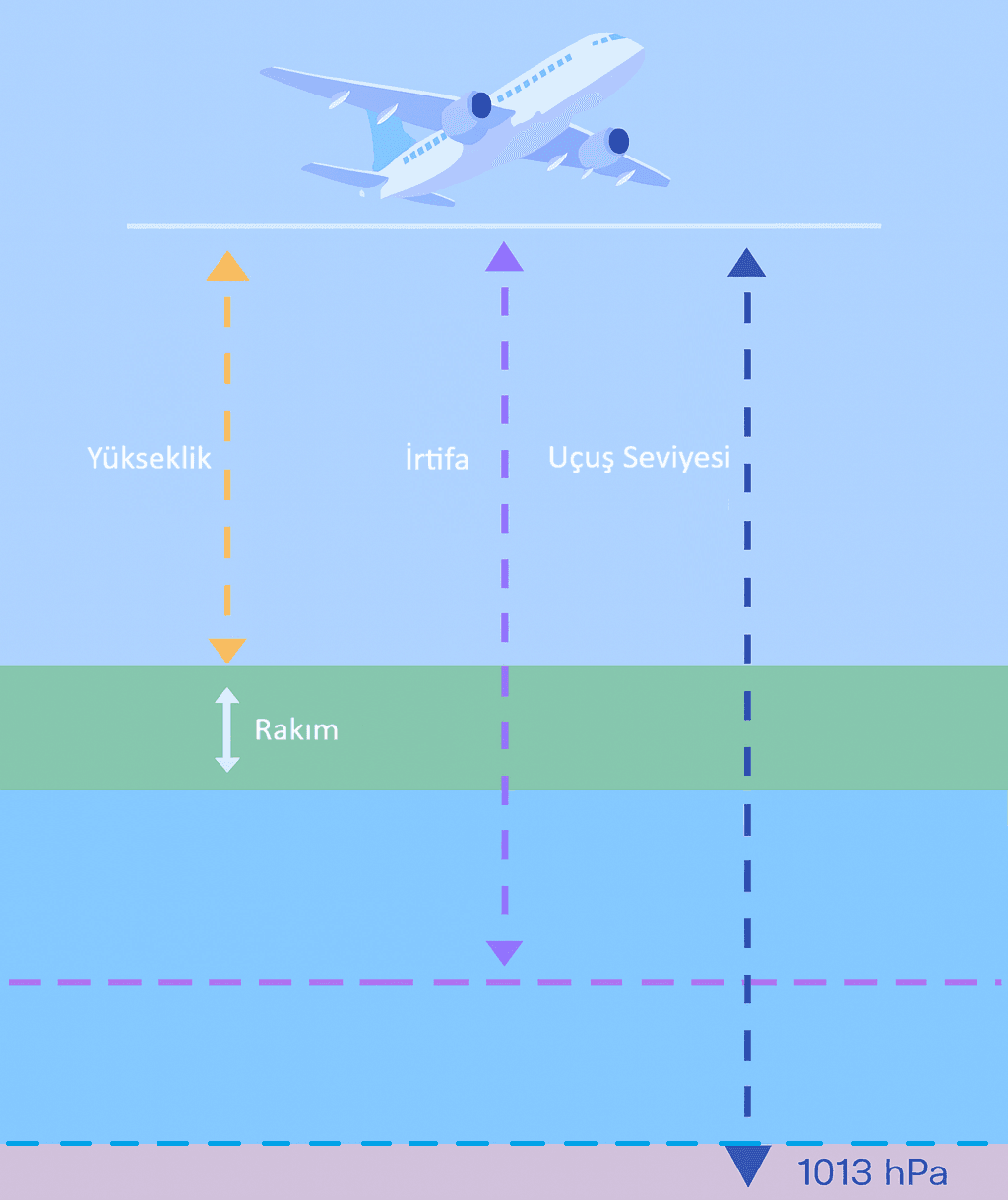
Flight Level (Generated with AI Assistance)
Altitude measurements in aircraft are primarily based on the pitot-static system. This system measures total pressure via the pitot tube and static atmospheric pressure via static ports. The altimeter calculates altitude by comparing these two values.
In modern aircraft, digital systems such as radar altimeters, GNSS receivers and ADS-B data are integrated alongside barometric systems to verify or correct barometric measurements. In particular, GNSS-based systems provide “geometric altitude”, which is compared with barometric altitude to ensure calibration.
Errors known as “Altimetry System Error (ASE)” can occur in pressure-based systems. These errors arise from instrument calibration, temperature differentials and airflow effects. Long-term performance analyses show that the accuracy of these systems can degrade over time.
In aviation, each type of altitude serves a specific operational purpose:
The combined and correct use of these types is essential for maintaining flight safety and optimizing performance.
In conclusion, the concept of altitude in aviation is not merely a height indicator but an integrated product of atmospheric properties, pressure values and measurement systems. Indicated, true, absolute, pressure, density and flight level altitudes directly influence both flight performance and air traffic organization. Barometric and radar-based systems form the primary tools for these measurements. In modern aviation, accurate analysis of atmospheric variables in altitude measurement is a decisive factor in ensuring flight safety.
Goodman, Christopher J, and Jennifer D. Small Griswold. “Climate Impacts on Density Altitude and Aviation Operations.” *Journal of Applied Meteorology and Climatology* 57, no. 3 (2018): 517–523. Accessed October 21, 2025. https://journals.ametsoc.org/view/journals/apme/57/3/jamc-d-17-0126.1.xml.
Grigorie, Teodor Lucian, Liviu, Dinca, Jenica-Ileana, Corcau, and Otilia Grigorie. “Aircrafts’ Altitude Measurement Using Pressure Information: Barometric Altitude and Density Altitude.” *WSEAS Transactions on Circuits and Systems* 9, no. 7 (July 2010): 503–512. Accessed October 21, 2025. https://www.researchgate.net/publication/262153819_Aircrafts%27_altitude_measurement_using_pressure_information_Barometric_altitude_and_density_altitude.
IVAO Türkiye. "Uçuş Çevresi." IVAO Türkiye. Accessed October 21, 2025. https://tr.ivao.aero/downloads/documents/Ucus%20Cevresi.pdf.
Johnston, Matthew. “Five Types of Altitude in Aviation.” California Aeronautical University. Accessed October 21, 2025. https://calaero.edu/aeronautics/principles-of-flight/5-types-of-altitude-in-aviation/.
Skybrary Aviation Safety. "Altitude, Flight Level and Height." Accessed October 21, 2025. https://skybrary.aero/articles/altitude-flight-level-and-height.

No Discussion Added Yet
Start discussion for "Altitude in Aviation" article
Classification of Altitude Types
1. Indicated Altitude
2. True Altitude
3. Absolute Altitude
4. Pressure Altitude
5. Density Altitude
6. Flight Level
Altitude Measurement Systems and Application Principles
Operational Use of Altitude Types