This article was automatically translated from the original Turkish version.
+1 More
Location | Amasya | ||||||||
|---|---|---|---|---|---|---|---|---|---|
Height(s) | 700 m from the sea 300 m from the Yeşilırmak | ||||||||
Founding Period | Ancient Age | ||||||||
Founder(s) | King Mithridates I of Pontus or Turkish ruler Karsan Han | ||||||||
Periods of Use | Ottoman Eretna Seljuk Danismend Byzantine Roman Persian | ||||||||
Construction Material | Rubble stone Cut stone | ||||||||
Sections | Lower Castle Girls' Palace Upper Castle | ||||||||
Doors | Square Midenos Palace Helkis | ||||||||
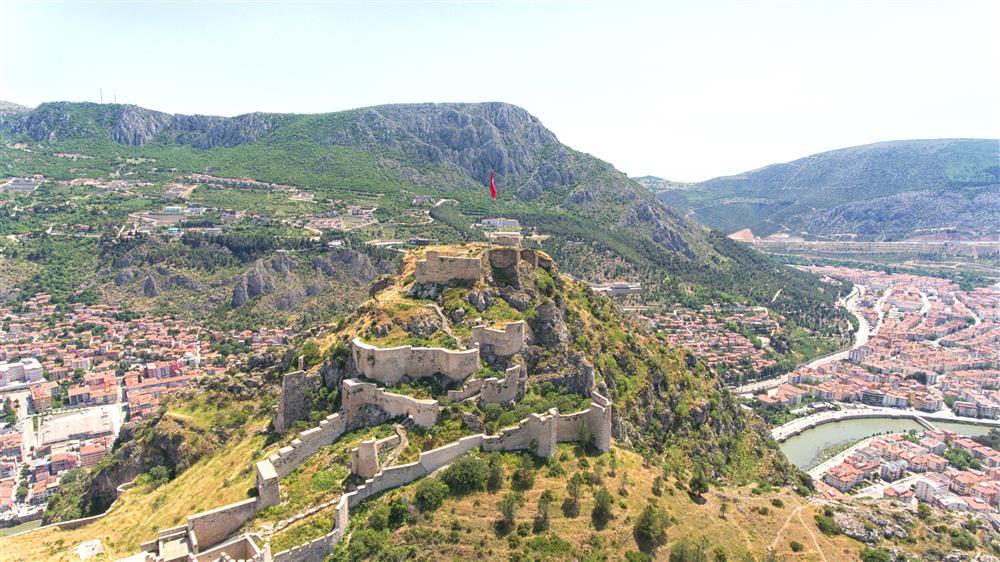
Amasya Castle is located on Harşena Hill, north of the city center of Amasya. Due to the geological structure and steep topography of the hill, the castle forms a natural defensive line. It is situated at an elevation of 700 meters above sea level and approximately 300 meters above the Yeşilırmak River. The castle consists of three main sections: Harşena Castle (Upper Castle), Kızlar Sarayı (Castle Terrace), and Aşağı Kale (Lower Castle, today known as Hatuniye Mahallesi).
.jpg&w=1280&q=75)
Amasya Castle
The construction of Amasya Castle dates back to antiquity. According to some sources, the castle was built by King Mithridates I of Pontus in the 3rd century BCE. Other sources attribute its construction to the Turkish ruler Karsan Han or Harsana.
Throughout history, the castle came under the rule of the Persians, Romans, Byzantines, Danişmentids, Seljuks, Eretnids, and Ottomans, undergoing various restoration efforts. In particular, after the Turkish conquest of Amasya in 1075, the castle entered a significant restoration phase. During the reign of Danişmentlid Seyfeddin İsmail Han, the Enderun Mosque was built in Hatuniye Mahallesi. Anatolian Seljuk Sultan I. Mesud repaired the Inner Castle and constructed a mosque, madrasa, and bathhouse there. During the Eretnid period, Amasya Emir Şadgeldi Paşa restored the castle and added a mosque and bathhouse. In the Ottoman period, the castle complex included a madrasa, prison, and Yıldırım Han Mosque.
The castle was constructed using cut stone and rubble stone. Eight defensive levels provide access from the banks of the Yeşilırmak River to the castle. Among the defensive systems is the Cilanbolu tunnel, a 150-step passage carved into the rock. This tunnel is a 8-meter-diameter corridor. The castle contains water cisterns, remnants of Ottoman bathhouses, and rock-cut tombs of the Pontic kings. The Inner Castle, built during the Hellenistic period, has four gates: Helkis, Saray, Midenos, and Meydan gates.
Hatuniye Mahallesi (Lower Castle) covers an area of approximately 800 meters along the Yeşilırmak River. It contains houses, bathhouses, and mosques from the Ottoman period. Kızlar Sarayı is separated from the Inner Castle by the railway. The exterior of the palace is built of stone, while the interior is constructed of brick and wood.
Systematic archaeological excavations at Harşena Castle began in 2009 under the leadership of Professor Dr. Emine Naza Dönmez. Excavations conducted in two main areas—the Upper Castle and Kızlar Sarayı—revealed remains belonging to four distinct architectural periods and terrace systems. Among the findings were gold coins bearing the insignia of Mamluk sultans, 6663 unmarked seal coins, and a silver coin from the reign of Sultan I. Selim.
Geophysical surveys employed magnetic and GPR (ground-penetrating radar) methods, producing subsurface images of structures around Kızlar Sarayı, the Inner Castle, and the mosque area. These studies enabled the identification of remnants of certain architectural features and the mapping of buried sections of the structures.
Harşena Hill and the Rock Tombs of the Pontic Kings were added to the UNESCO World Heritage Tentative List on 13 April 2015. The Management Plan for the Amasya Harşena Hill and Royal Rock Tombs Area has been prepared to cover the years 2022 to 2027. The area is governed by a comprehensive management plan spanning 75.93 hectares. Under this management framework, excavations, restorations, and conservation measures are carried out in collaboration between the Ministry of Culture and Tourism and the Amasya Municipality.
Amasya Provincial Directorate of Culture and Tourism. "Amasya Kalesi." T.C. Kültür ve Turizm Bakanlığı Amasya İl Kültür ve Turizm Müdürlüğü. Accessed July 8, 2025. https://amasya.ktb.gov.tr/tr-59516/amasya-kalesi.html.
Dönmez, Emine Naza. “Amasya Harşena Kalesi ve Kızlar Sarayı Kazılarında Ele Geçen Altın Memluk Sikkeleri Üzerine Düşünceler.” Türk Tarih Kurumu. Accessed July 8, 2025. https://www.ttk.gov.tr/wp-content/uploads/2022/03/05-EmineDonmez.pdf.
Higher Education Council National Thesis Center. "Amasya Kalesi ile İlgili Tez." *YÖK Tez Merkezi*. Accessed July 8, 2025. https://tez.yok.gov.tr/UlusalTezMerkezi/tezDetay.jsp?id=CPwSc3Pswa6C-5nTX9qgqw&no=2ml5VEi2OkExHe9I35xF_g.
Ministry of Culture and Tourism. "Amasya Harşena Mountain and Pontic Royal Rock Tombs Area Management Plan (2022–2027)." *General Directorate of Cultural Heritage and Museums*. Accessed July 8, 2025. https://kvmgm.ktb.gov.tr/Eklenti/102228,uyp---harsena-dagi-yonetim-planipdf.pdf?0.
Ministry of Culture and Tourism. "Amasya Kalesi." *Kültür Portalı*. Accessed July 8, 2025. https://www.kulturportali.gov.tr/turkiye/amasya/gezilecekyer/amasya-kales.

Location | Amasya | ||||||||
|---|---|---|---|---|---|---|---|---|---|
Height(s) | 700 m from the sea 300 m from the Yeşilırmak | ||||||||
Founding Period | Ancient Age | ||||||||
Founder(s) | King Mithridates I of Pontus or Turkish ruler Karsan Han | ||||||||
Periods of Use | Ottoman Eretna Seljuk Danismend Byzantine Roman Persian | ||||||||
Construction Material | Rubble stone Cut stone | ||||||||
Sections | Lower Castle Girls' Palace Upper Castle | ||||||||
Doors | Square Midenos Palace Helkis | ||||||||
Historical Process
Architectural Structure and Sections
Archaeological and Geophysical Studies
UNESCO Process and Conservation Efforts