


This article was automatically translated from the original Turkish version.
+2 More
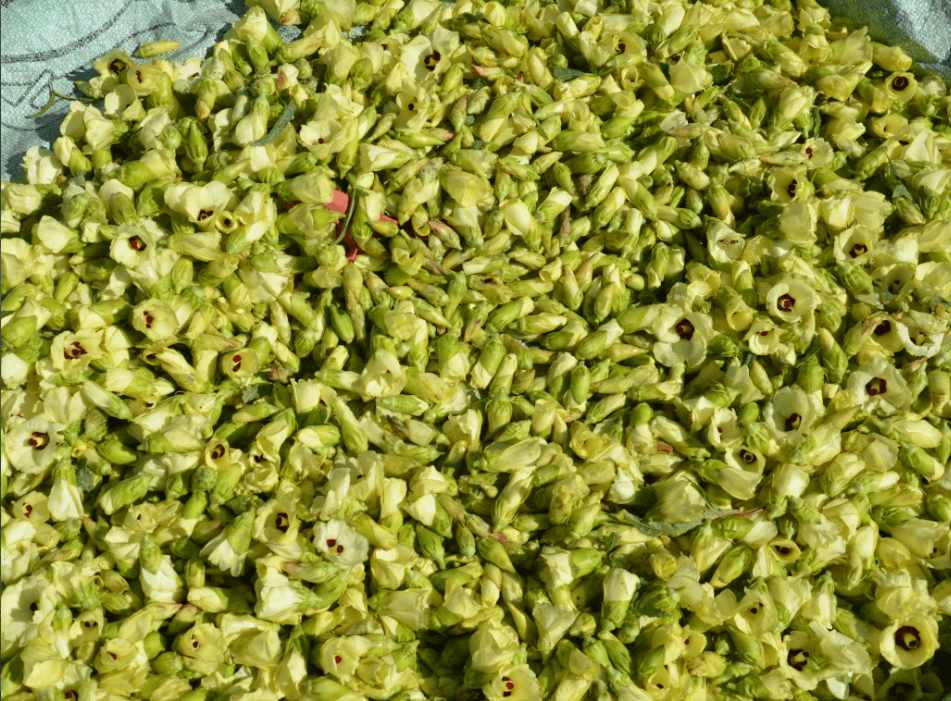
Amasya Flower Okra
Product / Product Group(s) | Processed and unprocessed fruits and mushrooms vegetables | ||||||||
|---|---|---|---|---|---|---|---|---|---|
Applicant/Registrant(s) | Amasya Provincial Directorate of Agriculture and Forestry | ||||||||
Registration Date | 29.05.2018 | ||||||||
File Number | C2016/031 | ||||||||
Registration Number | 352 | ||||||||
Amasya Çiçek Bamyası is a unique variety of okra native to Amasya Province in Türkiye, officially registered with the Turkish Patent and Trademark Office on 29 May 2018 under the designation “Geographical Indication.” The product is distinguished by its small fruit size and light green coloration and is particularly noted for its suitability for drying.

Amasya Çiçek Bamyası (AA)
Amasya Çiçek Bamyası is a variety of okra characterized by small fruits and a light green color. The fruits typically weigh between 1.4 and 2.3 grams, with a length of 16.4–28.6 mm and a diameter of 11.5–14.1 mm. The fruit ridges are either flat or concave. Fruit pubescence is minimal. The fruits are harvested together with their flowers, a feature from which the name “flower okra” is derived.
The stem color is green with red streaks and is locally known as “kızıl bacak.” Seeds are generally light or dark green. Leaves are light green, sparsely pubescent, and deeply lobed. The average plant height ranges from 113.4 cm to 157.1 cm, and its highly branched structure confers a high yield potential.
Chemical analyses indicate that fresh fruits contain 34.56–41.76 mg/100g of vitamin C. Upon drying, the product loses approximately 80% of its moisture content, yielding about 2 kg of dried okra from 10 kg of fresh okra.

Amasya Çiçek Bamyası Harvest (AA)
Production begins with sowing. Seeds germinate within 7–9 days and develop their first leaves within 12–18 days. Flowering typically begins after an average of 53–66 days. Each plant produces 4–5 lateral branches. Production can be carried out in accordance with organic farming practices.
Amasya Çiçek Bamyası is a water-loving plant, and irrigation 3–5 times per week is recommended. Drip irrigation is preferred; sprinkler irrigation is not advised. Farmyard manure or composted fertilizer is used for fertilization. Supplementary application of ammonium sulfate is possible.
Weed control is carried out through pre-sowing chemical treatment and subsequent hoeing. The most common disease is powdery mildew. Leafhoppers are the primary pests observed.
Harvesting of Amasya Çiçek Bamyası begins in early June and continues until the end of October. Harvesting is performed daily with the flowers intact. The harvested fruits are threaded onto cotton strings and left overnight before the flowers are removed. Drying is carried out in shaded areas without direct sunlight. The dried product acquires a golden yellow color.

Amasya Çiçek Bamyası (AA)
The product can be cultivated within the boundaries of the districts of Merkez, Taşova and Göynücek in Amasya Province, Erbaa in Tokat Province, and Mecitözü, Osmancık and Kargı in Çorum Province. Monitoring is coordinated by the Amasya Directorate of Food, Agriculture and Livestock.
Anadolu Ajansı. (2018). *Bamya Hasadı Üreticiyi Zorluyor*. Accessed May 27, 2025. https://www.aa.com.tr/tr/ekonomi/bamya-hasadi-ureticiyi-zorluyor/1218871
Anadolu Ajansı. (2019). *Bamyanın Tarladan Sofraya Zahmetli Yolculuğu*. Accessed May 27, 2025. https://www.aa.com.tr/tr/yasam/bamyanin-tarladan-sofraya-zahmetli-yolculugu/1546777
Turk Patent and Trademark Office. (2018). *Amasya Çiçek Bamyası – Coğrafi İşaret Sicil Belgesi No: 352*. Accessed May 27, 2025. https://ci.turkpatent.gov.tr/cografi-isaretler/detay/38196

Amasya Flower Okra
Product / Product Group(s) | Processed and unprocessed fruits and mushrooms vegetables | ||||||||
|---|---|---|---|---|---|---|---|---|---|
Applicant/Registrant(s) | Amasya Provincial Directorate of Agriculture and Forestry | ||||||||
Registration Date | 29.05.2018 | ||||||||
File Number | C2016/031 | ||||||||
Registration Number | 352 | ||||||||
Product Description and Distinctive Characteristics
Production Method
Sowing and Growth Process
Irrigation and Fertilization
Weed and Pest Control
Harvesting and Drying
Geographical Boundary and Monitoring