


This article was automatically translated from the original Turkish version.
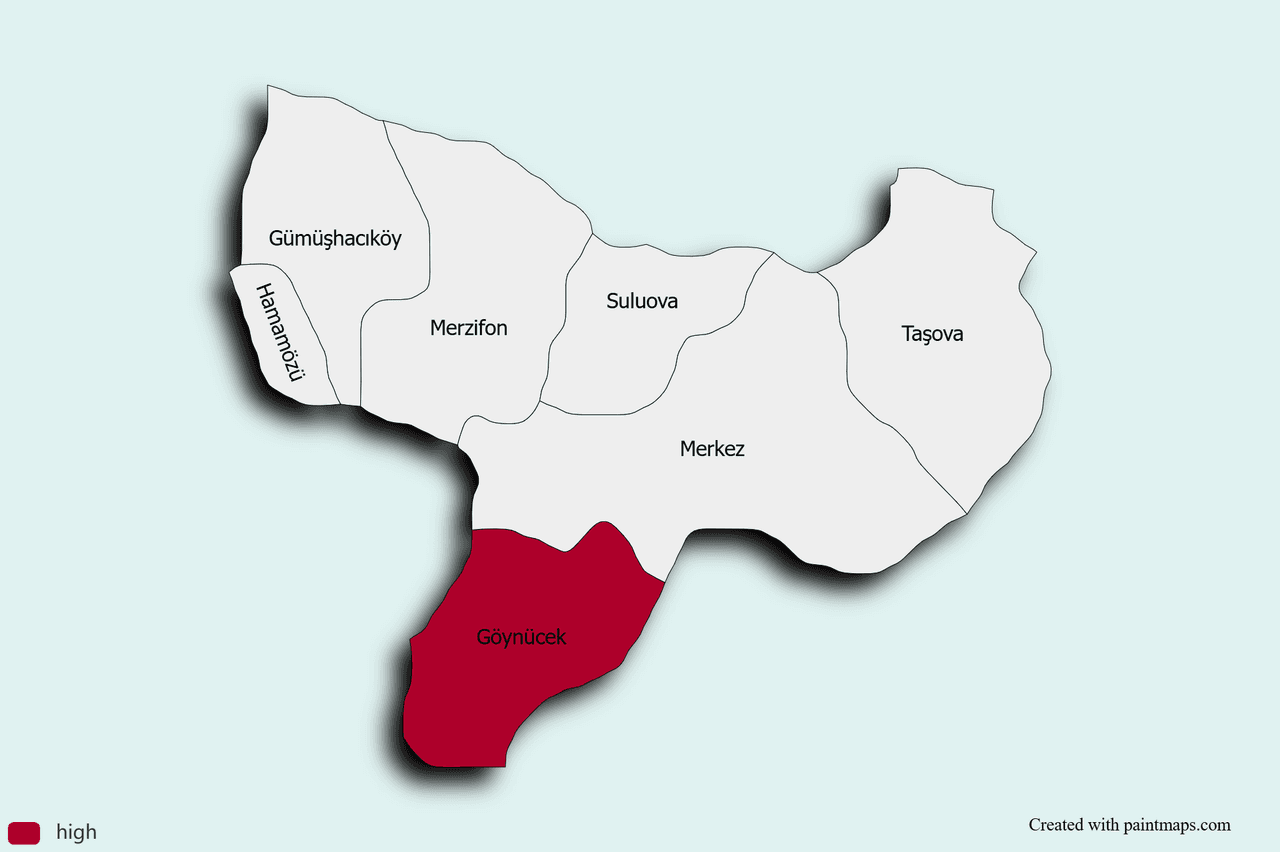
Göynücek (District)
Province(s) | Amasya | ||||||||
|---|---|---|---|---|---|---|---|---|---|
Region(s) | Black Sea | ||||||||
Population (2024) | 10.787 | ||||||||
Area(s) | 578 km² | ||||||||
Mayor(s) | Kemal Şahin | ||||||||
District Governor | Mustafa Kartal | ||||||||
Postal Code | 05900 | ||||||||
Economy | Agriculture and livestock | ||||||||
Cultural Structures | Water mills Kızlar Palace Gökçeli Castle | ||||||||
Göynücek is a district located in the southwest of Amasya, within the Çekerek River Valley, known for its economy based on agriculture and livestock farming. The district’s natural and historical fabric has been shaped by settlements such as Gökçeli Castle, Ilısu Hot Springs, Gediksaray and Ayvalıpınar mounds.

Göynücek (Göynücek Municipality)
The earliest settlement traces in Göynücek date back to the Chalcolithic Age (5500–3000 BCE), evidenced by the Ayvalıpınar and Gediksaray mounds. During the Middle Bronze Age (2500–2000 BCE), the region was part of the Hattic cultural sphere; between 750 and 585 BCE, it came under the dominance of Phrygian, Cimmerian, Scythian and Medo-Persian communities. In 301 BCE, it fell under Persian-Pontic control, and after the Battle of Zela in 47 BCE, it became part of the Roman Empire. Following Rome, the region came under Byzantine rule, then passed to Seljuk control in 1175 during the reign of II. Kılıçarslan. In 1341, it became part of the Eretna Beylik, and in 1393, it was incorporated into the Ottoman State. During the Ottoman period, the Gediksaray neighborhood was subordinate to the Amasya sanjak. Göynücek attained the status of a district center in 1922 and was officially designated as a district by Law No. 6324 dated 4 March 1954.
Göynücek is situated in the southwest of Amasya, bordering the provinces of Tokat, Çorum and Yozgat. The district covers an area of 578 km², with elevations ranging from 450 to 1,100 meters. The Çekerek River and its tributaries form the main watercourses of the district. Karadağ and Tekke Dağı are prominent highlands. The climate exhibits continental characteristics: summers are hot and dry, while winters are mild and rainy. Throughout the district, steppe, shrubland and occasional forested areas are found.
The total population of Göynücek district was 13,425 as of 2007, declining to 10,787 by 2024. During this period, population increases of 258, 457 and 424 were recorded respectively in the years 2020–2021, 2022–2023 and 2023–2024, while declines occurred at varying rates in other years. According to 2024 data, the male population stands at 5,504 (51.02%) and the female population at 5,283 (48.98%), with gender differences generally remaining within a few hundred people. Annual population fluctuations have followed a variable trend, influenced by local registration updates and migration patterns.
The district’s economy is largely based on agriculture. Major crops grown in the Çekerek Plain include okra, onion, barley, wheat, poppy and sugar beet. Göynücek okra has become a local brand. In fruit cultivation, apple, cherry, sour cherry, apricot, peach and walnut production are prominent. Investments such as the Gediksaray Sığırçayı Reservoir (2012; capacity 1,440,000 m³) and the Aşağı Çekerek Plain Irrigation Project have been undertaken to improve agricultural infrastructure. The district also hosts a small industrial zone, a flour mill and production of cereal-based products.
The district includes one municipality (Göynücek Municipality) and 38 villages. The district center consists of the town of Göynücek, which shares the same name. Administrative services are delivered through the district governorship, municipality and affiliated institutions. Public institutions operating in the district include the gendarmerie command, police directorate, district directorate of national education, directorate of agriculture and forestry, health group directorate and muftiate.
Villages are managed by elected village heads and elder councils, while the district municipality provides local services in the neighborhoods of the town center. The district’s administrative structure operates in coordination with the provincial governorship and affiliated provincial directorates.
Educational services in Göynücek district are provided by public institutions under the Ministry of National Education. The district has a total of 17 public schools: 1 preschool, 6 primary schools, 6 middle schools, 2 Imam Hatip middle schools, 1 multi-program Anatolian high school and 1 Imam Hatip high school. Teachers at these institutions provide education to students in both the district center and surrounding villages.
One institution supporting the educational infrastructure is the Göynücek District Public Library, established in 1978, which offers services with approximately 10,665 books and 89 periodicals. The library serves as an information center, particularly for students and researchers. The district also organizes adult education courses under the Directorate of National Education, implementing vocational development and lifelong learning programs. In recent years, certified producer training programs have been conducted in areas such as cultivated mushroom farming.
Göynücek district possesses significant potential for rural tourism due to its historical richness and natural beauty. Archaeological evidence confirms continuous settlement from the Chalcolithic Age, with mounds such as Ayvalıpınar, Gediksaray and Ilısu Kocaman Tepe dating back to this period. These archaeological sites reflect the region’s historical continuity.
One of the most notable historical structures in the district is Gökçeli Castle. The castle, which was inhabited during the Roman, Byzantine, Seljuk and Ottoman periods, remains preserved as an archaeological site. It stands out for its defensive architecture and strategic location.
Water mills are among the district’s historical and cultural assets rooted in its rural economy. The water mill in Karapınar Neighborhood of İkizyaka Village, which began operations in 1945, has remained functional as part of local agricultural production. These mills preserve traces of traditional production methods in the region.
The people of Göynücek place great importance on traditional folk dances to sustain their local culture. In the district, the dances known as “Yelleme” and “Mahir Çavuş” are performed during weddings, military send-offs and holidays.
Göynücek cuisine is shaped by traditional Anatolian culinary practices based on vegetables, fruits and cereals grown in the district’s fertile agricultural lands. Okra, a major product of the district’s agriculture, holds a distinctive place in the local cuisine. “Göynücek okra” is recognized regionally for its flavor and aroma and is used both fresh and dried in various dishes. This product has gained popular recognition with the saying “Amasya’s apple, Göynücek’s okra.”
In addition to okra, products such as onion, sugar beet, poppy, barley and wheat are also used in local cooking. Fruits such as cherry, apple, sour cherry, apricot, walnut and peach are used in desserts and jams, produced during summer months and stored for winter use. With ongoing product development initiatives, efforts are being made to promote Göynücek’s local cuisine, not only in Amasya and its surroundings but also at the national level.
Göynücek Belediyesi. "Fotoğraflar." *Göynücek Municipality Website.* Accessed May 4, 2025. https://www.goynucek.bel.tr/#lg=1&slide=1
Göynücek Belediyesi. “Göynücek.” Göynücek Municipality Website. Accessed May 4, 2025. https://www.goynucek.bel.tr/goynucek
Göynücek Kaymakamlığı. "Göletlerimiz." Göynücek Kaymakamlığı Web Sitesi. Accessed May 4, 2025. http://www.goynucek.gov.tr/goletlerimiz
Göynücek Kaymakamlığı. "Su Değirmenleri." Göynücek Kaymakamlığı Web Sitesi. Accessed May 4, 2025. http://www.goynucek.gov.tr/su-degirmenleri
Göynücek Kaymakamlığı. "İlçemizin Tarihçesi." Göynücek Kaymakamlığı Web Sitesi. Accessed May 4, 2025. http://www.goynucek.gov.tr/ilcemizin-tarihcesi
T. C.Amasya Valiliği. “Göynücek.” Accessed May 4, 2025. http://www.amasya.gov.tr/goynucek
T.C. Ministry of Culture and Tourism. “Göynücek.” *Amasya İlk Culture and Tourism Directorate.* Accessed May 4, 2025. https://amasya.ktb.gov.tr/TR-59477/goynucek.html
T.C.Göynücek Kaymakamlığı Governorship. “İlçemizde ‘Kültür Mantarı Yetiştiriciliği’ Eğitimlerinin Başarılı Sonuçları.” T.C. Göynücek District Governorship Website. Accessed May 4, 2025. https://www.goynucek.gov.tr/ilcemizde-kultur-mantari-yetistiriciligi-egitimlerinin-basarili-sonuclari
Türkiye İstatistik Institute (TÜİK). Address-Based Population Registration System Results. Accessed May 4, 2025. https://data.tuik.gov.tr/Bulten/Index?p=Adrese-Dayali-Nufus-Kayit-Sistemi-Sonuclari-2024-53783

Göynücek (District)
Province(s) | Amasya | ||||||||
|---|---|---|---|---|---|---|---|---|---|
Region(s) | Black Sea | ||||||||
Population (2024) | 10.787 | ||||||||
Area(s) | 578 km² | ||||||||
Mayor(s) | Kemal Şahin | ||||||||
District Governor | Mustafa Kartal | ||||||||
Postal Code | 05900 | ||||||||
Economy | Agriculture and livestock | ||||||||
Cultural Structures | Water mills Kızlar Palace Gökçeli Castle | ||||||||
No Discussion Added Yet
Start discussion for "Göynücek (District)" article
History
Geography and Climate
Population and Demographics
Economic Structure
Administrative Structure
Education
Tourism and Culture
Cuisine