


This article was automatically translated from the original Turkish version.
+2 More
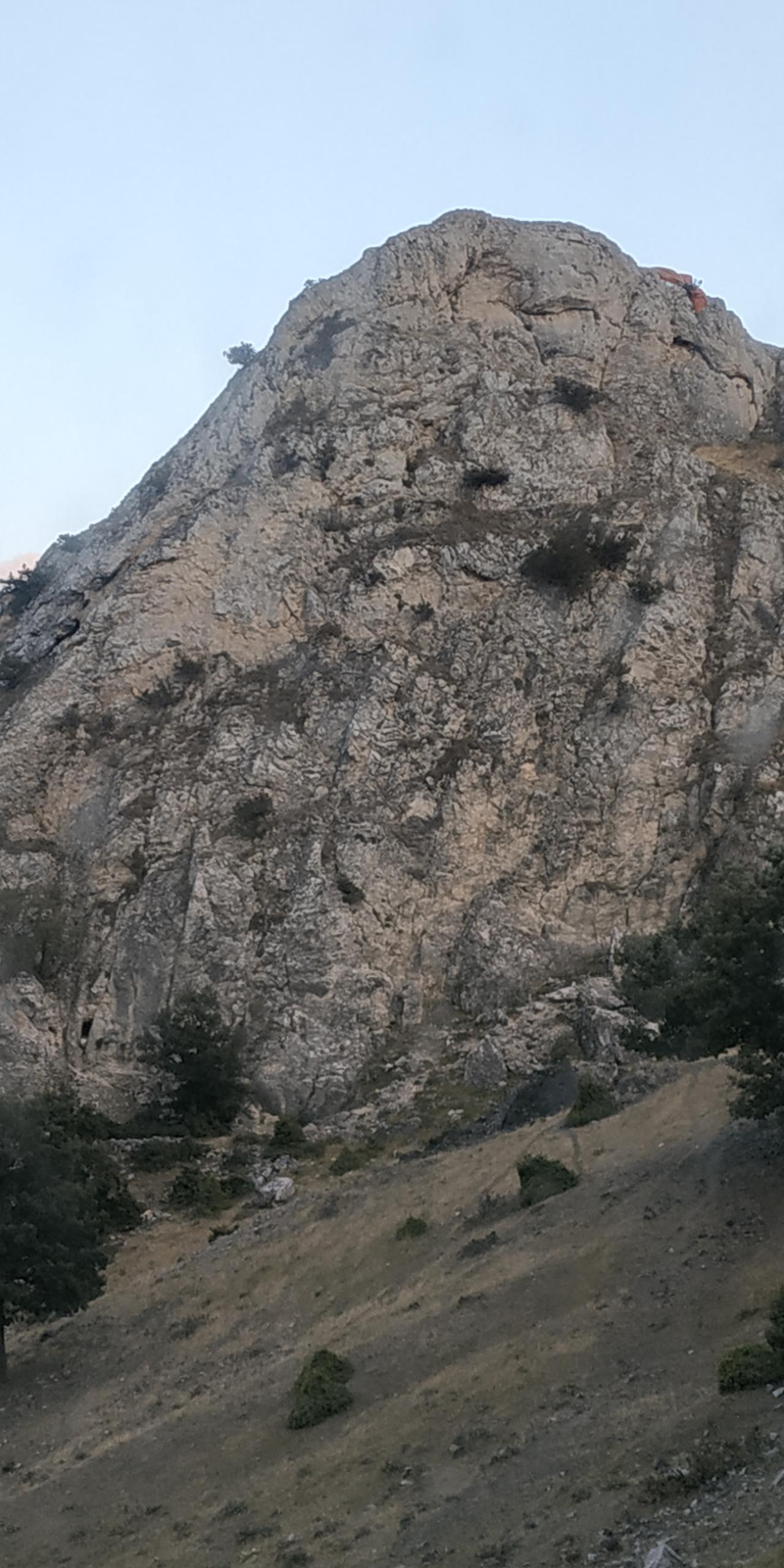
Gökçeli Castle (Photo: Yusuf Bilal Akkaya)
Location | Amasya Göynücek North-east of Gökçeli Village | ||||||||
|---|---|---|---|---|---|---|---|---|---|
Distance(s) | Approximately 8 km from the Göynücek district center | ||||||||
Geographical Feature | On a rocky hill dominating the Çekerek Valley | ||||||||
Purpose of Use(s) | Garrison and observation point | ||||||||
Gökçeli Kalesi is a historical defensive structure located on a rocky hill overlooking the Çekerek Valley within the boundaries of Göynücek district, Amasya Province. Known to have been used as a garrison during the Roman period, the castle serves both surveillance and defensive purposes due to its strategic location. Today, Gökçeli Kalesi stands in ruins and is recognized as one of Göynücek’s most significant historical monuments.
Gökçeli Kalesi is situated approximately one kilometre northeast of Gökçeli Village, which is under the jurisdiction of Göynücek district in Amasya Province, atop a rocky elevation commanding the Çekerek Valley. The castle, located about eight kilometres from the district centre, offers a dominant view of the surrounding area due to its strategic position.

Gökçeli Kalesi (Photograph: Yusuf Bilal Akkaya)
The exact construction date of Gökçeli Kalesi remains unknown; however, archaeological and historical studies suggest that the castle was built during the Iron Age. During the Roman period, it functioned as a garrison. Due to the geostrategic importance of the Çekerek Valley, Gökçeli Kalesi served as one of the key defensive and observation points in the region.
According to historical sources, Göynücek and its surroundings came under Roman rule following the Battle of Zela in 47 BCE. In this context, it is assessed that Gökçeli Kalesi was either constructed or significantly reinforced as part of the Roman defensive system during this period.

View of Gökçeli Kalesi (Photograph: Yusuf Bilal Akkaya)
The castle has been the subject of research by Franz Cumont, Hans Henning von der Osten, Hubertus von Gall, Mehmet Özsait, and the General Directorate of Cultural Heritage and Museums. These studies have confirmed its identification as a Roman garrison. However, alongside limited Roman-era ceramic fragments found around the site, Iron Age pottery dating to the 7th century BCE provides clear evidence that the structure was originally constructed during the Iron Age.
Following the division of the Roman Empire, Gökçeli Kalesi came under Byzantine control. In the late 11th century, with the Seljuk Turks establishing dominance over the Amasya region, the castle passed into Turkish administration.

Interior of Gökçeli Kalesi (Photograph: Yusuf Bilal Akkaya)
Gökçeli Kalesi was constructed in harmony with the rocky terrain on which it stands. Within the castle complex, a stone staircase of 98 steps leads to a concealed passage, which has been excavated multiple times by the General Directorate of Cultural Heritage and Museums. The structural elements of the castle support its dual function as a military and defensive installation. Although portions of the castle walls have been damaged over time, the foundational remains have survived to the present day.
In summary, Gökçeli Kalesi is one of the most important historical structures in Göynücek district, Amasya Province. Its multi-layered history spanning the Roman, Byzantine, and Seljuk periods serves as a testament to cultural continuity in the region. Today, in its ruined state, the structure is regarded as a significant archaeological element within Göynücek’s historical topography.
Amasya Göynücek District Integrated Hospital. "İlçemiz." Amasya İl Sağlık Müdürlüğü. Accessed October 5, 2025. https://goynucekentegre.saglik.gov.tr/TR-453803/ilcemiz.html#.
Amasya Sarraflar ve Kuyumcular Derneği. “Coğrafi Yapı.” *ASKD.* Accessed October 5, 2025. https://www.amasyakuyumculardernegi.com/amasya.php?cografi.
Amasya Valiliği. "Kaleler." Accessed October 5, 2025. http://www.amasya.gov.tr/kaleler.
Culture and Heritage General Directorate. "2006 Yılı Müze Kurtarma Kazıları." *T.C. Kültür ve Turizm Bakanlığı*. Accessed October 5, 2025. https://kvmgm.ktb.gov.tr/TR-44214/2006-yili-muze-kurtarma-kazilari.html.
Culture and Heritage General Directorate. "2007 Year Museum Rescue Excavations." T.C. Kültür ve Turizm Bakanlığı. Accessed October 5, 2025. https://kvmgm.ktb.gov.tr/TR-44198/2007-yili-muze-kurtarma-kazilari.html.
Göynücek Kaymakamlığı. "İlçemizin Tarihçesi." Göynücek Kaymakamlığı. Accessed October 5, 2025. http://www.goynucek.gov.tr/ilcemizin-tarihcesi.
Kaymakçı, Salih. “Doğu Pontos Bölgesi Kaleleri Ve Basamaklı Tünellerine Bir Örnek: Kaledere Kalesi - Yeni Bulgular Işığında Arkeolojik Bir Değerlendirme”. *Karadeniz İncelemeleri Dergisi* 14, no. 28 (April 2020): 569–86. Accessed October 5, 2025. https://dergipark.org.tr/tr/pub/kid/issue/54079/729942#article_cite.
Özsait, Mehmet. “2004 Yılı Samsun ve Amasya İlleri Yüzey Araştırmaları.” *23. Araştırma Sonuçları Toplantısı*, Volume 2. Antalya: T.C. Kültür ve Turizm Bakanlığı, Kültür Varlıkları ve Müzeler Genel Müdürlüğü, May 30–June 3, 2005. Accessed October 5, 2025. http://www.kulturvarliklari.gov.tr/sempozyum_pdf/arastirmalar/23_arastirma_2.pdf.

Gökçeli Castle (Photo: Yusuf Bilal Akkaya)
Location | Amasya Göynücek North-east of Gökçeli Village | ||||||||
|---|---|---|---|---|---|---|---|---|---|
Distance(s) | Approximately 8 km from the Göynücek district center | ||||||||
Geographical Feature | On a rocky hill dominating the Çekerek Valley | ||||||||
Purpose of Use(s) | Garrison and observation point | ||||||||
Location
History and Research
Architectural Features