


This article was automatically translated from the original Turkish version.
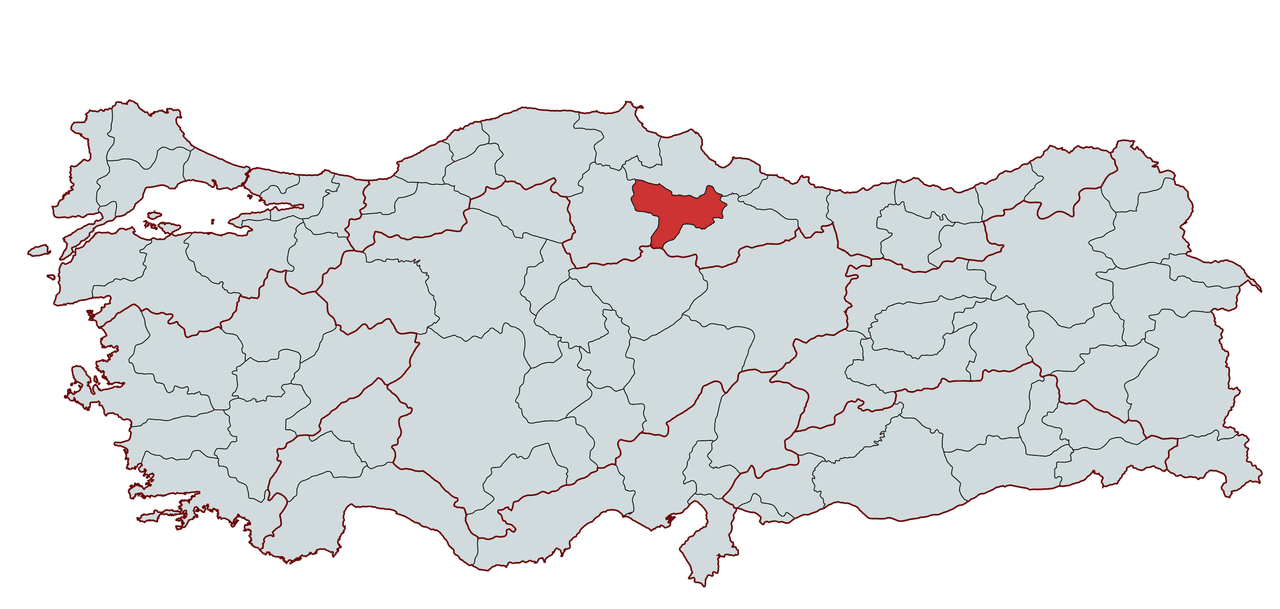
Amasya (Province)
Country | Türkiye | ||||||||
|---|---|---|---|---|---|---|---|---|---|
Region(s) | Black Sea Region | ||||||||
Population | 342,378 (2024) | ||||||||
Area(s) | 5 690 km² | ||||||||
Climate(s) | Black Sea and Continental Climate Transition Region | ||||||||
Important Structure(s) | Aynalı Mağara Gök Medrese Camii Burmalı Minare Camii Sultan II. Bayezid Külliyesi Amasya Castle Royal Rock Tombs | ||||||||
Governor(s) | Ömer Bakan | ||||||||
Mayor(s) | Turgay Sevindi | ||||||||
License Plate Code | 05 | ||||||||
Amasya is a province located in the interior regions of Black Sea Region in Türkiye. With an area of 5,690 km², the province is bordered by Tokat to the east, Yozgat to the south, Çorum to the west, and Samsun to the north. Situated on the Yeşilırmak Valley between the Central Black Sea Mountains (Canik Mountains), Amasya has been a settlement center inhabited by various civilizations throughout history.

Amasya Yalıboyu Evleri - Türkiye Kültür Portalı
The provincial center lies at an elevation of 411 meters and is built along both banks of the Yeşilırmak River. Amasya, noted for its historical fabric and cultural heritage, earned the title “City of Princes” during the Ottoman period as a place where princes received their education. It also played a significant role in the foundation process of the Republic of Türkiye as the site where the Amasya Circular, one of the pivotal moments of the War of Independence, was issued.
As of 2024, Amasya’s population is 342,378, with the majority residing in the provincial and district centers. Throughout history, Amasya has occupied a strategic position and bears traces of numerous civilizations from the Hittites to the Ottomans. Its transitional climate between the Black Sea and continental climates contributes to agricultural diversity.
The earliest settlement traces in Amasya extend back to the Neolithic and Chalcolithic periods. Archaeological findings indicate settlements dating as far back as 5500 BCE. Initially controlled by the Hittites, Amasya became one of the key centers of the Hittite Empire. After the Hittites, the Phrygians, Cimmerians, and Scythians dominated the region, leaving cultural imprints on Amasya.
Amasya was invaded by the Cimmerians in the 7th century BCE and later came under Lydian rule. In 546 BCE, with the Persian Empire’s conquest of Anatolia, Amasya passed under the administration of Persian satraps. During the Persian period, it was incorporated into the satrapy system and became an important center at the intersection of trade routes.
Following Alexander the Great’s conquests in the 4th century BCE, Amasya became the capital of the Kingdom of Pontus, one of the major Hellenistic kingdoms. The Pontic kings developed Amasya into an administrative and cultural center. The most remarkable structures of this era are the King Rock Tombs carved into the slopes of Mount Harşena. These monumental rock tombs, housing the graves of King Mithridates I and other rulers, reflect the Hellenistic period art traditions of the region.

Amasya Kral Kaya Mezarları - Türkiye Kültür Portalı
In 63 BCE, with the Roman Empire’s annexation of the region, Amasya came under Roman rule. Urbanization accelerated during this period, with roads, bridges, and water aqueducts constructed. Under Roman administration, Amasya attained the status of a developed city center.
Following the division of the Roman Empire, Amasya became part of the Eastern Roman (Byzantine) Empire. During the Byzantine era, it suffered invasions by the Sassanids and Arab. Captured by the Umayyads in 712, Amasya came under Muslim administration for a time but was later reclaimed by Emperor Leo III.
After the Battle of Manzikert in 1071, Melik Ahmet Danişmend Gazi, a Seljuk commander, captured Amasya in 1075 and founded the Danişmendids. The Danişmendids made Amasya one of the first Turkish settlement centers in Anatolia. During this period, mosques, madrasas, and tombs were constructed in the city.
Anatolian Seljuk Sultan II. Kılıçarslan annexed the Danişmend territories and incorporated Amasya into the Seljuk State. During the Seljuks period, Amasya received the title “Dârü’l-izz” (The Noble City) and became an important center of learning. Madrasas and caravanserais were built, establishing Amasya as one of Anatolia’s key educational and trade hubs.
After the defeat of the Anatolian Seljuks by the Mongols at the Battle of Köse Dağ in 1243, Amasya came under Mongol control. From 1265 onward, the city was governed by Ilkhanid governors. During this period, Amasya became one of the Mongols’ administrative and military centers.
After 1341, Amasya came under the rule of the Eretna Beylik, founded by Uyghur Turks. During this time, the city was governed by Kadı Burhaneddin and other local beys. As a result of the Ottoman expansion in Anatolia, Amasya was annexed to Ottoman territory in 1386 by Yıldırım Bayezid.
After coming under Ottoman rule, Amasya became a center where princes gained administrative experience. Known as the “City of Princes,” Amasya was where many future Ottoman sultans, including II. Murad, Fâtih Sultan Mehmed, and II. Bayezid such as, served as provincial governors before ascending the throne.
The Treaty of Amasya (1555), signed between the Ottoman Empire and Safavid Iran during the reign of Kanuni Sultan Süleyman, marked a turning point in Ottoman-Safavid relations.
In the late 16th century, Amasya suffered greatly during the Celali rebellions within the Ottoman Empire, leading to negative economic and social consequences. In the 17th and 18th centuries, the city recovered under Ottoman administration and continued to function as a center of education, trade, and cultural activity.
Amasya played a significant role during the War of Independence. The Amasya Circular was issued here on 22 June 1919. After the proclamation of the Republic, Amasya attained provincial status in 1924. Developments occurred in agriculture, livestock, and industry sectors, and the province, particularly known for its apple production, became one of Türkiye’s key agricultural centers. The opening of the Amasya-Merzifon Airport in 2008 strengthened the province’s transportation infrastructure.
Amasya is located in the interior of the Central Black Sea Region, between 34° 57’ 06” and 36° 31’ 53” east longitude and 41° 04’ 54” and 40° 16’ 16” north latitude. To the north lie Samsun, to the west Çorum, to the east Tokat, and to the south Yozgat provinces.
Amasya shares a total border length of 492 km with Samsun, Çorum, Tokat, and Yozgat. The longest border is with Samsun (169 km), and the shortest is with Yozgat (6 km). The provincial center is 336 km from Ankara, 671 km from Istanbul, 114 km from Tokat, 92 km from Çorum, and 131 km from Samsun.
Amasya’s surface features are highly diverse, shaped by mountains, valleys, and plains. The average elevation is 1,150 meters, while the provincial center lies at 412 meters.
Amasya exhibits a transitional climate between the Black Sea and continental climates. Consequently, climatic variations are observed across different regions of the province. The center, Göynücek, and Taşova districts display more continental characteristics, while Gümüşhacıköy, Hamamözü, Merzifon, and Suluova districts have a structure more aligned with the Black Sea climate.
Annual average precipitation ranges between 436 mm and 458 mm. Spring is the wettest season, while write months are dry.

Amasya central region - Anadolu Ajansı
Amasya is among the provinces with migration outflow. A significant portion of the youth population migrates to larger cities due to education and employment opportunities.
Amasya is an important agricultural center due to its fertile valleys and microclimatic conditions. Fruit cultivation, cereal production, and industrial crops are the main components of its agricultural output.
Amasya is especially renowned for the Amasya apple. Its high aroma and durability make it a preferred choice in local and national markets. cherry produced in various regions of the province are marketed both domestically and internationally. Peach, pear, quince, apricot, grape, and plum are other important fruit varieties grown in Amasya.
Wheat, maize, barley, green lentils, and potato are among the cereal crops cultivated in the province. Sugar beet is one of the most important industrial crops and contributes to the economy through processing at the Amasya Sugar Factory. Sunflower, poppy, and onion production are also significant.
Large and small livestock farming, poultry production, and dairy farming are well developed in Amasya, making livestock-based industry an important economic activity sector.
Amasya possesses a rich cultural heritage bearing traces of civilizations from antiquity to the Ottoman era.
Amasya Castle: Located on Mount Harşena, castle was used for defense during the Pontic, Byzantine, and Ottoman periods. The castle contains cisterns, dungeons, and tunnels.

Amasya Kalesi - Türkiye Kültür Portalı
Royal Rock Tombs: Dating to the 3rd century BCE, these rock tombs belonging to the Pontic kings are among Amasya’s most striking historical structures.
Burmalı Minare Camii (1237–1247): One of the oldest mosques from the Seljuk period, notable for its spiral minaret.
Sultan II. Bayezid Külliyesi (1486): Built by Ottoman Sultan II. Bayezid, this complex includes a mosque, madrasa, imaret, bathhouse, and library.
Gök Medrese Camii (1266): A significant structure from the Seljuk period, renowned for its architectural ornamentation.
Amasya cuisine presents a synthesis of traditional Turkish cuisine with regional influences from the Black Sea and Central Anatolia.
Traditional Amasya dishes include:
Amasya is governed by a governor appointed by the central government. As of 2024, the Governor of Amasya is Önder Bakan. The governors who have served since the founding of the Republic are as follows:
The Amasya Municipality Presidency is currently led by Turgay Sevindi as of 2024. The mayors who have served since the founding of the Republic are as follows:
Amasya consists of seven districts, including the central district.
The districts are:
Amasya has eight towns and 372 village. Rural settlements are generally located along the Yeşilırmak Valley and in mountainous areas. Population density is low in villages under district administration.
Amasya Belediyesi. "Amasya'nın Tarihi." Amasya Belediyesi, Accessed February 13, 2025. https://amasya.bel.tr/amasyan%C4%B1n-tarihi.
Amasya Ticaret ve Sanayi Odası. "Amasya Tarihi." Accessed February 13, 2025. https://amasyatso.org.tr/amasya-tarihi/.
Devlet Hava Meydanları İşletmesi. "Merzifon Şehir Tarihçesi." DHMI, Accessed February 13, 2025. https://www.dhmi.gov.tr/Sayfalar/Havalimani/Merzifon/SehirTarihcesi.aspx.
T.C. Amasya Valiliği. "Amasya Nüfus Verileri." Amasya Valiliği, Accessed February 13, 2025. http://www.amasya.gov.tr/nufus.
T.C. Kültür ve Turizm Bakanlığı. "Amasya Genel Bilgiler." Accessed February 13, 2025. https://amasya.ktb.gov.tr/TR-59457/genel-bilgiler.html.
T.C. Ministry of Culture and Tourism. "Amasya Genel Bilgiler." T.C. Ministry of Culture and Tourism, Accessed February 13, 2025. https://amasya.ktb.gov.tr/TR-59457/genel-bilgiler.html.
T.C. Ministry of Culture and Tourism. "Amasya." T.C. Ministry of Culture and Tourism, Accessed February 13, 2025. https://amasya.ktb.gov.tr/.
T.C.Amasya Valiliği. "Görev Yapmış Amasya Valileri." Amasya Governorship, Accessed February 13, 2025. http://www.amasya.gov.tr/gorev-yapmis-valilerimiz.
Türkiye Diyanet Vakfı İslam Ansiklopedisi. "Amasya Tarihi." İslam Ansiklopedisi, Accessed February 13, 2025. https://islamansiklopedisi.org.tr/amasya-tarihi.
Türkiye Diyanet Vakfı İslam Ansiklopedisi. "Amasya." İslam Ansiklopedisi, Accessed February 13, 2025. https://islamansiklopedisi.org.tr/amasya.

Amasya (Province)
Country | Türkiye | ||||||||
|---|---|---|---|---|---|---|---|---|---|
Region(s) | Black Sea Region | ||||||||
Population | 342,378 (2024) | ||||||||
Area(s) | 5 690 km² | ||||||||
Climate(s) | Black Sea and Continental Climate Transition Region | ||||||||
Important Structure(s) | Aynalı Mağara Gök Medrese Camii Burmalı Minare Camii Sultan II. Bayezid Külliyesi Amasya Castle Royal Rock Tombs | ||||||||
Governor(s) | Ömer Bakan | ||||||||
Mayor(s) | Turgay Sevindi | ||||||||
License Plate Code | 05 | ||||||||
History
Early Settlements and Antiquity
Hellenistic and Roman Period
Byzantine Period
Turkish Entry and Seljuk Period
Mongol, Ilkhanid, and Beylik Periods
Ottoman Period
Post-Republic Era
Geography
Location and Boundaries
Topography and Geology
Valleys
Mountains
Plains
Climate
Water Resources
Rivers and Streams
Dams and Reservoirs
Population and Demographic Structure
Urban and Rural Population Distribution
Amasya Population by District (2024)
Migration Trends
Economy
Agricultural Production
Fruit Cultivation
Cereals and Industrial Crops
Livestock and Food Industry
Historical and Cultural Heritage
Gastronomy
Administration
Amasya Governors (1923–Present)
Amasya Mayors (1923–Present)
Districts and Settlement Structure