Type of Geographical Indication | Protected Designation of Origin | ||||||||
|---|---|---|---|---|---|---|---|---|---|
Registration Number | 424 | ||||||||
Registration Date | March 14, 2019 | ||||||||
Product / Product Group(s) | Processed and unprocessed fruits and mushrooms vegetables | ||||||||
Province(s) | Amasya | ||||||||
Applicant/Registrant(s) | Amasya Provincial Directorate of Agriculture and Forestry | ||||||||
The Amasya misket apple is a distinctive apple variety unique to Amasya province in Türkiye, registered with a geographical indication as a protected designation of origin. It was officially registered on March 14, 2019, and is protected by the Amasya Provincial Directorate of Agriculture and Forestry. The geographical scope of the registration includes the districts of Amasya Merkez, Suluova, Merzifon, Gümüşhacıköy, Hamamözü, Taşova, and Göynücek.
Amasya province lies in a transitional zone between the Black Sea and Central Anatolian climates, with elevations ranging from 411 to 1,150 meters above sea level. The microclimate created by the Yeşilırmak Valley, particularly the breezes through its gorges, plays a crucial role in developing the unique aroma and flavor of the Amasya misket apple. The annual average rainfall of 460.1 mm falls within the 400–600 mm range required for the apple’s cultivation. With a chilling requirement of 2,536 hours, the Amasya misket apple thrives in Amasya’s climate, which has averaged 2,526 chilling hours over the past 45 years.
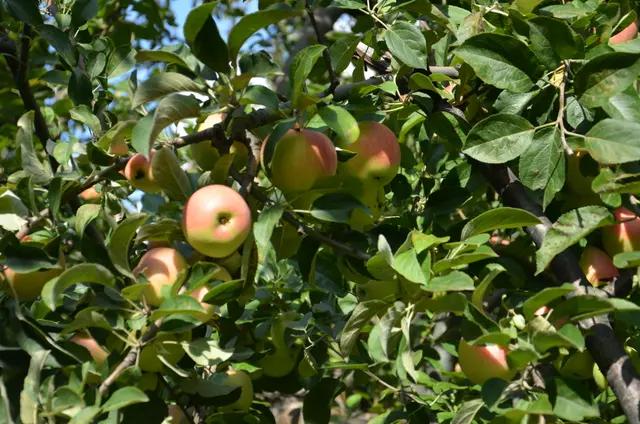
The Amasya misket apple belongs to the Malus domestica species of the Rosaceae family. Its flowers are white, taking on a light pink hue when blooming. The fruit is medium-sized, with a broad midsection and thin, firm skin. The sun-exposed side is dark glossy red, while other areas are light red with a glossy green background in parts. The flesh is crisp, juicy, slightly greenish-white, and sweet. The seed cavity is star-shaped with five compartments, each potentially containing two seeds.
Physical and chemical characteristics include:
Amasya misket apples are typically grown on seedling rootstocks or semi-dwarf rootstocks such as MM111 or MM106. Orchards are established with 8x8 or 10x10 meter spacing, though in clonal rootstock orchards, this can be reduced to 5x4 meters. Trees begin bearing fruit at 7–8 years of age, with an economic lifespan of 35–50 years.
Golden Delicious is commonly used as a pollinator. Since half of the 5–6 fruits emerging from each fruit bud naturally drop, thinning is not required. The harvest period spans mid-September to late October. The apples can be stored in cold storage or traditional underground storage, remaining viable until May due to a waxy coating on their skin.
The apples can be dried for year-round consumption. Fresh apples have a moisture content of 87.7%, but drying increases the water-soluble dry matter content by 6–8 times. Dipping dried apples in a 2% citric acid solution imparts a tangy flavor.
All stages, from production to marketing, are overseen by the Amasya Provincial Directorate of Agriculture and Forestry. The inspection team includes experts from the Black Sea Agricultural Research Institute and the Amasya Chamber of Agriculture. Inspections are conducted at least once a year during the flowering (April 20–30), development (July 20–30), and harvest (October 10–30) periods.
Türk Patent ve Marka Kurumu. "Amasya Misket Elması." Coğrafi İşaretler Portalı. Accessed October 25, 2025. https://ci.turkpatent.gov.tr/cografi-isaretler/detay/38182
Türk Patent ve Marka Kurumu. Amasya Misket Elması Coğrafi İşaret Sicil Belgesi. Accessed October 25, 2025. https://ci.turkpatent.gov.tr/Files/GeographicalSigns/f10a99e2-92de-4318-a88e-20fb45252ca2.pdf

Type of Geographical Indication | Protected Designation of Origin | ||||||||
|---|---|---|---|---|---|---|---|---|---|
Registration Number | 424 | ||||||||
Registration Date | March 14, 2019 | ||||||||
Product / Product Group(s) | Processed and unprocessed fruits and mushrooms vegetables | ||||||||
Province(s) | Amasya | ||||||||
Applicant/Registrant(s) | Amasya Provincial Directorate of Agriculture and Forestry | ||||||||
No Discussion Added Yet
Start discussion for "Amasya Misket Apple " article
Ecological and Climatic Characteristics
Botanical Characteristics
Production and Storage
Processing and Added Value
Inspection
This article was created with the support of artificial intelligence.