


This article was automatically translated from the original Turkish version.
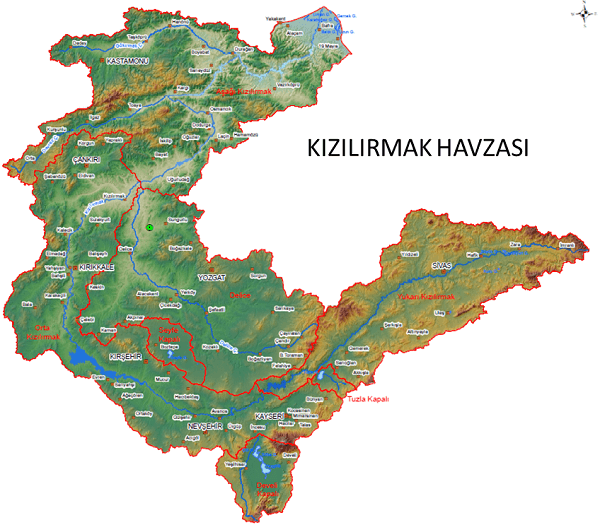
Kızılırmak Basin
Door | River | ||||||||
|---|---|---|---|---|---|---|---|---|---|
Source | İmranlı | ||||||||
Length(s) | 355 km 1 | ||||||||
Country | Türkiye | ||||||||
Region(s) | Central Anatolia | ||||||||
Casting | Black Sea | ||||||||
Basin | 78,180 km² | ||||||||
Branches | Gökırmak Devrez Delice | ||||||||
Cities | Samsun Kırıkkale Sivas | ||||||||
Climate(s) | Continental Climate | ||||||||
Discharge | Low | ||||||||
Dams | Derbent Dam Altınkaya Dam Boyabat Dam Obruk Dam Kapulukaya Dam Hirfanlı Dam Bayramhacılı Dam Yamula Dam İmranlı Dam | ||||||||
The Kızılırmak Basin is Türkiye’s second-largest basin and is located at the intersection of the Central Anatolia, Black Sea, and Marmara regions. The basin is significant for its water resources and agricultural production. The Kızılırmak River forms the primary water source of this basin and is the longest river in Türkiye by length. The water of the Kızılırmak has a major impact on the region’s economic activities. The river plays a crucial role in agriculture drinking water supply irrigation and energy production. The region is one of Türkiye’s important natural areas due to its numerous wetlands fertile agricultural lands and biological diversity.
The Kızılırmak Basin covers a vast area between Türkiye’s Central Anatolia Black Sea and Marmara regions. To the east it includes Amasya to the west Eskişehir to the north Samsun and to the south Konya and Niğde provinces. The total area of this basin is approximately 81 000 km² making it Türkiye’s second-largest basin. The Kızılırmak River adds richness to the region in terms of both water and agriculture as a vital source of life across this extensive geography. The river originates within the boundaries of Sivas province which contains the main sources of the basin’s water. Flowing from its source in Sivas the Kızılırmak River passes through Çorum Amasya Kayseri Nevşehir and several other provinces before emptying into the Black Sea. The surrounding mountains plateaus and river valleys shape the region’s topography and provide essential habitats for natural life.
The Kızılırmak’s journey beginning in Sivas and flowing through provinces such as Kayseri Amasya and Çorum before reaching the Black Sea directly affects water access and agricultural activities for all settlements in the region. The northern boundaries of this large basin lie near the Black Sea while its southern boundaries extend into the arid areas of Central Anatolia. This geographical position influences the basin’s climatic diversity and water resources.

Kızılırmak Basin Agricultural Sector Vulnerability Map (General Directorate of Water Management, Ministry of Agriculture and Forestry of the Republic of Türkiye)
The Kızılırmak Basin is a region rich in alluvial soils that provide highly productive agricultural land. These alluvial soils yield high productivity especially in irrigated farmlands. The basin’s geological structure varies with mountainous areas and plateau levels interspersed throughout. The Kızılırmak River originates within the boundaries of Sivas province and as it flows toward the Black Sea it encounters numerous distinct topographical features. This diversity is shaped by valleys plateaus and high mountains along the river’s course. Mountains alter the speed and direction of water flow influencing the river’s journey. This dynamic shapes the basin’s changing water pathways and ecosystem diversity.
The mountainous areas in the northeastern part of the region form the highest slopes surrounding the Kızılırmak. These mountains provide critical habitats for local ecosystems while the valleys create unique wetlands and fertile soils characteristic of the area. The changes in the riverbed along the Kızılırmak’s course influence water velocity and flow which in turn affect the development of vegetation and ecosystems in the region. Additionally settlements in the area are shaped according to these topographic features influencing their spatial distribution.

Scenic View of the Kızılırmak River Near Samsun (Pexels)
The Kızılırmak Basin lies under the influence of the continental climate of Central Anatolia. Summers are hot and dry while winters are cold and snowy. The northern part of the basin receives more precipitation because it is closer to the Black Sea whereas the southern and southeastern areas experience hotter and drier climatic conditions. These differing climate conditions are among the key factors affecting the basin’s irrigation needs and agricultural production. Despite these varying climatic conditions the water of the Kızılırmak River is continuously used for agricultural irrigation and drinking water supply.
Winter snowfall particularly replenishes the region’s water sources and contributes to rising groundwater levels. This provides a significant advantage for water availability during summer months. Climatic variations in the Kızılırmak Basin play a decisive role in organizing agricultural activities. Crops are cultivated using varieties resilient to hot and dry summer conditions while low winter temperatures influence fruit and vegetable production.
The Kızılırmak River at 1 355 kilometers in length is Türkiye’s longest river and meets the water needs of many provinces along its course. Originating in Sivas province the Kızılırmak River flows through Çorum Amasya Kayseri and other provinces before emptying into the Black Sea. The river is used for irrigating agricultural lands supplying drinking water and generating energy.
Dams constructed along the Kızılırmak have increased the region’s electricity generation capacity and enabled more efficient water use. These dams also help regulate water flow and minimize the effects of seasonal fluctuations. Thanks to these dams irrigation systems have become more efficient contributing to increased agricultural production especially in the arid areas of Central Anatolia. Significant increases in agricultural yields in the region are directly linked to the volume and velocity of water carried by the Kızılırmak.
The Kızılırmak Basin is a rich ecological region hosting diverse vegetation types and fauna species. The wetlands extending along the river serve as a vital stopover on bird migration routes. The areas irrigated by the Kızılırmak support complex interactions among various animal species and plant communities. This natural richness enables the conservation of biological diversity in the region. The Kızılırmak River also serves as a vital natural resource providing livelihoods for local communities and sustaining the surrounding environment.
The fertile soils of the region support both arable farming and the development of livestock activities. The abundance of water resources enhances agricultural productivity through irrigation while also being essential for the survival of local ecosystems. Vegetation in the region varies seasonally and investments in irrigation systems and water management help preserve these ecosystems.
The Kızılırmak Basin is one of Türkiye’s most productive agricultural regions. Crops such as wheat barley maize cotton sugar beet and vegetables are cultivated here. The extensive irrigation opportunities increase agricultural productivity and sustain the local economy. Additionally irrigation enables greater crop diversity and the cultivation of resilient varieties that withstand climatic challenges.
Livestock farming is another key sector in the basin’s economy with significant production of meat and dairy products. Alongside agriculture food processing industries have also developed. The interdependence of agriculture and livestock farming provides livelihoods for the local population. Furthermore investments in textiles and food processing in the Kızılırmak Basin contribute to the region’s economic growth.
The Kızılırmak Basin plays a decisive role in the national economy due to its water resources agricultural lands and biological diversity. Sustainable management of the basin’s water resources reduction of environmental impacts and efficient support of agricultural activities are essential for the region’s future development.
The Kızılırmak Basin forms the drainage area of the Kızılırmak one of Türkiye’s longest rivers and has increasingly faced rising drought risks in recent years due to climate change. The Ministry of Agriculture and Forestry of the Republic of Türkiye has developed the Kızılırmak Basin Drought Management Plan and associated projects aimed at ensuring the sustainable use of water resources in the basin. Key measures outlined in the project dated 9 August 2023 include groundwater monitoring drought scenario modeling establishment of early warning systems and public awareness campaigns for water users.
One of the most critical aspects of drought management is controlling water consumption in the agricultural sector. The Kızılırmak Basin sustains vast agricultural lands in Central Anatolia and the Black Sea regions and therefore drought periods intensify both economic and ecological pressures. Water stress in the basin has become more pronounced due to irregular seasonal rainfall leading to yield losses in certain agricultural areas.
The flow regime of the Kızılırmak River is shaped by regional climatic conditions and seasonal precipitation variations across the Anatolian Plateau. The river’s annual average discharge varies from its source in Sivas to its mouth at the Black Sea. During drought periods especially in summer months significant reductions in discharge are observed affecting agricultural irrigation and ecosystem balance.
According to the Ministry of Agriculture and Forestry’s water management plans monitoring studies on the Kızılırmak’s flow characteristics provide strategic information regarding both flood risks and low-flow periods. Data collected through flow measurement stations serve as reference points for basin planning. Additionally water consumption rates in the basin alter the river’s natural regime and artificial interventions such as dams and irrigation canals affect flow equilibrium.
The hidromorphological characteristics of the Kızılırmak River encompass physical features such as riverbed shape water depth flow velocity bank structure and floodplain conditions. The river maintains its natural meandering structure in many sections but is modified in others by dams and weirs. This structural alteration poses certain risks to ecosystem integrity.
Morphological changes in the Kızılırmak Basin have accelerated due to the expansion of settlement areas and agricultural lands. Processes such as bank erosion sediment transport and channel widening are among the main factors threatening the river’s natural structure. Furthermore changes in the hydrological regime limit the river’s self-renewal capacity directly impacting biological diversity.
Ministry of Agriculture and Forestry of the Republic of Turkey. "KIZILIRMAK HAVZASI KURAKLIK YÖNETİM PLANI." *Tarım ve Orman Bakanlığı Su Yönetimi Genel Müdürlüğü.* Accessed May 11, 2025. Accessed adresi
Ministry of Agriculture and Forestry of the Republic of Turkey. "Technical Assistance for the Preparation of River Basin Management Plans in 6 Basins." *General Directorate of Water Management, Ministry of Agriculture and Forestry.* Accessed May 11, 2025. Accessed adresi
Murat Kızılkaya. “Scenic View of the Kızılırmak River near Samsun, Turkey JPG.” Pexels. Accessed May 11, 2025. https://www.pexels.com/photo/scenic-view-of-the-kizilirmak-river-near-samsun-turkey-24205931/
Türkiye Cumhuriyeti Tarım ve Orman Bakanlığı. "Kızılırmak Havzası Kuraklık Yönetim Planının Hazırlanması Projesi 9 Ağustos JPG." Tarım ve Orman Bakanlığı. Accessed May 11, 2025. https://www.tarimorman.gov.tr/SYGM/Sayfalar/GormeEngellilerDetay.aspx?OgeId=1004&Liste=Haber
Türkiye Cumhuriyeti Tarım ve Orman Bakanlığı. "Kızılırmak JPG." Tarım ve Orman Bakanlığı Su Yönetimi Genel Müdürlüğü. Accessed May 11, 2025. https://www.tarimorman.gov.tr/SYGM/Sayfalar/Detay.aspx?SayfaId=134
Türkiye Cumhuriyeti Tarım ve Orman Bakanlığı. “Kızılırmak Havzası Taşkın Yönetim Planının Hazırlanması Projesi Çalışmaları Devam Ediyor JPG.” *Tarım ve Orman Bakanlığı Su Yönetimi Genel Müdürlüğü.* Accessed May 11, 2025. https://www.tarimorman.gov.tr/SYGM/Sayfalar/GormeEngellilerDetay.aspx?OgeId=64&Liste=Haber

Kızılırmak Basin
Door | River | ||||||||
|---|---|---|---|---|---|---|---|---|---|
Source | İmranlı | ||||||||
Length(s) | 355 km 1 | ||||||||
Country | Türkiye | ||||||||
Region(s) | Central Anatolia | ||||||||
Casting | Black Sea | ||||||||
Basin | 78,180 km² | ||||||||
Branches | Gökırmak Devrez Delice | ||||||||
Cities | Samsun Kırıkkale Sivas | ||||||||
Climate(s) | Continental Climate | ||||||||
Discharge | Low | ||||||||
Dams | Derbent Dam Altınkaya Dam Boyabat Dam Obruk Dam Kapulukaya Dam Hirfanlı Dam Bayramhacılı Dam Yamula Dam İmranlı Dam | ||||||||
Geographical Location and Boundaries
Geological Structure and Topography
Climate Characteristics
Water Resources and the Kızılırmak River
Ecosystem and Natural Life
Agricultural Activities and Economy
Drought in the Kızılırmak Basin
Flow Characteristics of the Kızılırmak River
Hidromorphological Characteristics of the Kızılırmak River
