This article was automatically translated from the original Turkish version.
+2 More
Location | Antalya Türkiye Finike district | ||||||||
|---|---|---|---|---|---|---|---|---|---|
Date(s) | 5th century BCE – 6th century CE | ||||||||
City Type | Terraced city located in the inland area of the Lycian cities | ||||||||
Important Structure(s) | Theatre Temple of Athena Bouleuterion Odeon Bathhouse Agora Stadium | ||||||||
Cultural Context | Member of the Lycian League, Roman period urban development works | ||||||||
Located along the northern edge of the Lycian region, at the foot of the Akdağlar mountains, the Ancient City of Arykanda occupies a prominent position within the ancient urban landscape of Anatolia, characterized by a terraced settlement plan adapted to the natural topography, public buildings, and monumental tomb architecture. Situated at an elevation of approximately 1,000 meters near the village of Arif, within the Finike district of present-day Antalya Province, Arykanda continued its architectural development through the Hellenistic, Roman, and Byzantine periods, becoming an archaeological site that reflects cultural and social continuity in the interior regions of Lycia.
The Ancient City of Arykanda is situated at the 27th kilometer of the Finike–Elmalı road, nestled against the southern slopes of the Taurus Mountains. The ancient settlement was established in a location offering both defensive advantages and climatic benefits, with a panoramic view over the Finike Gulf. The naturally sloping terrain enabled the city to be developed across successive terraces, a feature that decisively shaped its architectural planning and transportation routes.
The city, known in ancient sources as Arykanda, appears in Lycian inscriptions as “Arykawanda.” This name means “place beside the high cliff,” in harmony with the city’s geographical features. The settlement’s history is documented by Lycian coins dating to the 5th century BCE. Arykanda was among the cities represented in the Lycian League and likely held voting rights. During the Roman period, it experienced architectural growth in accordance with imperial policies, with a notable increase in construction activity during the 2nd century CE. The city suffered extensive damage from earthquakes in the 6th century CE and was gradually abandoned. The latest settlement traces date to the Byzantine period.

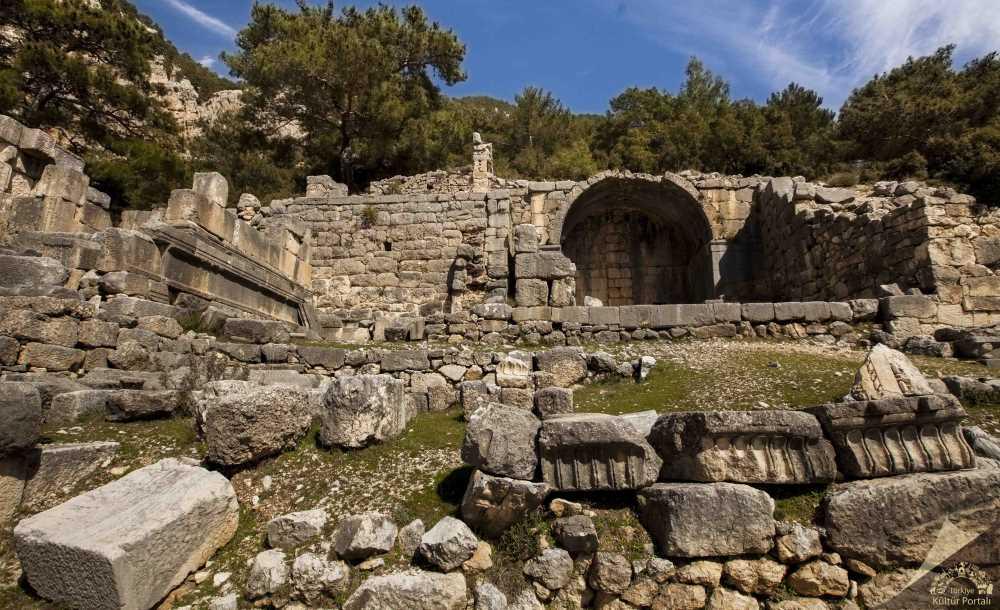
Arykanda Ancient City Bouleuterion Image (Culture Portal)
The settlement layout of Arykanda follows a plan that conforms to the natural slope, spreading across successive terraces. Each terrace housed structures with distinct functions: the lowest terrace contained the agora and baths; the middle terraces featured social and cultural buildings such as the stadium, theater, and odeion; and the upper terraces accommodated religious structures and residential areas. Staircases and narrow pathways connecting the terraces were designed in accordance with the city’s topographic character.
The theater is built into the sloping terrain of the southwestern part of the city. The cavea, with approximately 20 rows of seating, is constructed directly onto the natural ground. Although the skene (stage building) and orchestra sections are largely ruined, the overall layout reflects typical Roman theater design.

Arykanda Ancient City Ancient Theater Image (Culture Portal)
The stadium, measuring 170 meters in length, is built on a narrow terrace to the east of the city. The seating areas were carved directly from local rock. Semi-circular turning areas are located at both ends of the structure. It is believed that athletic competitions and races were held in this space.
The agora is a rectangular square surrounded by colonnaded galleries. Serving as the center of trade, social interaction, and daily life in the city, the agora was intensively used especially during the Roman period.
The bath complex is located near the agora and exhibits elements of Roman thermal architecture. Functional areas such as the caldarium, tepidarium, and frigidarium have been identified. Parts of the building’s water cisterns and heating system have survived to the present day.
The odeion is a structure designed to host small-scale performances and gatherings, with a capacity of approximately 1,000 people. Adjacent to the odeion is the bouleuterion, the council chamber responsible for the city’s administrative functions. The building’s floor plan suggests the presence of an organized system of governance in the city.
One of the temples in Arykanda, located on the northeast terrace, stands out due to its architectural features. Built on a two-tiered terrace following the terrain’s incline, the structure features a Doric column arrangement and a stepped podium. The temple’s location, orientation, and architectural details support the hypothesis that it was associated with the cult of Athena. Its east-west alignment conforms to ancient sacred architectural conventions.
Three distinct necropolis areas in the city document burial traditions from different historical periods. The most densely populated necropolis is located north of the stadium. The tombs found in these areas—including sarcophagi, vaulted chamber tombs, and rock-cut tombs—are dated to both the Hellenistic and Roman periods. Reliefs and inscriptions on the tomb structures provide clues regarding family structures and social classes in the city. Some sarcophagi feature mythological scenes on their frontal panels. Rock-cut tombs are typically single-chambered and achieve a monumental appearance through columns and ornamental friezes on their façades.
Arykanda attracted the attention of Western travelers in the mid-19th century, and the first systematic documentation efforts began in the mid-20th century. Following excavations and research conducted under the supervision of Turkish archaeologists since 1971, most of the city has been documented, and several structures have undergone conservation. Today, Arykanda is open to visitors as an archaeological site under the jurisdiction of the Antalya Museum. Most structures have been preserved in their original positions, with interventions kept to a minimum.
Video Explaining Arykanda Ancient City (Habertürk TV)
Despite its location in the interior of Lycia, Arykanda Ancient City stands out as a remarkable example of an ancient settlement due to its advanced public buildings, unique terraced urban layout, and monumental tomb architecture. Supported by elements such as the theater, stadium, agora, baths, temple, and tomb structures, the terraced urban fabric continued its social and cultural development from the Hellenistic period through to the Byzantine era.
Antalya Valiliği. “Arykanda.” *Antalya Müzesi Bağlı Antik Kentler Bilgilendirme Broşürü*. Accessed June 29, 2025. http://www.antalya.gov.tr/kurumlar/antalya.gov.tr/Site/sehir_kartlari/antik_kentler/antalya_muzesi_bagli/arykanda.pdf.
Antalya İl Directorate of Culture and Tourism. "Arykanda." *Official Website of the Antalya Provincial Directorate of Culture and Tourism, Ministry of Culture and Tourism of the Republic of Turkey.* Accessed June 29, 2025. https://antalya.ktb.gov.tr/TR-67539/arykanda.html.
Ministry of Culture and Tourism. "Arykanda." *Culture Portal*. Accessed June 29, 2025. https://www.kulturportali.gov.tr/turkiye/antalya/gezilecekyer/arykanda.
Sancaktar, Hacer. “Arykanda Antik Kenti’ndeki Athena Tapınağı’nın Lokalizasyonuna İlişkin Öneriler”. Cedrus 6, June (June 2018): 359–75. Accessed June 29, 2025. https://dergipark.org.tr/tr/pub/cedrus/issue/50420/680425.
“Arykanda Antik Kenti'nin Sırları Neler?” Habertürk TV. Date Published May 30, 2020. Accessed June 29, 2025. https://youtu.be/SmLZ2z5NPP8?si=4Q4ewbGNaSR55dmy.

Location | Antalya Türkiye Finike district | ||||||||
|---|---|---|---|---|---|---|---|---|---|
Date(s) | 5th century BCE – 6th century CE | ||||||||
City Type | Terraced city located in the inland area of the Lycian cities | ||||||||
Important Structure(s) | Theatre Temple of Athena Bouleuterion Odeon Bathhouse Agora Stadium | ||||||||
Cultural Context | Member of the Lycian League, Roman period urban development works | ||||||||
No Discussion Added Yet
Start discussion for "Ancient City of Arykanda" article
Location and Natural Environment
Naming and Historical Development
Urban Planning and Terraced System
Public Buildings
Theater
Stadium
Agora
Baths
Odeion and Bouleuterion
Religious Structures
Necropolises and Tomb Architecture
Research and Conservation Efforts