This article was automatically translated from the original Turkish version.
+2 More
Period(s) | Roman Byzantine | ||||||||
|---|---|---|---|---|---|---|---|---|---|
Feature(s) | Agricultural and textile center | ||||||||
Religion(s) | Early Christianity One of the Seven Churches in the Bible | ||||||||
Excavations | Since 1962, Basilica, Colonnaded Street, Temple | ||||||||
Important Event(s) | AD 366 Battle of Thyateira | ||||||||
Thyateira is an ancient city located within the boundaries of the Akhisar district of Manisa Province in modern-day Türkiye. The modern district of Akhisar has been built entirely over the ancient city. Remains are concentrated particularly in the Tepe Mezarlığı Open-Air Site and Hastane Höyüğü. The city was established adjacent to the fertile plain watered by the river known as Lycos (Lykos, Lykus, Lycus/Gördük/Gürdük Çayı), at the northern end of the Phrygios (Phryks/Kumçayı) or Hyllos basin. It is recognized as the largest ancient settlement in northern Lydia and southern Mysia. Thyateira lay not only alongside the ancient road connecting Pergamon (Bergama) and Sardis (Salihli) but also near the main route linking Smyrna and Bithynia at a greater distance.

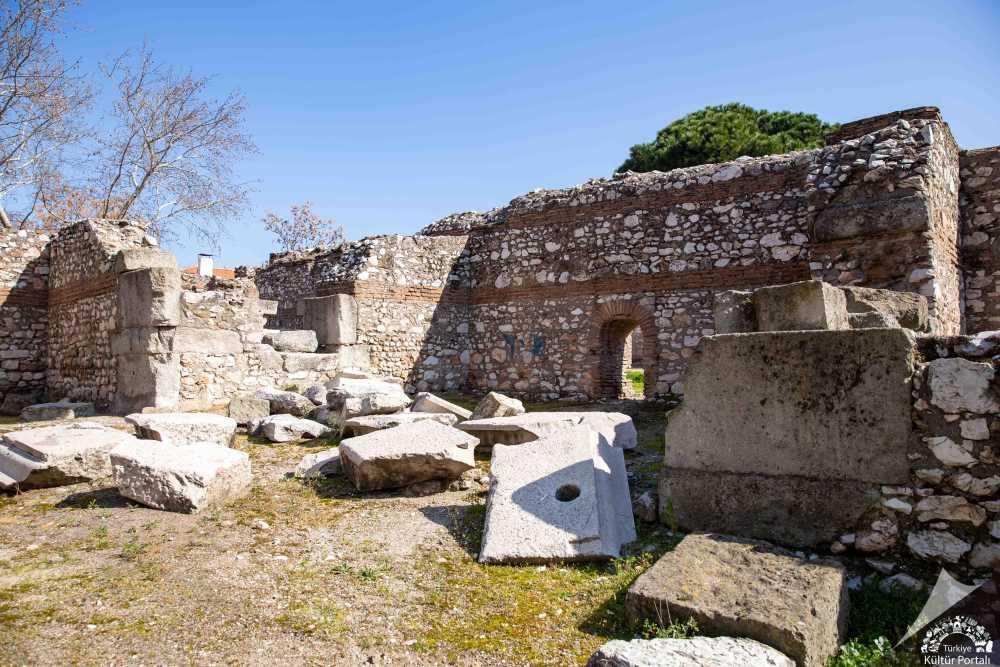
Thyateira Ancient City (Republic of Türkiye Akhisar Municipality)
Thyateira rose to prominence especially during the Roman Empire as one of the major cities of western Anatolia. The city’s economy was based primarily on agriculture and partially on industry. The most significant industry was textiles, with wool production, dyeing of wool and fabrics, and linen manufacturing being highly developed. Other common trades included fabric dyeing, pottery production, shoemaking, leatherworking, and bronze craftsmanship. A large number of epigraphic records relate to these activities.
Thyateira is recorded in the Bible as one of the seven Christian congregations. In this context, the city became a center of faith during the early periods of Christianity in western Anatolia. Consequently, from the seventeenth century onward, numerous travelers and explorers conducted studies in the city. The first serious localization study was carried out by Paul Rycault, the British representative in İzmir (1670). Various priests and travelers stationed in İzmir—including Thomas Smith, Edmund Chishull, Piton de Tournefort, and Richard Pococke—published their observations on the city. The drawings by Thomas Allom and the works of Robert Walsh in the nineteenth century hold particular visual importance. Evliya Çelebi visited Akhisar in 1671 and provided detailed information about the region.
The first archaeological excavations in Thyateira began in 1962 under the leadership of Professor Dr. Yusuf Boysal at the Tepe Mezarlığı Open-Air Site. Between 1968 and 1971, excavations conducted by archaeologist Rüstem Duyuran revealed a basilica-like structure with an apse from the Roman and Byzantine periods, as well as a colonnaded street. Since 2011, excavations have been continued by a team led by Professor Dr. Engin Akdeniz on behalf of Dokuz Eylül University. At Hastane Höyüğü, findings spanning from the Late Neolithic and Early Chalcolithic periods through to antiquity have been uncovered.
Among the remains at Tepe Mezarlığı is an apsidal basilica dated to the second to sixth centuries CE. The walls of the structure reach a height of four to five meters; its plan is rectangular with a northern apse. The width is approximately ten meters and the length about forty-three meters. To the west of the building are square or rectangular rooms and spaces. In the area, mosaics, frescoes, ceramic fragments, and Roman coins have been recovered.
The north-south oriented colonnaded street from the Roman period extends from Tepe Mezarlığı northward to Hastane Höyüğü. The street is 9.83 meters wide; the column bases and capitals are dated to the second century CE. Two types of column capitals have been identified: Ionic volute capitals and various decorative motifs.
The temple structure uncovered at Hastane Höyüğü was constructed using dasite blocks and covered with marble cladding. The building was erected in the second century BCE and repaired twice during the Roman period. It was in use until the fifth century CE, after which a Byzantine structure was built atop the mound and the surrounding area was used as a necropolis.

Thyateira Ancient City (Akhisar Municipality, Republic of Türkiye)
In 366 CE, Thyateira was the site of a battle between the forces of Procopius, a Cilician commander who rebelled for the Roman throne, and those of Valens, brother of the legitimate heir Valentinian I. Valens’s forces emerged victorious, and Procopius was executed.
Remains of the ancient city of Thyateira, particularly at the Tepe Mezarlığı Open-Air Site, are open to visitors. In the first six months of 2019, this site was visited by 11,282 people. Artifacts uncovered during excavations are exhibited in the Manisa and Akhisar museums. Restoration work began in 2019 and was planned for completion in 2020.
Akdeniz, E. Thyateira Kazısı. *Türkiye Turizm Ansiklopedisi*. 2020. Accessed June 21, 2025. https://turkiyeturizmansiklopedisi.com/thyateira-kazisi
T.C.Akhisar Belediyesi. *Thyateira*. Accessed June 21, 2025. https://www.akhisar.bel.tr/akhisar/thyateira

Period(s) | Roman Byzantine | ||||||||
|---|---|---|---|---|---|---|---|---|---|
Feature(s) | Agricultural and textile center | ||||||||
Religion(s) | Early Christianity One of the Seven Churches in the Bible | ||||||||
Excavations | Since 1962, Basilica, Colonnaded Street, Temple | ||||||||
Important Event(s) | AD 366 Battle of Thyateira | ||||||||
No Discussion Added Yet
Start discussion for "Ancient City of Thyateira" article
Historical Development and Economy
Religious and Cultural Significance
Archaeological Excavations
Architectural and Archaeological Findings
The Battle of Thyateira
Visitation and Conservation