

Generated with YZ
Andrei Tarkovsky
Eş | Larisa Tarkovskaya (1970–1986) Irma Raush (1957–1970) | ||||||||
|---|---|---|---|---|---|---|---|---|---|
Name(s) | Andrei Arsenyevich Tarkovsky | ||||||||
Birth | April 4, 1932, Zavrazhye, Russia | ||||||||
Death | December 29, 1986, Paris, France | ||||||||
Education | Moscow State Institute of Cinematography (VGIK) | ||||||||
Child | Andrei Tarkovsky Jr. | ||||||||
Important Films | Ivan’s Childhood (1962), Andrei Rublev (1966), Solaris (1972), Mirror (1975), Stalker (1979), Nostalghia (1983), The Sacrifice (1986) | ||||||||
Award(s) | Berlin Golden Bear (1962) Cannes Special Jury Prize (1986) Cannes Best Director (1983) | ||||||||
Andrei Arsenyevich Tarkovsky (1932–1986) is a director who gained prominence in the second half of the 20th century for his formal innovations and personal narrative techniques in cinema history. His filmography is shaped around themes of time memory nature and spirituality. According to academic consensus his cinema focuses more on visual thought than on narrative and on the continuity of human experience rather than on plot structure.
Tarkovsky’s films stand out for their long-take sequences that expand the boundaries of cinematic storytelling and for their balance of silence and natural elements. His career which began in the Soviet Union during the 1960s continued during his years of exile in Europe. Although his works did not directly confront the political conditions of the time their content which emphasized the spiritual dimension of human existence became the subject of ideological debates.
The director’s artistic approach is defined by viewing cinema not merely as a visual medium but as a field through which time and consciousness are reflected. His works aim to represent thought visually alongside the treatment of rhythm and movement.
Andrei Tarkovsky was born in 1932 in the village of Zavrazhye in Russia. His father Arseny Tarkovsky was one of the distinguished poets of his era; this provided Tarkovsky with an environment steeped in literature and art from childhood. His family’s cultural interests laid the foundation for the symbolic storytelling that would later occupy a central place in his cinema.
Tarkovsky received training in music and painting in Moscow before enrolling at the Gerasimov Institute of Cinematography (VGIK). There he studied film theory and practice under the guidance of director Mikhail Romm. His student films revealed experiments with visual balance space and silence.
Between 1956 and 1960 he worked on several short films. His graduation film The Steamroller and the Violin (1961) attracted attention for its visual rhythm and poetic approach seen through a child’s perspective. This film contains the earliest indications of themes that would become enduring elements in Tarkovsky’s cinema.
Tarkovsky’s first feature film Ivan’s Childhood (1962) explores the impact of war on children. The film won the Golden Bear at the Berlin Film Festival and established the director’s international reputation. This work presents the contrast between the destructiveness of war and the loss of innocence through a minimalist narrative.
Andrei Rublev (1966) interrogates the relationship between faith creation and freedom through the life of a 15th century icon painter. The film was subject to prolonged censorship and was only permitted for limited release by Soviet authorities in a shortened form. Solaris (1972) adapted from Stanisław Lem’s novel examines human consciousness guilt and memory within a science fiction framework.
Zerkalo (The Mirror 1975) is one of the director’s most personal films. It carries autobiographical traits weaving together childhood memories family relationships and historical ruptures. Stalker (1979) while based on a literary adaptation treats themes of faith hope and human search in allegorical form. Nostalghia (1983) and Offret (The Sacrifice 1986) are his final films made during his period of exile.
Tarkovsky described cinema as “the art of sculpting time.” Long takes slow pacing and the use of natural sounds are defining features of his films. His desire to depict the flow of time within the film without interruption lies at the heart of his rhythmic structure.
Natural elements such as water fire trees and earth appear frequently in his films. These elements create atmosphere and carry symbolic meaning. Light is regarded as a tool that blurs the boundaries between dream and reality. These elements are particularly prominent in The Mirror and Stalker.
Characters in his films are typically silent; visual narration dominates over dialogue. Musical choices are rhythmically attuned to the imagery. These characteristics demonstrate that Tarkovsky’s cinematic language is grounded not in plot narration but in emotional and intellectual intensity.

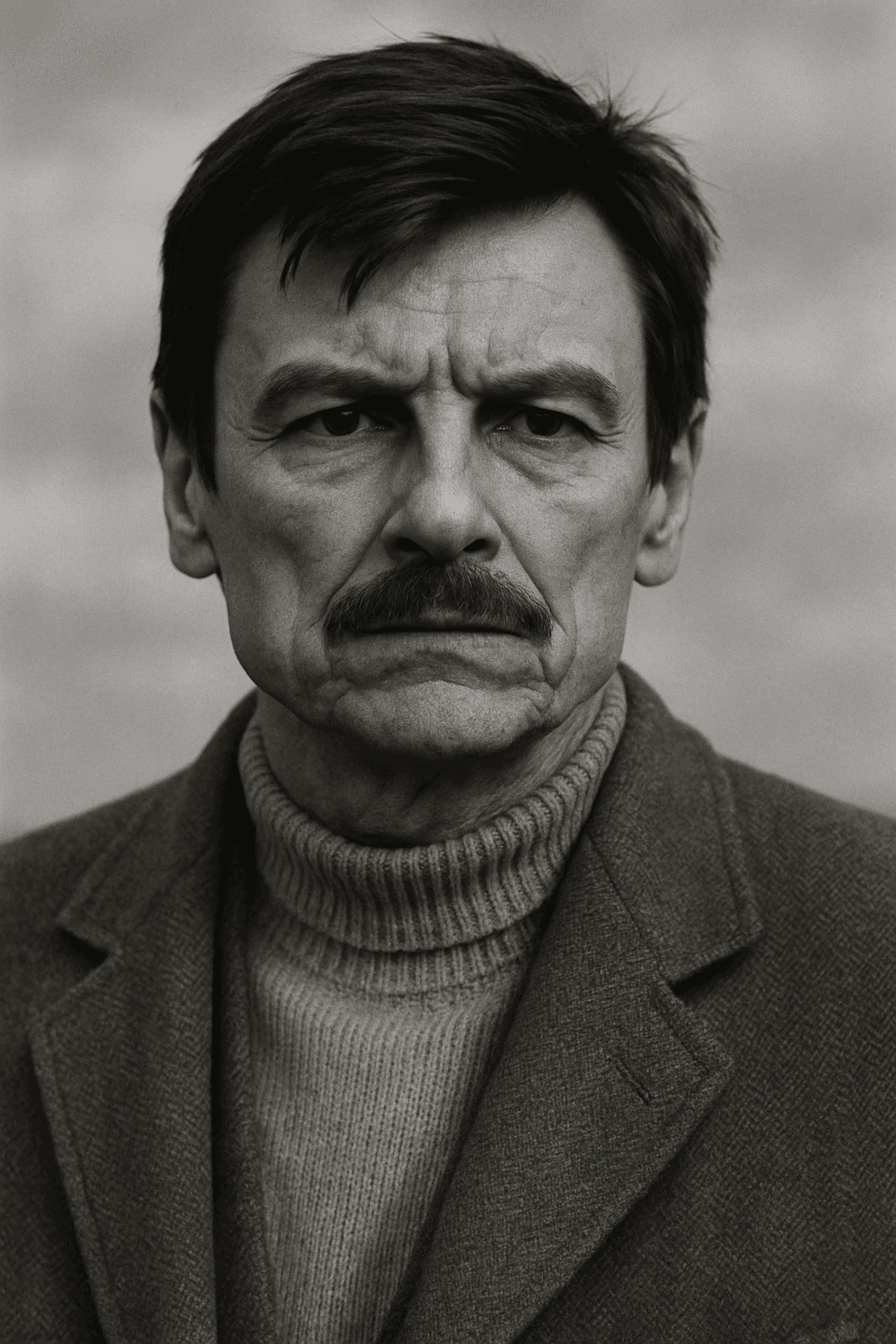
Andrei Arsenyevich Tarkovsky (Generated by Artificial Intelligence)
Tarkovsky married Irma Raush in 1957. They had a son named Andrei Tarkovsky Jr. Later he lived with his second wife Larisa Tarkovskaya who served as assistant producer on many of his films. His family remained a constant source of support for his cinematic work.
The director also engaged in writing during his personal life. In his diaries he recorded observations on the creative process time and spiritual balance. These notes were published after his death and have become an important resource for film historians and researchers.
Throughout his career Tarkovsky experienced various ideological disagreements with Soviet authorities. His frequent exploration of religious philosophical and individual themes led to periodic restrictions on production permits. This situation eventually prompted him to leave his homeland and produce films in Italy and Sweden.
In the early 1980s Tarkovsky moved to Italy and began living abroad. Nostalghia (1983) which he made during this period deals with spiritual longing experienced in a foreign country. The film won the award for Best Director at the Cannes Film Festival. The Sacrifice (1986) was filmed in Sweden and completed shortly before the director’s death.
During his years of exile Tarkovsky’s health deteriorated. He died in Paris in 1986 from lung cancer. He is buried in the Sainte-Geneviève-des-Bois cemetery near Paris. After his death his works were honored through various retrospectives and his writings were published.
After Tarkovsky’s death his son Andrei Tarkovsky Jr. led efforts to preserve and archive his legacy. The director’s manuscripts photographs and notebooks have been made accessible online.
Andrei-Tarkovsky.com. "Biography." *Andrei-Tarkovsky.com.* Accessed October 9, 2025. https://andrei-tarkovsky.com/bio.html
Andrei-Tarkovsky.com. "Films." Andrei-Tarkovsky.com. Accessed October 9, 2025. https://andrei-tarkovsky.com/films.html
Andrei-Tarkovsky.com. "Writings." Andrei-Tarkovsky.com. Accessed October 9, 2025. https://andrei-tarkovsky.com/writings.html
Andrei-Tarkovsky.com. “Homepage.” Andrei-Tarkovsky.com. Accessed October 9, 2025. https://andrei-tarkovsky.com/
Bakırcılar, Günay. “Sinema ve Resim Sanatının Kesişen Noktası: Andrei Tarkovski.” Art-E Sanat Dergisi 17, no. 34 (2024): 1056–1079. Accessed October 9, 2025. https://dergipark.org.tr/tr/download/article-file/4200609
Cinephilia Beyond. "The Exile and Death of Andrei Tarkovsky." Cinephilia Beyond. Accessed October 9, 2025. https://cinephiliabeyond.org/the-exile-and-death-of-andrei-tarkovsky/
Daily Sabah. “Andrei Arsenevich Tarkovsky: Russian Auteur with Legacy of Distinctive Time Film Aesthetics.” Accessed October 9, 2025. https://www.dailysabah.com/arts/portrait/andrei-arsenevich-tarkovsky-russian-auteur-with-legacy-of-distinctive-time-film-aesthetics
Duyar, Süleyman. “Tarkovski: Bir Auteur’ün Yaşamı, Sanatı ve Filmleri.” TİRÂD Tirebolu İletişim Fakültesi Akademik Dergisi 1, no. 2 (July 2024). Accessed October 9, 2025. https://dergipark.org.tr/tr/download/article-file/4002117
IMDb. "Andrei Tarkovsky – Biography." IMDb. Accessed October 9, 2025. https://www.imdb.com/name/nm0001789/bio/?ref_=nm_ov_at_pop_2
IMDb. "Andrei Tarkovsky – Media." Accessed October 9, 2025. https://www.imdb.com/name/nm0001789/mediaindex/?ref_=nm_ov_at_pop_3
IMDb. "Andrei Tarkovsky – Quotes." Accessed October 9, 2025. https://www.imdb.com/name/nm0001789/quotes/?ref_=nm_ov_at_dyk_1
IMDb. "Andrei Tarkovsky." IMDb. Accessed October 9, 2025. https://www.imdb.com/name/nm0001789/
IMDb. “Andrei Tarkovsky – Awards.” IMDb. Accessed October 9, 2025. https://www.imdb.com/name/nm0001789/awards/?ref_=nm_ov_at_pop_4
Letterboxd. “Andrei Tarkovsky.” Letterboxd. Accessed October 9, 2025. https://letterboxd.com/director/andrei-tarkovsky/
MUBI. "Andrei Tarkovsky." MUBI. Accessed October 9, 2025. https://mubi.com/tr/cast/andrei-tarkovsky
New Yorker. "The Drenching Richness of Andrei Tarkovsky." New Yorker. Accessed October 9, 2025. https://www.newyorker.com/magazine/2021/02/15/the-drenching-richness-of-andrei-tarkovsky
Rotten Tomatoes. “Andrei Tarkovsky.” Rotten Tomatoes. Accessed October 9, 2025. https://www.rottentomatoes.com/celebrity/andrei_tarkovsky
Senses of Cinema. "Andrei Tarkovsky." Senses of Cinema. Accessed October 9, 2025. https://www.sensesofcinema.com/2002/great-directors/tarkovsky/
The Culturium. “Andrei Tarkovsky: Cinematic Genius.” The Culturium. Accessed October 9, 2025. https://www.theculturium.com/andrei-tarkovsky-cinematic-genius/
The Guardian. “Andrei Tarkovsky.” The Guardian. Accessed October 9, 2025. https://www.theguardian.com/film/andrei-tarkovsky
İkbal Bozkurt Avcı and Derya Çetin. “Andrey Tarkovsky Sinemasında Zaman-İmgesi: Ayna.” Akdeniz Üniversitesi İletişim Fakültesi Dergisi 37 (2022): 319–335. Accessed October 9, 2025. https://dergipark.org.tr/tr/download/article-file/2278887

Generated with YZ
Andrei Tarkovsky
Eş | Larisa Tarkovskaya (1970–1986) Irma Raush (1957–1970) | ||||||||
|---|---|---|---|---|---|---|---|---|---|
Name(s) | Andrei Arsenyevich Tarkovsky | ||||||||
Birth | April 4, 1932, Zavrazhye, Russia | ||||||||
Death | December 29, 1986, Paris, France | ||||||||
Education | Moscow State Institute of Cinematography (VGIK) | ||||||||
Child | Andrei Tarkovsky Jr. | ||||||||
Important Films | Ivan’s Childhood (1962), Andrei Rublev (1966), Solaris (1972), Mirror (1975), Stalker (1979), Nostalghia (1983), The Sacrifice (1986) | ||||||||
Award(s) | Berlin Golden Bear (1962) Cannes Special Jury Prize (1986) Cannes Best Director (1983) | ||||||||
Education and Early Years
Film Career and Themes
Artistic Approach and Style
Personal Life
Exile Years and Death