

This article was automatically translated from the original Turkish version.
+1 More
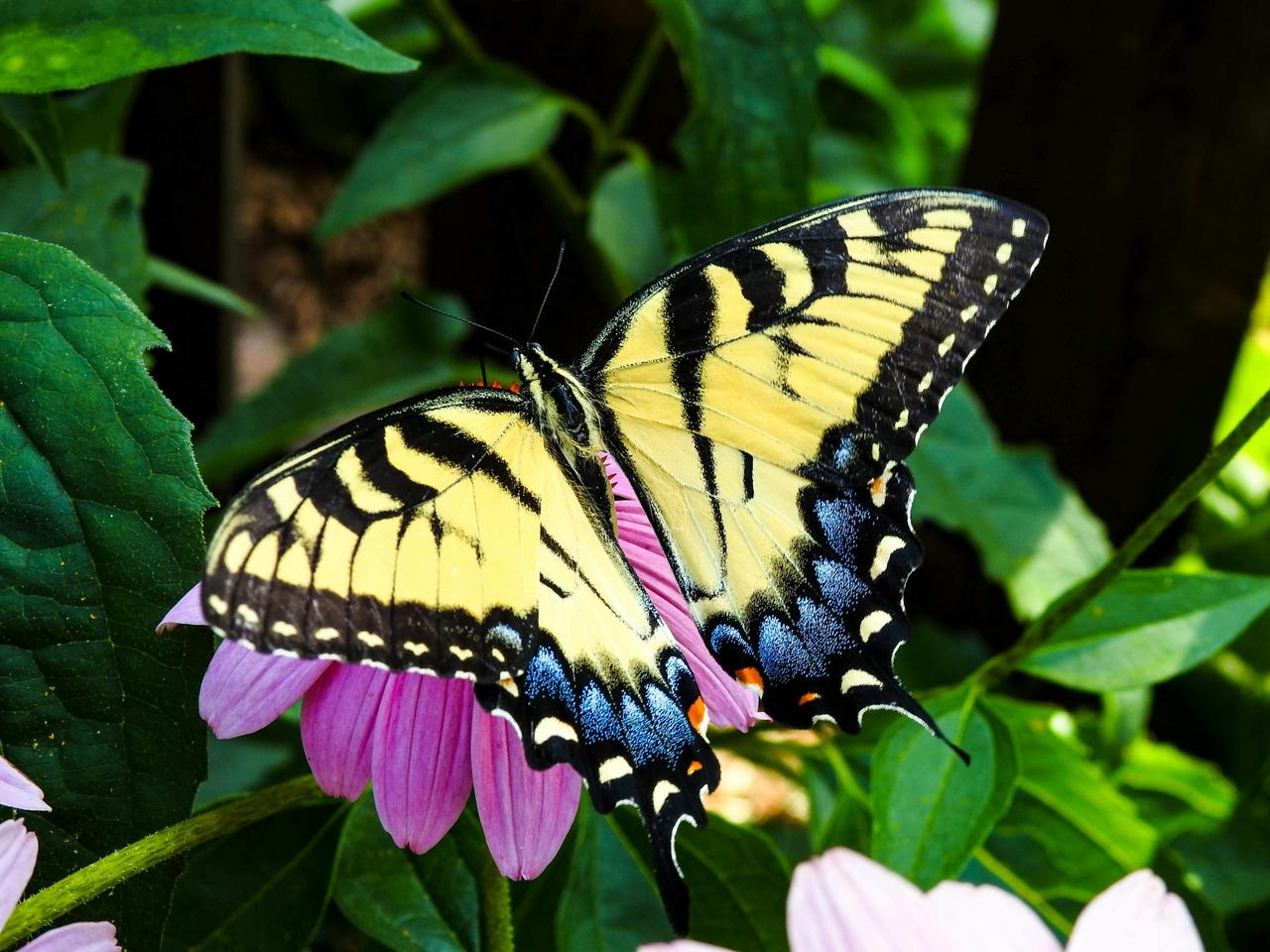
Anise Swallowtail (Papilio alexanor)
Türkiye Distribution | Aegean, Western and Eastern Mediterranean, Southeastern Anatolia; (specific records exist from Balıkesir, Manisa, Antalya and Ankara) | ||||||||
|---|---|---|---|---|---|---|---|---|---|
World Distribution | Mediterranean Basin, Middle East, North Africa, Western Asia, Western and Central Asia | ||||||||
Distinctive Pattern | On the forewings, a long and two short black stripes resembling a tiger's coat; long tails at the hindwing margins | ||||||||
General Color | Yellow or yellowish-white | ||||||||
Wingspan | 70-80 mm | ||||||||
Habitat | Roadside edges rocky areas valley slopes open and stony slopes | ||||||||
Anise Swallowtail (Papilio alexanor) is a large species of butterfly belonging to the family Papilionidae. It was first described in 1800 by Eugen Johann Christoph Esper. Its wingspan ranges from 70 to 80 mm. The wing color is typically whitish-yellow or bright yellow; on the forewings, one long and two short black stripes resembling a tiger pattern are prominent. The hindwings feature long, slender tail projections characteristic of the family. The species is taxonomically divided into several subspecies and is distributed across southern Europe and western Asia.

Anise Swallowtail (Papilio alexanor)
The life cycle of the species consists of egg, larva (caterpillar), pupa and adult stages. The eggs of the Anise Swallowtail are initially pale greenish-white with a pearl-like appearance but turn milky brown during development. The caterpillars are characterized by a green or yellow background with black stripes and red spots.
The host plants on which the caterpillars feed include species from the Apiaceae family such as Opopanax chironium, Seseli montanum, Ferula communis (giant fennel), Carum carvi (caraway), and Pimpinella saxifraga. It has also been observed feeding on wild celery, dill and parsley species in nature. The species overwinters in the pupal stage, and the pupae are surrounded by a silken girdle structure. The flight period of adults varies depending on the altitude and climatic conditions of their location.
The Anise Swallowtail exhibits different feeding habits during different stages of its life cycle. During the larval (caterpillar) stage, it primarily feeds on plant leaves. In this stage, the leaves of certain trees and shrubs serve as an important food source. Caterpillars consume young, nutrient-rich leaves to support their growth and development.
Adults mainly feed on nectar from flowers. Nectar provides the primary energy source for butterflies. The Anise Swallowtail visits a variety of flowering plants, thereby contributing to pollination. In some cases, adults have been observed feeding on liquids from moist soil, decaying plant material, or mineral-rich surfaces. This behavior helps butterflies meet their mineral requirements.
Papilio alexanor is a species native to the Palearctic region and is distributed across Asia and Europe as well as the Mediterranean coasts of North Africa and the Middle East. Globally, it has been recorded across broad areas including the Mediterranean basin, Western and Central Asia, and parts of South America. Within Türkiye, it is particularly observed in the Aegean, Western Mediterranean, Eastern Mediterranean and Southeastern Anatolia regions. Specific observation records exist for provinces such as Balıkesir, Manisa, Antalya and Ankara.
This butterfly is not highly selective in its habitat preferences and can survive at elevations up to 2,700 meters above sea level. Its primary habitats include road edges, open slopes, valley sides, and stony or rocky areas. It is actively observed during spring and summer months in areas with abundant flowering plants.
The Anise Swallowtail is one of the butterfly species playing a significant biological role in its ecosystems. While adults feed on flower nectar, they contribute to plant pollination, aiding in the preservation of plant diversity and the maintenance of ecosystem balance. Additionally, butterflies are sensitive indicators of environmental change, making them valuable indicators of habitat health. Therefore, the presence of species such as the Anise Swallowtail is important for the conservation of biological diversity.
The Anise Swallowtail may be negatively affected by factors such as habitat loss, environmental pollution and pesticide use. Therefore, protecting its habitats is of great importance. Conservation efforts are based on preserving natural vegetation, reducing chemical use in agricultural areas, and maintaining natural habitats rich in flowering plants. Furthermore, scientific research on butterfly species and nature conservation projects contribute to monitoring and protecting these species.
Ekşi Sözlük. "Kaplan Kelebeği." Accessed February 22, 2026. https://eksisozluk.com/kaplan-kelebegi--1229831
Pexels. “Doğada Güzel Kırlangıçkuyruğu Kelebeği.” Accessed February 22, 2026. https://www.pexels.com/tr-tr/fotograf/dogada-guzel-kirlangickuyrugu-kelebegi-32417282/
Thompson, J. N. “The Evolution of Diet Breadth: Monophagy and Polyphagy in Swallowtail Butterflies.” *Journal of Evolutionary Biology* 11, no. 5 (1998): 563–578. Accessed February 22, 2026. https://academic.oup.com/jeb/article/11/5/563/54083432
Wiklund, Christer, Nils Ryman, and Magne Friberg. “Local Monophagy and Between-Site Diversity in Host Use in the European Swallowtail Butterfly, *Papilio machaon*.” *Biological Journal of the Linnean Society* 123, no. 1 (2018): 179–190. Accessed February 22, 2026. https://academic.oup.com/biolinnean/article/123/1/179/4636221

Anise Swallowtail (Papilio alexanor)
Türkiye Distribution | Aegean, Western and Eastern Mediterranean, Southeastern Anatolia; (specific records exist from Balıkesir, Manisa, Antalya and Ankara) | ||||||||
|---|---|---|---|---|---|---|---|---|---|
World Distribution | Mediterranean Basin, Middle East, North Africa, Western Asia, Western and Central Asia | ||||||||
Distinctive Pattern | On the forewings, a long and two short black stripes resembling a tiger's coat; long tails at the hindwing margins | ||||||||
General Color | Yellow or yellowish-white | ||||||||
Wingspan | 70-80 mm | ||||||||
Habitat | Roadside edges rocky areas valley slopes open and stony slopes | ||||||||
No Discussion Added Yet
Start discussion for "Anise Swallowtail (Papilio alexanor)" article
Biological Life Cycle and Host Plants
Feeding
Geographical Distribution and Habitat Characteristics
Importance
Conservation