


This article was automatically translated from the original Turkish version.
+1 More
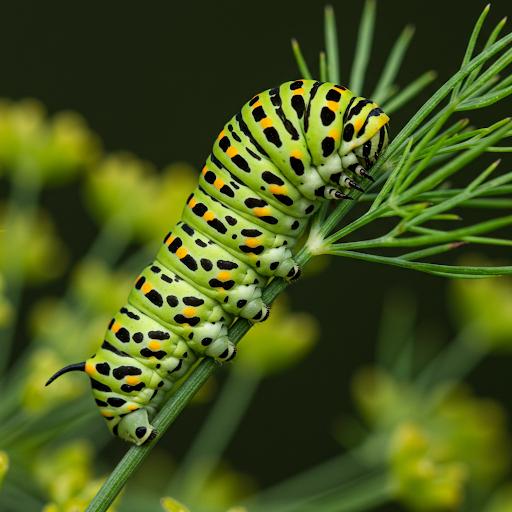
Crimson-winged Butterfly Larva
Regions Where It Is Observed in the World | Europe, the Mediterranean coasts, Asia, and North America. | ||||||||
|---|---|---|---|---|---|---|---|---|---|
Regions Where It Is Observed in Türkiye | Marmara, Aegean, Mediterranean, Thrace and Central Anatolia. | ||||||||
Swallowtail butterfly (Papilio machaon) is a species found in Türkiye common and is known for its elegant wing structure. This butterfly is particularly notable during its caterpillar stage. The caterpillar stands out not only by its appearance but also by its survival strategies and defense mechanisms.
The swallowtail butterfly reproduces when the female lays her eggs on the leaves of mansion plants. These plants are typically members of the Apiaceae family (also known as Umbelliferae), including wild carrot, celery, and parsley such as. The eggs are usually placed on the underside of the leaves. Initially greenish or yellow-gray in color, they gradually change to reddish-brown and bluish tones. The presence of small shells on the eggs indicates that the young caterpillar has hatched.
The newly hatched caterpillar is black and covered with red warts. It also has a large white spot on its back. As the caterpillar grows, a significant change occurs in its coloration. It transitions from black to green and develops black transverse stripes during this process. Orange-red spots appear along these stripes. The morphological development of the caterpillar is rapid and typically lasts 15–16 days. The developing caterpillar feeds by chewing the leaves of its host plants. The nutrition behavior of the caterpillar plays a crucial role in the species’ survival. As it grows, it may share food resources with other caterpillars in its environment or consume shed skin remnants.
One of the most striking defense mechanisms of the swallowtail caterpillar is the osmetrium, a paired, forked, horn-like organ located in the head region behind its head. When threatened, the caterpillar extrudes this structure. The osmetrium is orange in color and secretes a highly pungent fluid. This fluid serves as a defensive weapon, providing effective protection against potential predators. This defense mechanism is critical to the caterpillar’s survival.
Young caterpillars actively use this mechanism, but as they mature and cease feeding prior to pupation, they stop using the osmetrium. This is due to limited energy reserves and reduced need for defense at this stage.
After completing the caterpillar stage, the swallowtail larva enters the pupa stage before transitioning to its final developmental phase. During this stage, the caterpillar attaches itself to the stem of its host plant or nearby shrubs and transforms into a pupa. Pupae become more resistant to external environmental factors and adapt to their surroundings through color changes. In Summer months, pupae are typically green or yellowish with small black spots. In Winter months, they turn brown and develop prominent horns at the head end.
The duration of the pupal stage varies according to environmental conditions. In central Europe, the pupal stage lasts approximately 2–3 week, but in pupae that enter winter dormancy, this period can extend to several months. Throughout the pupal stage, internal transformations continue until the adult butterfly emerges.
Both its external appearance and survival strategies contribute to the species’ success in nature. The osmetrium organ protects the caterpillar from predators, while the color changes during the pupal stage enable adaptation to environmental conditions, opportunity its survival.
Bilim Genç. "Türkiye’nin Kırlangıçkuyruk Kelebekleri." TÜBİTAK, 2024. Accessed April 15, 2025. Link
Kelebek Türk. “Kırlangıçkuyruk (Papilio machaon Linnaeus, 1758).” KelebekTürk, 2024. Accessed April 15, 2025. Link
The Plant Native. "What Is a Host Plant?" The Plant Native. Updated 2024. Accessed April 15, 2025. Link

Crimson-winged Butterfly Larva
Regions Where It Is Observed in the World | Europe, the Mediterranean coasts, Asia, and North America. | ||||||||
|---|---|---|---|---|---|---|---|---|---|
Regions Where It Is Observed in Türkiye | Marmara, Aegean, Mediterranean, Thrace and Central Anatolia. | ||||||||
No Discussion Added Yet
Start discussion for "Caterpillar of the Swallowtail Butterfly" article
Hatching from the Egg
Osmetrium
Pupa