This article was automatically translated from the original Turkish version.
+1 More
Location | Ankara Türkiye | ||||||||
|---|---|---|---|---|---|---|---|---|---|
Foundation | 2007 | ||||||||
Feature(s) | Traditional agricultural tools 1961 domestic HSG tractor laboratory equipment | ||||||||
Number of Visitors | Approximately 4,000 per year | ||||||||
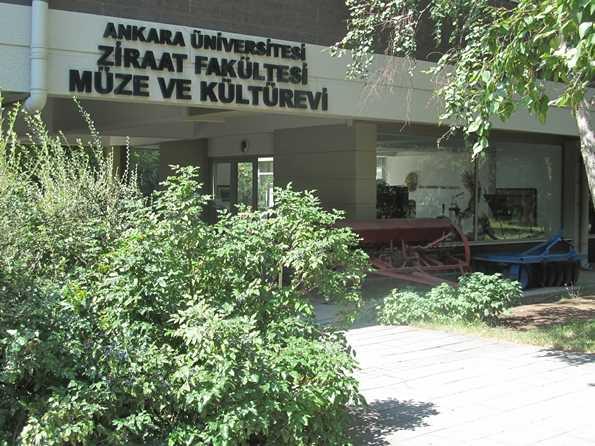
The Museum and Cultural House of Ankara University Faculty of Agriculture was opened on 21 November 2007. The museum is a center that reflects the historical development of agricultural higher education in Türkiye and preserves the legacy of pioneering institutions in this field. The institutional origins of the museum extend back to the Agricultural School established in Halkalı Istanbul in 1892, the Shepherd School opened in Ankara Kalaba in 1898, and the Higher Institute of Agriculture founded in 1933. These three institutions form the foundational pillars of modern agricultural education in Türkiye.
The museum building is two stories high. On the ground floor, two large halls display traditional and modern agricultural tools. The upper floor consists of ten rooms and a corridor. Scientific instruments, laboratory equipment, academic publications, and documents are systematically exhibited in this section. The exhibition layout is organized chronologically to create a narrative spanning from the past to the present.
The ground floor features numerous tools used in agriculture in the past. These include hand tools such as the hand hoe, sickle, yaba, and threshing flail, as well as machines such as the grape crusher, plow, motorized cultivator, combine harvester, seed crusher, and tracked tractor. One of the museum’s most notable exhibits is the HSG Tractor, entirely manufactured in Türkiye using local materials between 1961 and 1962. This tractor was developed by faculty members of the Department of Agricultural Machinery and stands as one of the earliest examples of domestic tractor production in Türkiye.
The upper floor is equipped with instruments and materials that reflect the scientific dimension of agricultural education. This section displays laboratory equipment such as water baths, desiccators, densimeters, hand centrifuges, precision balances, microscopes, graduated cylinders, and flame photometers. Additionally, a Kjeldahl protein analysis apparatus from 1960, distillation apparatuses, and various glassware are exhibited. These instruments were actively used in practical training for students in the past.
The museum is not limited to technical and academic instruments; it also documents the cultural dimension of agricultural education. A carpet weaving loom donated from the School of Home Economics, various handcrafted items related to agricultural production, rare books from the period of the Higher Institute of Agriculture, student journals, and archival documents enrich the collection. A photograph from 1939 showing students playing ice hockey offers an interesting glimpse into the social aspects of education.
The museum is visited by approximately four thousand people annually. The majority of visitors are primary, middle, and high school students. During scheduled educational tours, students are taught how the instruments and equipment in the museum were used. The historical development of agricultural education is presented through visual and narrative content. At the end of the tours, students are given seeds and cups to participate in simple activities that encourage engagement with agriculture.
Ankara Üniversitesi Ziraat Fakültesi Müze ve Kültür Evi (Ankara University Faculty of Agriculture)
Ankara University Faculty of Agriculture. "Ankara Üniversitesi Ziraat Fakültesi Müze ve Kültür Evi." YouTube. Accessed August 16, 2025. https://www.youtube.com/watch?v=uCoyQgkmsuQ
Türkiye Kültür Portalı, Ministry of Culture and Tourism. "Ankara Üniversitesi Ziraat Fakültesi Müzesi." *Türkiye Kültür Portalı*. Accessed August 16, 2025. https://www.kulturportali.gov.tr/turkiye/ankara/gezilecekyer/ankara-unverstes-zraat-fakultes-muzes
Çakır İlhan, Ayşe. “Ankara Üniversitesi Ziraat Fakültesi Müze ve Kültür Evi.” *Türkiye Turizm Ansiklopedisi.* Accessed August 16, 2025. https://turkiyeturizmansiklopedisi.com/ankara-universitesi-ziraat-fakultesi-muze-ve-kultur-evi
Location | Ankara Türkiye | ||||||||
|---|---|---|---|---|---|---|---|---|---|
Foundation | 2007 | ||||||||
Feature(s) | Traditional agricultural tools 1961 domestic HSG tractor laboratory equipment | ||||||||
Number of Visitors | Approximately 4,000 per year | ||||||||
No Discussion Added Yet
Start discussion for "Ankara University Faculty of Agriculture Museum and Culture House" article
Architectural Structure and Layout
Ground Floor – Agricultural Machinery and Traditional Tools
Upper Floor – Laboratory and Educational Equipment
Scientific and Cultural Collection
Educational Activities and Visitor Profile