


This article was automatically translated from the original Turkish version.
+1 More
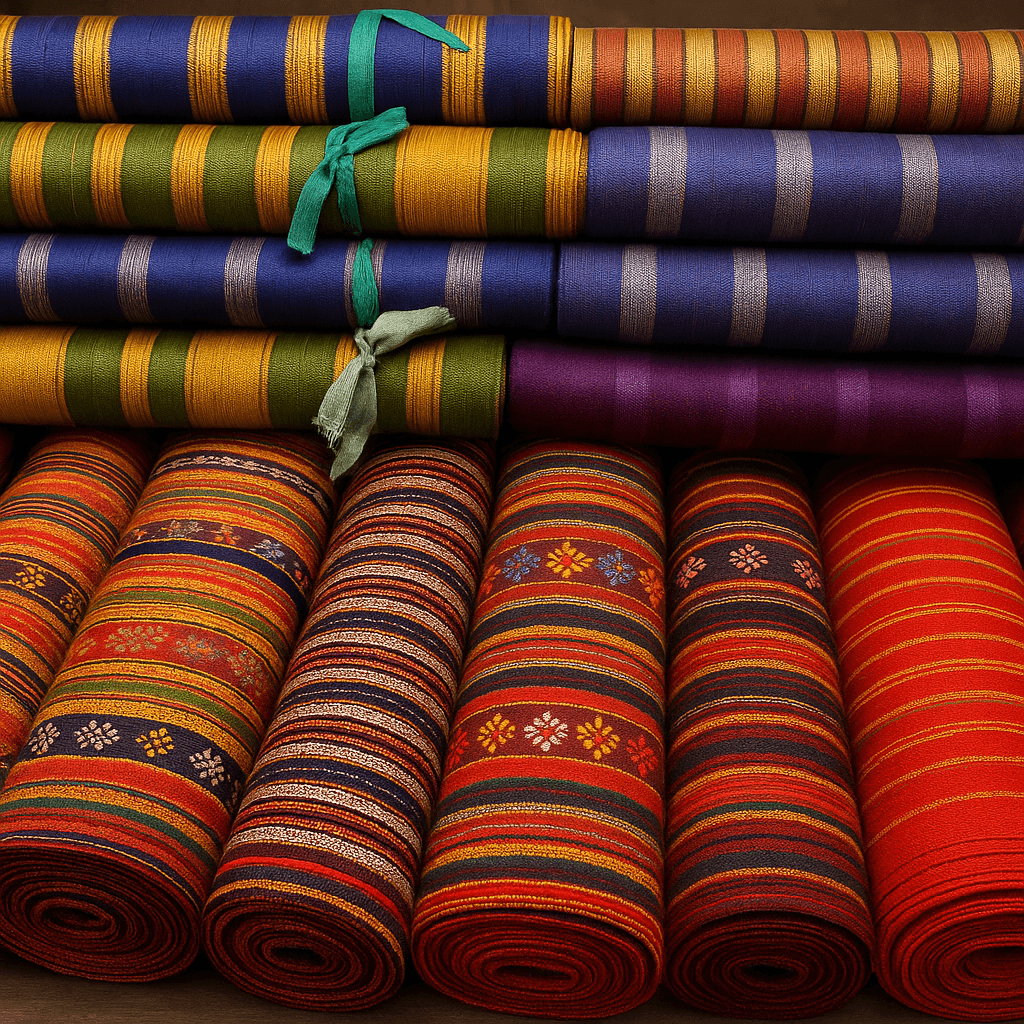
Antep Kutnu Fabric
Type of Geographical İndication | Mahreç Sign | ||||||||
|---|---|---|---|---|---|---|---|---|---|
File Number | C2015/009 | ||||||||
Application Date | 2015-01-19 | ||||||||
Registration Number | 199 | ||||||||
Registration Date | 2016-08-25 | ||||||||
Product / Product Group(s) | Textiles | ||||||||
Province(s) | Gaziantep | ||||||||
Applicant/Registrant(s) | Gaziantep Development Foundation | ||||||||
Status | Registered | ||||||||
Antep kutnu fabric is a type of satin fabric produced and used for centuries in Gaziantep, typically woven using warp satin or tabby weave techniques, featuring longitudinal striped patterns. Historically, the warp was made of fine silk, while the weft consisted of a cotton-silk blend, predominantly creating a “yollu” (longitudinally striped) fabric. Over time, artificial silk (floş) yarn began to be used for the warp and cotton yarn for the weft.
In Türkiye, it is the only silk fabric woven entirely on handlooms (though more advanced armure and jacquard looms are now also employed), exclusively in Gaziantep. Made from artificial silk (floş) and cotton yarn, it contains no synthetic materials, making it a healthy fabric type.

Longitudinal Striped Patterns: Composed of longitudinal stripes formed by colored warp threads. The width, color, and pattern of these stripes vary.
Silky and Lustrous Appearance: Due to its satin weave and production techniques—particularly cendereleme—it has a glossy surface. It is noted that the golden-yellow hue imparts a natural luster to the fabric.
Materials: The warp uses fine silk (in early periods) or artificial silk (floş) yarns of 100, 120, or 150 denier; the weft typically uses two-ply cotton yarn of 20/NE.
Naturalness and Healthiness: The raw materials are artificial silk and cotton; the absence of synthetic substances makes it a healthy fabric. Natural kitre zamp resin, derived from the apricot tree, is used as a sizing agent.
Weave Structure: Depending on fabric thickness and fineness, the number of weft threads per centimeter ranges from 10 to 12, while the number of warp threads per centimeter varies between 56 and 70. The weaves used are generally warp satin or tabby, with occasional rib weaves.
Resist-Dyeing Technique: Due to the resist-dyeing (batik) method applied to warp threads, naturally occurring patterns emerge. In this technique, threads are tied according to the desired pattern, and dyeing proceeds from dark to light tones.
Variety: Variants include “kutnu fabric,” “meydaniye kutnu fabric,” and “alaca kutnu fabric,” depending on weft density and warp characteristics. Additionally, more than 60 named varieties exist based on the width, color, and pattern of the colored warp stripes (e.g., Mecidiye, hindiye, zencirli, sedefli).
This fabric is used in regional clothing, folk dance costumes, scarves, vests, shirts, ties, bags, and decorative items such as curtains and upholstery. It is also recorded that Ottoman sultans had garments made from it.

The craft of weaving kutnu fabric is known as kutnuculuk, and its production involves multiple stages.
Unwinding: Warp yarns in bobbin form are wound onto four-armed cabinets called “devere,” covering approximately 16 m², to form “çile.” To prevent tangling, the yarns are secured with “bağlık” or “çapraz” threads; the prepared bundles are called “şak.”
Dyeing: Prepared çile are dyed in large vats using water, dye substances, soda, and salt. Dyeing typically lasts 30–45 minutes. Today, direct dyes are commonly used, but traditional natural dye methods and the resist-dyeing technique are still applied. In resist-dyeing, threads are tied according to the pre-determined pattern, and dyeing proceeds from dark to light tones.
Mezek: The preparation of dyed or undyed warp threads for weaving.
Sizing: Natural kitre zamp resin from the apricot tree is applied to the yarns to strengthen them, prevent breakage, and enhance luster.
Manual Opening and Combing: Sized yarns are stretched between wall rods and straightened.
Kavuk: Straightened yarns are wound onto wooden spindles called “milef,” each 50 cm long, and stored in damp bags to rest.
Preparation for Warping: Prepared “kavuk” are wound onto reels called “levent” and transferred to the loom.
Warping: Warp threads are individually passed through the heddles and reed teeth, determined by the fabric’s pattern and density.
Weft Yarn Preparation: Two-ply cotton yarn is typically used. These yarns are sized with corn, barley, or wheat starch and wound onto bobbins, which are then placed in the shuttle.
Weaving: Weaving is performed using shuttle techniques, historically on wooden whip looms and today on more advanced armure and jacquard looms.
Steaming and Sizing: The fabric is moistened with water and starch, folded, and left to rest under weight.
Cendereleme: The damp fabric is pressed between rollers in a cendere machine. This process polishes the surface and closes fabric pores. For patterned (water-path) designs, the fabric is folded in half before cendereleme.
Pressing: Several rolls of fabric are stacked and clamped in a press for one day under pressure, imparting smoothness and luster. Since all stages of production—particularly resist-dyeing and weaving—rely on craftsmanship and manual labor, they must take place within the boundaries of Gaziantep.

The geographical indication certification of Antep kutnu fabric is supervised under the coordination of the Gaziantep Chamber of Industry. Manufacturers are registered in a record book maintained by the Gaziantep Chamber of Industry. Producers are verified annually in January using trade registry, tax, and TOBB records. The Supervision Committee consists of at least three members: at least one representative from relevant committees of the Gaziantep Chamber of Industry, one appointed by the Chamber (secretariat/organization), and one appointed by the Gaziantep Provincial Directorate of Culture and Tourism. Committee members are renewed every four years. Registered firms are inspected once a year, typically during the first four months of the year. In case of a complaint, an inspection is conducted within one month from the complaint date. Inspection criteria include the suitability of materials (warp/weft yarns, sizing agent), compliance with production methods (resist-dyeing, weaves), presence of patterns (striped, resist-dyed designs), yarn densities (number of weft/warp threads), and fabric luster or sheen. Inspections and complaint evaluations are coordinated by the General Secretariat of the Gaziantep Chamber of Industry.
Anadolu Ajansı. “İplikten Kumaşa Zarafetin Adı: Kutnu.” Accessed May 27, 2025. https://www.aa.com.tr/tr/kultur-sanat/iplikten-kumasa-zarafetin-adi-kutnu/798669
Ministry of Culture and Tourism of the Republic of Türkiye. "Antep Kutnu Kumaşı." Accessed May 27, 2025. https://www.kulturportali.gov.tr/portal/antepkutnukumasi
T.C.Gaziantep İl Directorate of Culture and Tourism. "Kutnu Dokumacılığı." Accessed May 27, 2025. https://gaziantep.ktb.gov.tr/TR-100496/kutnu-dokumaciligi.html
Turkish Patent and Trademark Office. "Kutnu Kumaşı – Coğrafi İşaret Detayı." Accessed May 27, 2025. https://ci.turkpatent.gov.tr/cografi-isaretler/detay/38152
Turkish Patent and Trademark Office. "Kutnu Kumaşı – Coğrafi İşaret Tescil Belgesi." PDF document. Accessed May 27, 2025. https://ci.turkpatent.gov.tr/Files/GeographicalSigns/e5186cbf-a0d5-40b3-ac61-c57e2924c04b.pdf

Antep Kutnu Fabric
Type of Geographical İndication | Mahreç Sign | ||||||||
|---|---|---|---|---|---|---|---|---|---|
File Number | C2015/009 | ||||||||
Application Date | 2015-01-19 | ||||||||
Registration Number | 199 | ||||||||
Registration Date | 2016-08-25 | ||||||||
Product / Product Group(s) | Textiles | ||||||||
Province(s) | Gaziantep | ||||||||
Applicant/Registrant(s) | Gaziantep Development Foundation | ||||||||
Status | Registered | ||||||||
Distinguishing Features
Manufacturing Process
Supervision