

This article was automatically translated from the original Turkish version.
The Anunnaki are a pantheon of deities in Mesopotamian mythology, particularly within the religious traditions of the Sumerian, Akkadian, Babylonian, and Assyrian civilizations. The term originates from Sumerian and generally means “children of An.” Here, An refers to the supreme god of the sky, and the Anunnaki represent divine beings descended from him. This pantheon was regarded as the divine representatives of numerous structures, from the organization of the cosmos to the social hierarchy on earth.
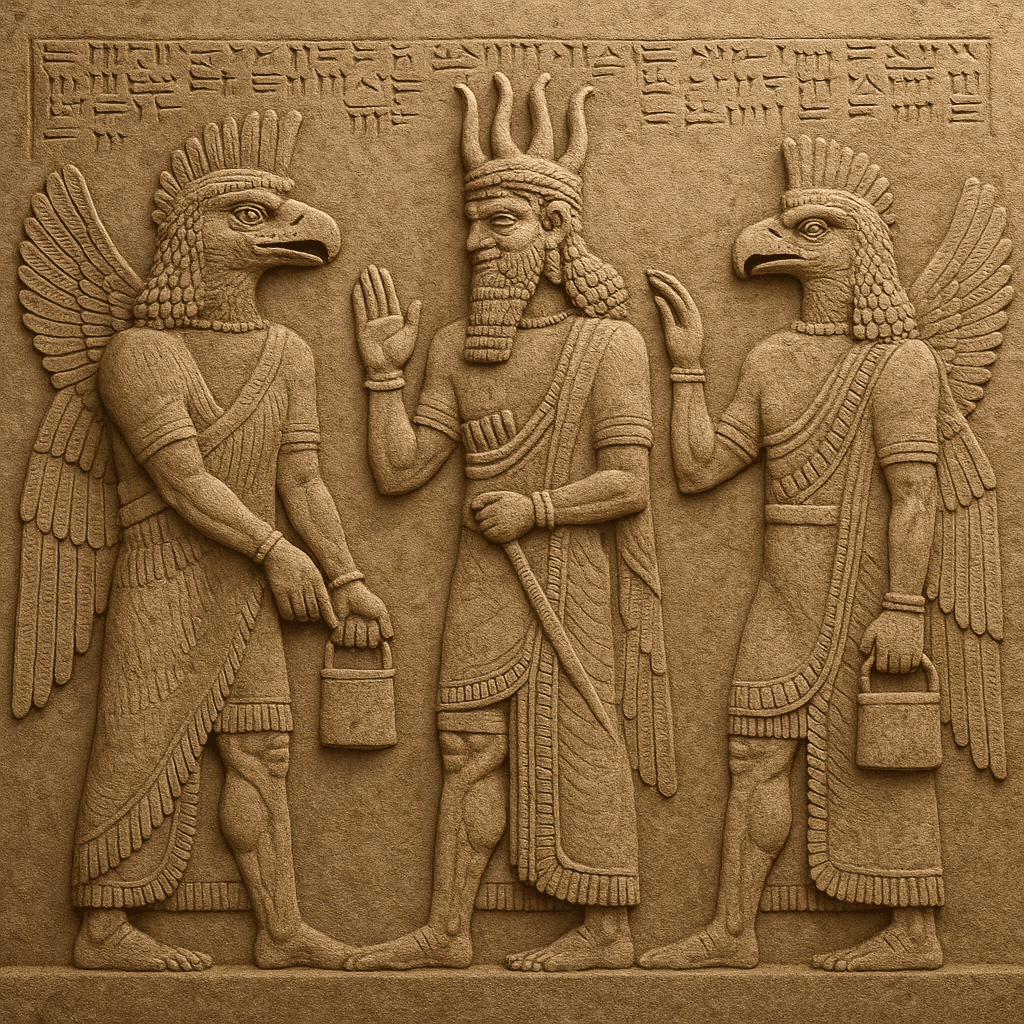
Stone Relief Depicting the Anunnaki (Generated by Artificial Intelligence)
The Sumerians’ polytheistic worldview sought to explain natural phenomena and cosmic order through divine figures. Within this framework, the Anunnaki were accepted as the deities who maintained cosmic order. Each deity represented a specific natural force or social function and served as a principal character in mythological narratives.
According to Sumerian belief, the gods formed families, married, and had children, resulting in the formation of a divine pantheon. Each Sumerian city-state had its own chief deity. For example, the city of Uruk revered Inanna; Nippur worshipped Enlil; and Eridu honored Enki as its principal god.
In Sumerian art, the Anunnaki are typically depicted as human-shaped beings adorned with divine attributes. One such attribute is the horned helmet worn on their heads. Although these deities were believed to possess extraordinary powers, these powers were limited by certain moral or cosmic laws. For instance, Sumerian myths describe the gods experiencing human emotions such as jealousy, anger, and remorse.
The Anunnaki formed a hierarchical structure within the divine pantheon. At the top stood An, the god of the sky, followed by Enlil, the god of air and earth; Enki, the god of wisdom and fresh water; and Ninhursag, the goddess of the earth. The Anunnaki subsequently appear in myths as the children and assistants of these chief deities.
Their responsibilities included:
In some narratives, the Anunnaki are also described as deities of the underworld and associated with life after death.
In Sumerian mythology, the purpose of human creation was to serve the gods. According to this belief, the Anunnaki created humans through genetic engineering under the leadership of Enki, following a rebellion among the lesser gods who were forced to perform arduous labor. This creation narrative is especially prominent in texts such as the Atra-Hasis Epic.
Rituals and worship were considered acts of service to the gods. Temples served as central places dedicated to these deities, and communication with the Anunnaki was conducted through priests. Offerings, prayers, and votive gifts were performed to appease the Anunnaki.
The Anunnaki are central to mythological accounts of creation and flood. Events such as Enlil ordering the destruction of humanity and Enki opposing this decree to save humankind reveal conflicts and divisions among the gods. The Anunnaki are frequently referenced in texts such as the Epic of Gilgamesh, the Atra-Hasis, and the Enuma Elish.
In Zecharia Sitchin’s book The Lost Book of Enki, the Anunnaki are interpreted as advanced extraterrestrial beings from the distant planet Nibiru. This interpretation claims that the Anunnaki conducted experiments on humans, created Homo sapiens through genetic intervention, and shaped ancient civilizations. However, such interpretations are not scientific but are regarded as speculative fiction and are not supported by academic sources.
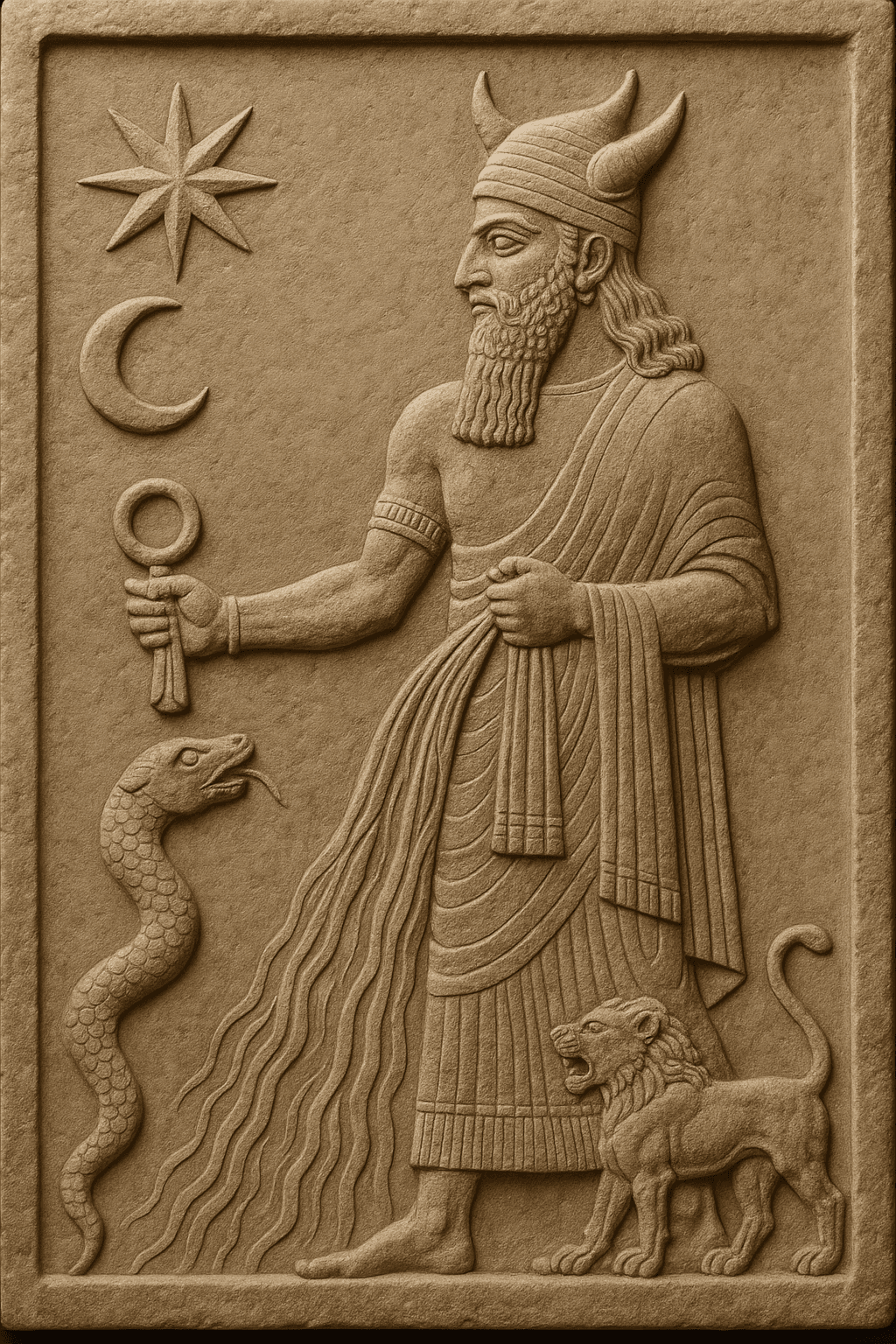
Stone Relief Depicting the Sumerian God Enki (Generated by Artificial Intelligence)
Some cultural interpretations tend to establish an indirect link between the Anunnaki and the Sirius star system. These interpretations are largely based on the fact that Sirius was regarded as sacred by many ancient civilizations. In Mesopotamian inscriptions, Sirius is referred to as Kak-si-sa or Kak-si-di and was seen as a cosmic guide or divine marker.
In many myths concerning Sirius, it is claimed that beings originating from this star were culture-bringers. Some modern interpretations of the Anunnaki’s divine origins in Mesopotamian myths associate them with the Sirius system. However, this connection is found primarily in esoteric and alternative history theories, not in academic literature.
The Anunnaki are not only celestial beings but are also situated within the underworld. In certain Mesopotamian texts, the Anunnaki are depicted as deities who render judgments in the land of the dead. This understanding indicates that they held absolute authority not only over creation and governance but also over life after death.
One of the primary Anunnaki figures active in the underworld is the goddess of death, Ereshkigal. Alongside her, other deities assumed roles such as dispensing justice and judging the souls of the dead. In this sense, the Anunnaki manifest at both poles of the cycle of life and death.
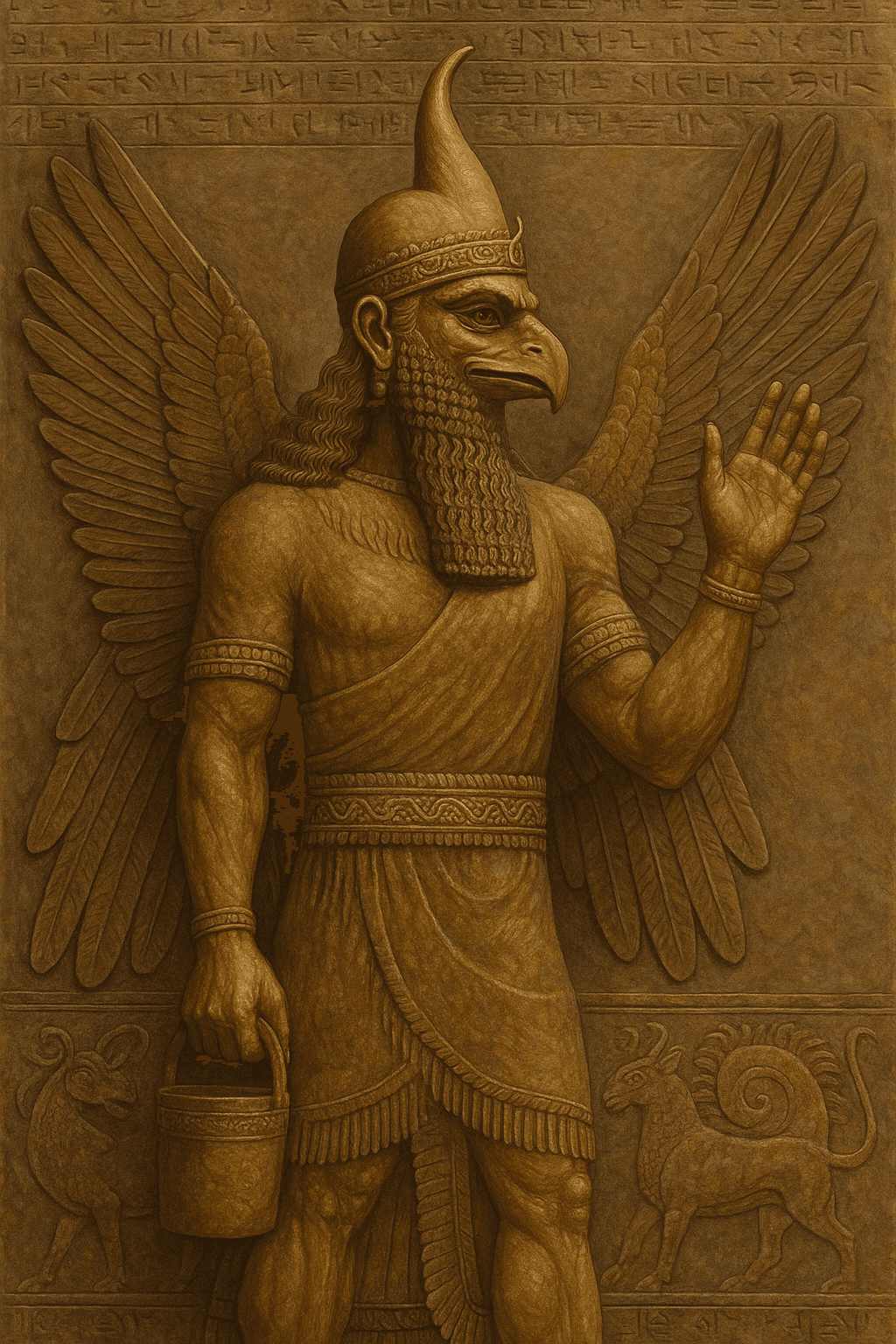
Depiction of an Anunnaki Figure (Generated by Artificial Intelligence)
Each Sumerian city-state adopted a specific deity or goddess as its patron and constructed temples dedicated to that god. These deities were generally members of the Anunnaki pantheon. For example:
Each city-state established religious ceremonies, festivals, and worship practices tied to its patron deity. The central role of these deities laid the foundation for the theocratic structure of Sumerian politics.
The Anunnaki were not confined to Sumerian religion alone but continued to feature in the mythologies of subsequent Mesopotamian civilizations—Akkadian, Babylonian, and Assyrian. During these periods, the names of the gods changed and their functions were redefined, yet the concept of the Anunnaki largely retained its meaning as a divine assembly or celestial council.
In particular, Babylonian mythology distinguishes the Anunnaki from another group of deities called the Igigi. The Anunnaki are regarded as higher-ranking gods, while the Igigi are described as celestial beings who serve them. This distinction illustrates a class structure among the gods and reveals how labor was divided at a cosmic level.
However, with the decline of Mesopotamia’s political power during the first millennium BCE, the belief in the Anunnaki lost its local influence. Nevertheless, these figures persisted in mythological texts and eventually became foundational elements in esoteric traditions and alternative historical narratives.
The Anunnaki are one of the fundamental theological and cultural pillars of Mesopotamian mythology. Emerging alongside the Sumerians, this pantheon serves as a divine explanation for numerous concepts, including the creation and organization of the universe, the origin of humanity, and the shaping of society. These beings, descended from chief deities such as An, Enlil, Enki, and Ninhursag, emerged not only as explanations for natural phenomena but also as figures legitimizing the political and social order of city-states.
Each Anunnaki assumed specific duties: on one hand, they stood at the center of temple-based worship systems; on the other, they functioned through mythological narratives to interpret concepts such as ethics, punishment, duty, and fate. In Sumer, worship was directly offered to these deities, and the religious rituals of society were organized around them.
The concept of the Anunnaki, which continued to exert influence in cultures such as Babylon and Assyria, evolved into various mythological narratives, yet always retained at its core the idea of divine beings who establish and preserve a supernatural order. In the modern era, while this concept has become the subject of various speculative and esoteric interpretations, historically and academically, the Anunnaki are regarded as a concrete extension of Sumerian cosmology and religious thought.
In conclusion, the Anunnaki are not merely divine figures; they are also a reflection of how Mesopotamian societies understood the world, structured their social order, and conceived of the cosmos.
Altuncu, Abdullah. Sümer Mitolojisi Bağlamında Otorite Tarafından Şekillendirilen İbadet ve Törenler. Kilis: Kilis 7Aralık Üniversitesi İlahiyat Fakültesi Dergisi, 2014. Accessed June 16, 2025.
Altuncu, Abdullah.Sümerlerde Tanrı Anlayışı ve Tanrılar Panteonu. Kilis: Kilis 7Aralık Üniversitesi Sosyal Bilimler Dergisi, 2014. Accessed June 16, 2025.
Etgü, Yıldız Tilbe. Sumer Kent Devletlerinin Tanrı ve Tanrıçaları. Master's thesis, Ondokuz Mayıs Universitesi, 2022. Accessed June 16, 2025.
Sitchin, Zecharia. Enki'nin Kayıp Kitabı: Dunya Dışı Bir Tanrının Hatıraları ve Kehanetleri. Translated by Yasemin Tokatlı. Istanbul: Ruh ve Madde Yayınları, 2016. Accessed June 16, 2025.
Uluişık, Yaprak Pelin. "Turk ve Dunya Mitolojilerinde Sirius Kültü." Mediterranean Journal of Humanities 6, no. 2 (2017): 345–365. Accessed June 16, 2025.

The Place of the Anunnaki in Sumerian Religion
Characteristics and Representation of the Anunnaki
Roles and Hierarchy
Relationships with Humans
The Anunnaki in Mythological Narratives
Connections Between the Anunnaki and the Sirius Cult
The Anunnaki’s Relationship with the Underworld
City-States and the Anunnaki Cult
The Evolution of the Anunnaki Belief After Sumer