


This article was automatically translated from the original Turkish version.
+1 More
Architectural Design Process
Main Stages | Analysis, Conceptual Design, Planning, Implementation, Monitoring | ||||||||
|---|---|---|---|---|---|---|---|---|---|
Process Actors | Client, Architect, Engineers, Technical Team, Contractor, Public Institutions | ||||||||
Key Outputs | Sketches, Concept Drawings, Architectural Plans, 3D Models, Construction Drawings, Building Permit | ||||||||
Fundamental Principles | Functionality, Aesthetics, Safety, Sustainability, Economy | ||||||||
The architectural design process is an interdisciplinary field in which the conceptual functional aesthetic structural and behavioral qualities of a building as a whole and all its constituent components are interpreted defined and documented to meet specific requirements. This process is also described as the identification of problems in an ill-defined domain and the resolution of these problems through cognitive mechanisms. Architectural design is regarded as a thinking activity that transforms into a design product through the influence of creativity. While inherently an individual creative activity the resolution of complex problems typically requires collaborative efforts from experts across multiple disciplines such as architecture engineering landscape architecture and interior architecture.

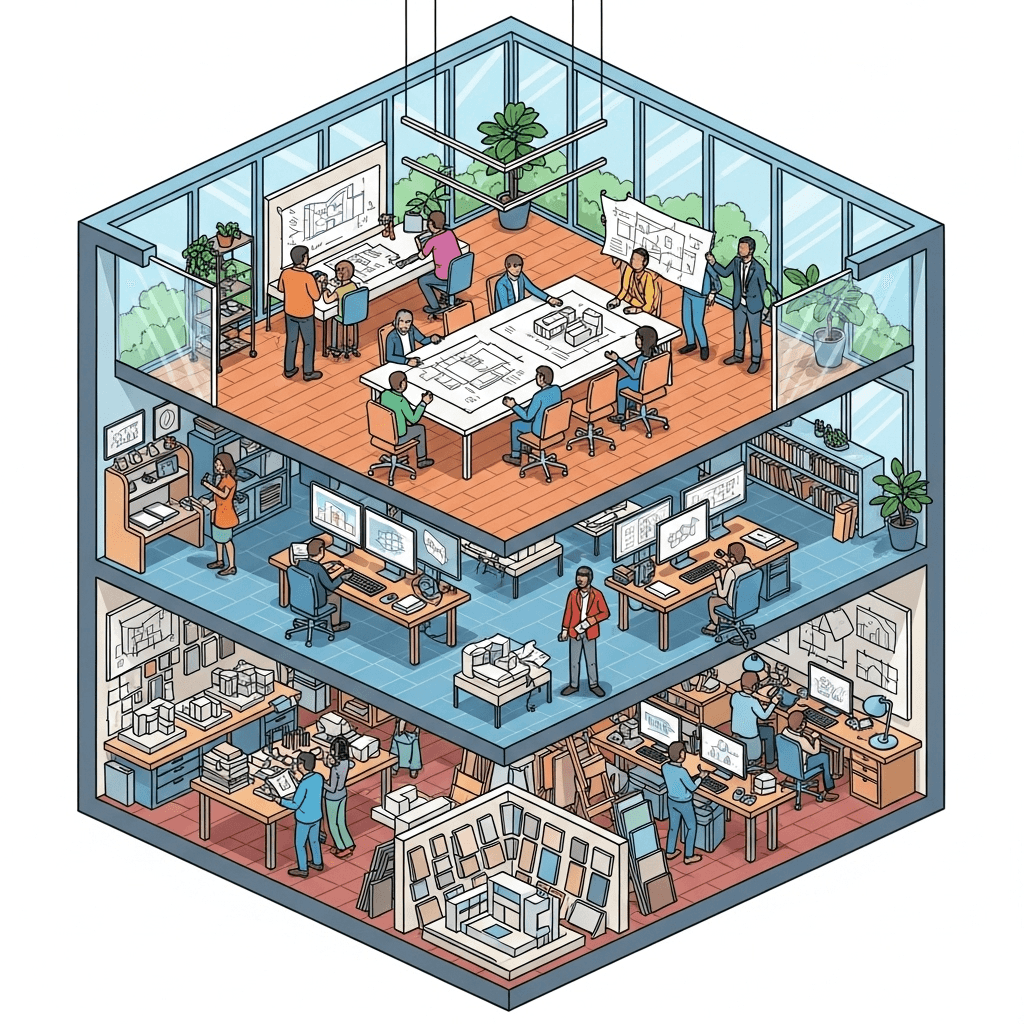
Design is a Journey from Idea to Reality (Generated by Artificial Intelligence)
The architectural design process has evolved alongside changing social technological and cultural conditions throughout history. In early periods architectural production was shaped by artisan architects in whom the planning construction and supervision of buildings were unified in a single individual. This is evident in ancient Egyptian Mesopotamian and Greek architecture. Vitruvius’s work De Architectura is one of the earliest sources documenting how architects in ancient Rome operated according to principles of aesthetics durability and functionality.
During the Middle Ages architectural production was largely organized within guild systems and the design and construction of large structures such as cathedrals were collective processes spanning many years. In this period the identity of the architect became anonymous and knowledge was transmitted through oral tradition. With the Renaissance architects such as Alberti Palladio and Michelangelo entered architectural history as figures who emphasized individual creativity and the design process was redefined as an intellectual activity.
In the 18th and 19th centuries industrialization led to the technical specialization of building production and engineering knowledge began to be integrated into the architectural process. During this period the distinction between architect and engineer became more pronounced and new building typologies emerged. Simultaneously schools such as Beaux-Arts and Bauhaus institutionalized architectural design education and developed systematic approaches to the design process.
The 19th century was a period in which the architectural design process was rationalized through modernist principles and norms. Figures such as Le Corbusier and Gropius conceptualized design as the solution to a problem and emphasized stages of analysis synthesis and evaluation within the process. From the 1960s onward postmodern discourse reintroduced subjective local and cultural values into the design process.
With the widespread adoption of computer-aided design (CAD) from the 1980s onward architectural production became digitalized and concurrent engineering and interdisciplinary coordination became fundamental components of contemporary design processes. Today architectural design processes have become both more complex and more integrated through methods such as Building Information Modeling (BIM) and parametric design.
The architectural design process has been explained through various models by different theorists. These models examine the nature steps and interrelationships among actors from different perspectives.
Before the widespread use of computer technology the architectural design process was largely sequential and algorithmic. In this approach designs were drawn on paper and once the architectural preliminary design reached a certain stage information exchange occurred with other disciplines such as construction mechanical and electrical engineering. The project team convened at specific intervals for meetings and revised designs according to decisions made. However this method had disadvantages including the need to redraw drawings with each revision prolonging the project development process due to continuous backward revisions and the potential for errors in repeated drawings.

Traditional Design Stage (Generated by Artificial Intelligence)
The architectural design process is not merely an aesthetic production domain but also a systematic problem-solving process composed of distinct stages. Within this framework various theorists have developed systematic models dividing the process into stages such as analysis synthesis evaluation and communication.
Lawson states that the design process is infinite and that there is no single correct or error-free process. According to him the process requires not only solving problems but also identifying them and incorporates the designer’s subjective judgments based on experience.
Cross defines the design process as a structure consisting of four fundamental stages: exploration generation evaluation and communication. In this model there is a cyclical relationship between the generation and evaluation stages.
Similarly Kızılırmak explains the process in four steps: analysis synthesis evaluation and communication. These steps were followed in the Rize Land Registry and Cadastre Directorate service building project beginning with problem definition continuing with information gathering and analysis and proceeding to the synthesis stage where design decisions were made based on these analyses. In the evaluation stage the architectural project was examined in conjunction with solutions from other disciplines.
Advances in computer and communication technologies have transformed the organizational structure of the traditional sequential process. Today the preparation of designs in digital environments has led to a transformation in interdisciplinary design organization. With digitization other disciplines such as engineering can now work simultaneously and synchronously with architects from the very beginning of the design process without being constrained by time or space.
This approach is also known as Concurrent Engineering. Concurrent engineering aims to ensure that all project stakeholders are integrated into the design process to produce comprehensive and mutually consistent outcomes. This understanding seeks to minimize inconsistencies omissions and errors between projects by enabling feedback and mutual corrections between design and construction phases.
The architectural design process is also examined through various theoretical frameworks and philosophies.
According to many researchers design is fundamentally a problem-solving process. In this approach the act of design begins with the emergence of a need or problem and aims to find appropriate solutions. The designer performs a cognitive activity during this process. Creativity and problem solving are viewed as essentially the same cognitive activity in this context.
Design is also a creative and cognitive process. Creativity in this context is defined as the emergence of something new and unconventional. The creative process enables innovation through the integration and organization of sensory emotional and imaginative faculties with intellectual capacities.
In this process the designer’s personal environmental and cognitive variables play a decisive role. Biological-personal and cultural variables of the individual such as lifestyle values experience and beliefs along with socio-group and physical environmental variables such as family structure education and living surroundings directly influence this process. Together these components form the individual’s cultural schema. Cultural schema are culturally shared models that enable individuals to interpret the world. The designer’s cultural schema is formed through the mental processing of normative values and meanings via cognitive processes such as understanding grouping learning and memory and interacts with the creative cognitive process to shape the act of designing.
Amid social changes of the 1960s the concept of participation emerged as central in individual-centered domains. In architecture this approach began to be discussed as the systematic and conscious inclusion of users in the design process. The underlying premise is that users possess accumulated experience derived from their interaction with their environment and that this experience should be incorporated into design parameters. This approach can be divided into two main categories:
The architectural design process has a structure that requires contributions from various professional and disciplinary groups. One of the greatest challenges of the process is the necessity for multiple disciplines to collaborate on multiple subjects. At this point architects are responsible not only for the design of the building but also for ensuring coordination among other project stakeholders. In this role architects act as “system integrators” combining technological developments project management and construction content while managing relationships with clients.
In the project process, architects collaborate simultaneously and in constant communication with actors such as structural engineers, mechanical engineers, and electrical engineers, shaping the project through an interdependent framework. In traditional processes, this coordination is achieved through periodic meetings; in digital processes, it is carried out independently of time and space using technologies such as intranet, extranet, email, instant meetings (meet now), and remote desktop access.
At the beginning of the design process, a “program of requirements” is developed to define the needs and expectations of users and clients, as well as institutional identity and spatial requirements. This program establishes the fundamental framework for the design and serves as a reference for spatial organization.
Today, the design process is largely conducted through computer-aided design (CAD) software. These tools are used in numerous areas including drafting, document storage, design, calculations, and interdisciplinary communication. To prevent data loss and ensure compatibility in interdisciplinary work, the use of common software or convertible file formats such as .dxf is essential. Some software, such as MicroStation TriForma, enables the integration of different disciplines within a single project model.
For communication, features such as “Web Publish,” “E-transmit,” and “I-drop” allow data sharing without the need to send original drawing files.
Building energy simulation programs are widely used as effective methods for determining building energy loads and identifying energy consumption profiles. Traditionally, these programs have been employed at the end of the design process to “verify” performance; however, contemporary approaches advocate integrating these tools from the very beginning of the design process to actively “enhance” the design. Simulations conducted in the early stages of design enable the analysis of how decisions regarding form, size, orientation, and materials affect energy consumption, thereby facilitating the creation of higher-performance buildings. Nevertheless, these programs face limitations such as complex user interfaces, detailed data requirements, and difficulties in interpretation.
In Türkiye, the architectural design process is a production process shaped by regulations, professional practices, and interdisciplinary relationships, yet it is frequently disrupted by various structural issues. This process involves the participation of designing architects as well as engineers, consultants, construction inspectors, and public authorities. However, in practice, the integrated approach anticipated by theoretical models is often insufficiently realized.
Various problems have been observed in the architectural design process within Türkiye’s construction sector. Research has categorized these issues under the following headings:
These problems create conditions for project revisions during implementation, rework of construction elements, increased costs, time delays, material waste, and unauthorized deviations from the project.
Gümüşburun Ayalp, Gülden, and Mehmet Emin Öcal. “Türk inşaat sektöründe mimari tasarım süreci hataları ve nedenleri.” *Erciyes Üniversitesi Fen Bilimleri Enstitüsü Fen Bilimleri Dergisi* 32, no. 1 (2016): 1–8. Accessed July 1, 2025. https://dergipark.org.tr/tr/pub/erciyesfen/issue/25541/269492
Hacıalibeyoğlu, Ferhat. "Mimari tasarım sürecinde katılım sorunu ve yaklaşımlar." *Mimarlık Dergisi*, no. 379 (2014). Accessed July 1, 2025. http://www.mimarlikdergisi.com/index.cfm?sayfa=mimarlik&DergiSayi=393&RecID=3477
Harputlugil, Gülsu Ulukavak. "Mimari Tasarım Süreci İçinde Bina Enerji Simülasyon Programı Uygulamalarının Yeri." *Teknoloji Dergisi*, Karabük Teknik Eğitim Fakültesi Yayınları 10 (2007): 143–159. Accessed July 1, 2025. https://www.researchgate.net/publication/236256527_Mimari_Tasarim_Sureci_Icinde_Bina_Enerji_Simulasyon_Programi_Uygulamalarinin_Yeri
Çelik, Tuğçe. "Rize Tapu ve Kadastro Müdürlüğü Yeni Hizmet Binasının Mimari Tasarım Süreci." *Journal of Architectural Sciences and Applications* 7, no. 2 (2022): 674–692. Accessed July 1, 2025. https://dergipark.org.tr/en/pub/mbud/issue/73692/1132052
Önal, Gökçe Ketizmen. “Yaratıcılık ve kültürel bağlamda mimari tasarım süreci.” *Uludağ Üniversitesi Mühendislik Fakültesi Dergisi* 16, no. 1 (2011). Accessed July 1, 2025. https://dergipark.org.tr/tr/pub/uumfd/issue/21674/233263
İnan, Nurgül, and Tayfun Yıldırım. "MİMARİ TASARIM SÜRECİNDE DİSİPLİNLERARASI İLİŞKİLER VE EŞZAMANLI - DİJİTAL ORTAM TASARIM OLANAKLARI." *Gazi Üniversitesi Mühendislik Mimarlık Fakültesi Dergisi* 24, no. 4 (2009). Accessed July 1, 2025. https://dergipark.org.tr/tr/download/article-file/75531
[1]
Ferhat Hacıalibeyoğlu, "Mimari tasarım sürecinde katılım sorunu ve yaklaşımlar," Mimarlık Dergisi, sayı 379 (2014), Erişim 1 Temmuz 2025, http://www.mimarlikdergisi.com/index.cfm?sayfa=mimarlik&DergiSayi=393&RecID=3477

Architectural Design Process
Main Stages | Analysis, Conceptual Design, Planning, Implementation, Monitoring | ||||||||
|---|---|---|---|---|---|---|---|---|---|
Process Actors | Client, Architect, Engineers, Technical Team, Contractor, Public Institutions | ||||||||
Key Outputs | Sketches, Concept Drawings, Architectural Plans, 3D Models, Construction Drawings, Building Permit | ||||||||
Fundamental Principles | Functionality, Aesthetics, Safety, Sustainability, Economy | ||||||||
No Discussion Added Yet
Start discussion for "Architectural Design Process" article
Historical Development
Stages and Models of the Process
Traditional (Linear) Process
Systematic Process Models
Bryan Lawson’s Model (2005)
Nigel Cross’s Model (2008)
Kızılırmak’s Model (2010)
Digital (Concurrent) Process
Theoretical Approaches
Design as Problem Solving
Design as a Creative and Cognitive Process
User-Centered Design
Interdisciplinary Relationships and Coordination
Application Areas and Tools
Program of Requirements
Digital Technologies and Software
Performance Evaluation Simulations
The Architectural Design Process in Türkiye
Problems