


This article was automatically translated from the original Turkish version.
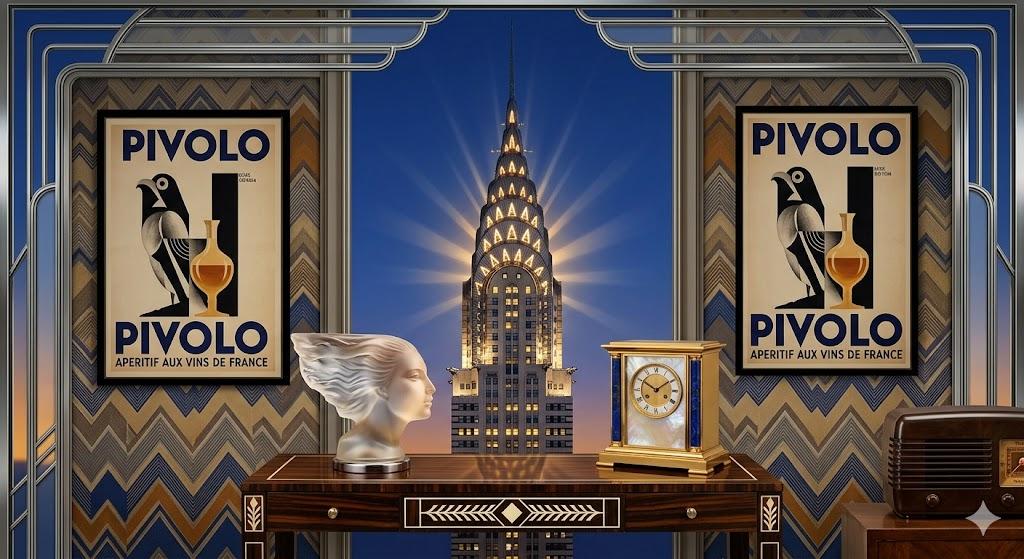
Art Deco (generated by artificial intelligence)
Design Purpose | Aesthetic Functionality | ||||||||
|---|---|---|---|---|---|---|---|---|---|
Graphic Pioneer | A. M. Cassandre | ||||||||
Architectural Icon | Chrysler Building | ||||||||
Luxury Material | Ivory, Ebony, Shagreen | ||||||||
Modern Material | Chrome, Bakelite, Steel | ||||||||
Visual Focus | Speed and the Machine Age | ||||||||
Primary Inspiration | Cubism and Futurism | ||||||||
Basic Form | Geometric and Symmetric | ||||||||
Official Epoch | 1925 Paris Exhibition | ||||||||
Formation Site | Paris, France | ||||||||
Art Deco is a decorative art and design movement that was influential internationally between 1919 and 1939, encompassing architecture, interior design, furniture, graphic design, fashion and industrial products. Originally known as “le style moderne” or “Jazz Moderne,” the style acquired its current name following academic reassessments in 1968. The movement derives its name from the 1925 Exposition Internationale des Arts Décoratifs et Industriels Modernes (International Exhibition of Modern Decorative and Industrial Arts) held in Paris.

Art Deco (Generated by Artificial Intelligence)
Art Deco emerged both as a continuation of its predecessor, Art Nouveau, and as a reaction against its elitist, handcrafted and organic forms. Art Deco drew inspiration from modern art movements such as Cubism, Futurism, Constructivism, Bauhaus, De Stijl and Surrealism. In particular, the fragmented structures of Cubism and the dynamic lines of Futurism—with its philosophy that “speed is beauty”—formed the foundational aesthetic of the movement. The aerodynamic designs of modern ships, trains and automobiles as well as the art of Ancient Egypt, especially following the 1922 discovery of Tutankhamun, and Mesoamerican civilizations such as the Aztecs were also major sources of inspiration.
The movement’s core visual characteristics include symmetry, repetitive linear patterns, zigzags, triangles and chevron (V-shaped) motifs, along with aerodynamic and geometric forms. Unlike fine art intended solely for contemplation, Art Deco aimed to elevate functional objects—clocks, ashtrays, automobiles, buildings—to an artistic level and make aesthetically satisfying items accessible to the masses through mass production technologies. Overall, the movement embodied a celebration of the Machine Age and the technological progress of its time.
In Art Deco designs, traditional French craftsmanship was combined with modern industrial production techniques. Exotic and luxurious materials such as ivory, sharkskin, ebony, mahogany, rosewood, tortoiseshell and zebra hide were used alongside modern industrial materials that reflected the era’s technological advances, including stainless steel, chrome, aluminum, concrete, plastic and Bakelite.
Art Deco developed in its country of origin, France, primarily as a luxurious, ornamental style characterized by rich materials. However, under the economic impact of the Great Depression at the end of the 1920s and the beginning of the 1930s, it evolved in the United States of America into a simpler, more streamlined substyle known as “Streamline Moderne,” which favored economical materials such as chrome and concrete and minimized ornamentation. This American approach was widely applied through public projects such as those by the Works Progress Administration (WPA), extending from libraries to schools. The movement spread to global cities including Havana, Mumbai, Jakarta, Shanghai, London, Sydney and Melbourne, establishing a worldwide influence.
• Architecture: Art Deco had a significant presence especially in New York skyscrapers such as the Chrysler Building and in the modern architectural approaches of designers like Le Corbusier and Mies van der Rohe.
• Furniture and Decorative Arts: Émile-Jacques Ruhlmann designed luxurious furniture using exotic woods and ivory, while Jules Leleu created notable interior designs of the era, including for the Normandie ocean liner. In glass art, René Lalique was a leading figure.
• Graphic Design and Typography: New typefaces such as Bifur, Broadway and Peignot were developed, departing from traditional typography to evoke a machine-made aesthetic. Ukrainian-born French designer A. M. Cassandre (Adolphe Jean-Marie Mouron) became one of the pioneers of modern graphic design by applying this new typographic sensibility and fragmented geometric forms to advertising posters. In fashion and pattern illustration, the “pochoir” (stencil printing) technique was widely used; artists such as Erté (Romain de Tirtoff) captured the era’s aesthetic on magazine covers.
• Painting: Tamara de Lempicka is regarded as one of the most important painters of the movement for her stylized and geometric portraits depicting the society of the time.
Goss, Jared. “French Art Deco - the Metropolitan Museum of Art.” *Metmuseum.org.* Accessed March 10, 2026. https://www.metmuseum.org/essays/french-art-deco
Kurtcu, F. “Art Deco Sanat Akımında Tipografi: A. M. Cassandre.” Art-e Sanat Dergisi 17, no. 34 (2025): 590–603. https://dergipark.org.tr/tr/pub/sduarte/article/1587779#article_cite
New York Public Library. “Art Deco: A Research Guide.” The New York Public Library. 2009. Accessed March 10, 2026. https://www.nypl.org/node/171023
Tate. “Art Deco – Art Term | Tate.” Tate. 2017. Accessed March 10, 2026. https://www.tate.org.uk/art/art-terms/a/art-deco
The Art Story. "Art Deco Movement Overview." 2016. Accessed March 10, 2026. https://www-theartstory-org.translate.goog/movement/art-deco/?_x_tr_sl=en&_x_tr_tl=tr&_x_tr_hl=tr&_x_tr_pto=tc

Art Deco (generated by artificial intelligence)
Design Purpose | Aesthetic Functionality | ||||||||
|---|---|---|---|---|---|---|---|---|---|
Graphic Pioneer | A. M. Cassandre | ||||||||
Architectural Icon | Chrysler Building | ||||||||
Luxury Material | Ivory, Ebony, Shagreen | ||||||||
Modern Material | Chrome, Bakelite, Steel | ||||||||
Visual Focus | Speed and the Machine Age | ||||||||
Primary Inspiration | Cubism and Futurism | ||||||||
Basic Form | Geometric and Symmetric | ||||||||
Official Epoch | 1925 Paris Exhibition | ||||||||
Formation Site | Paris, France | ||||||||
Origins and Influences
Aesthetic Features and Philosophy
Material Usage
Regional Development and Substyles
Applications and Key Figures