


This article was automatically translated from the original Turkish version.
+3 More
Artificial Intelligence-Assisted Automation
Basic Components | Robotics Process Automation (RPA), Machine Learning (ML), Natural Language Processing (NLP), Computer Vision | ||||||||
|---|---|---|---|---|---|---|---|---|---|
Main Advantages | Increased efficiency, reduced costs, decreased error rates, 24/7 operation, enhanced decision-making | ||||||||
Application Area(s) | Production marketing healthcare finance customer service logistics | ||||||||
Other Name(s) | Intelligent Automation (IA) | ||||||||
Artificial Intelligence-Assisted Automation is the integration of artificial intelligence (AI) technologies with automation systems to perform business processes and tasks with minimal or no human intervention. While traditional automation executes repetitive tasks based on predefined rules, AI integration endows these systems with human-like cognitive abilities such as learning, adapting, analyzing data, and making decisions. This technology significantly expands the scope and effectiveness of automation by leveraging advanced algorithms and AI subfields including machine learning (ML), natural language processing (NLP), and computer vision. By enhancing efficiency, reducing costs, lowering error rates, and enabling organizations to focus on more strategic tasks, AI-assisted automation is driving transformation across both industrial and corporate sectors.

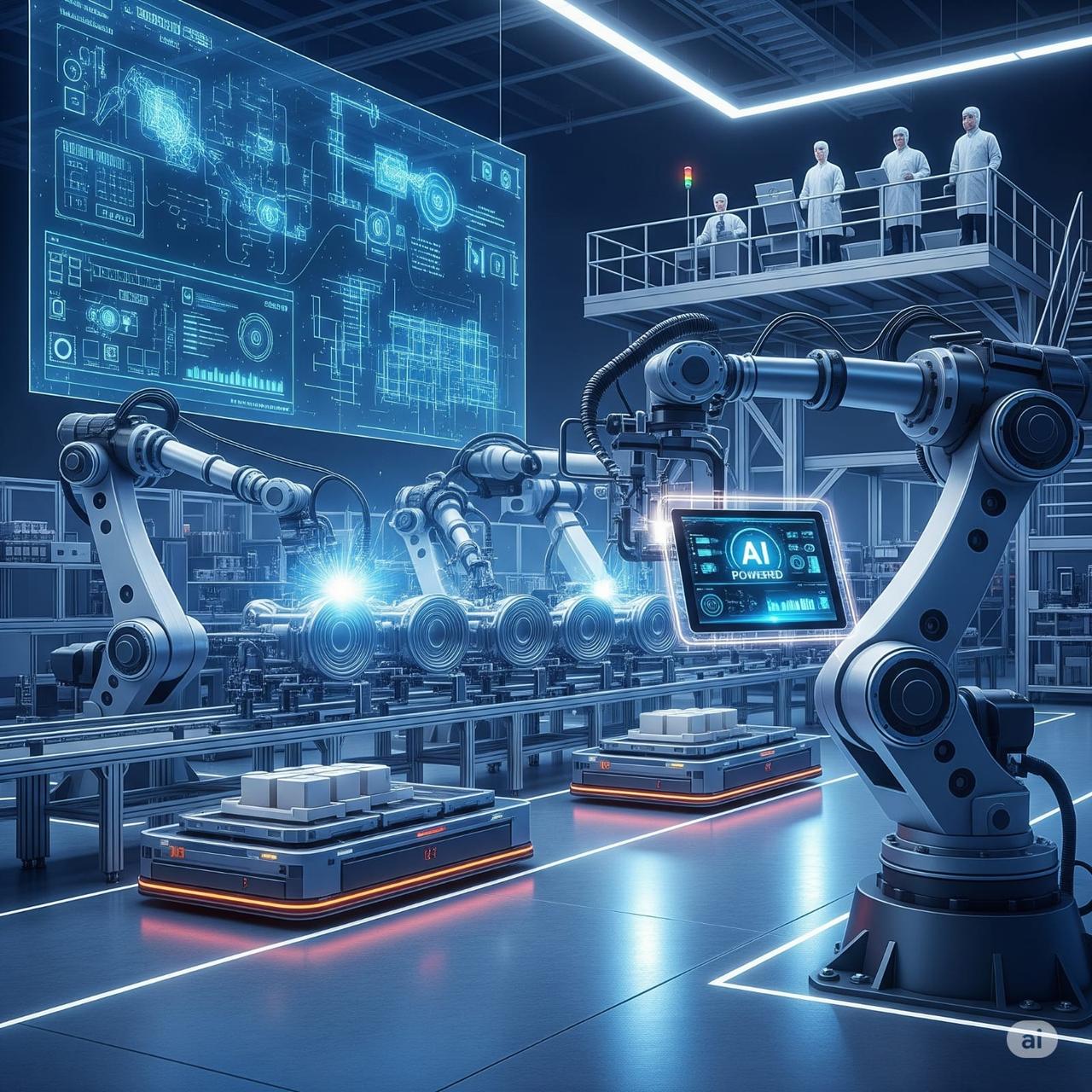
(This Image Was Generated by Artificial Intelligence)
To understand AI-assisted automation, it is essential to first examine each of these two core components separately. Artificial intelligence is a field of science and engineering that enables computer systems to perform tasks typically requiring human intelligence, such as problem solving, learning, perception, and decision making. Through techniques like machine learning and deep learning, AI systems can analyze large datasets to recognize patterns and improve their performance over time. Automation, on the other hand, refers to the collection of technologies that enable a process or system to operate automatically without human intervention. It is commonly used to accelerate repetitive, rule-based tasks, reduce human errors, and increase efficiency.
The convergence of these two technologies represents a significant evolution in automation. Traditional automation systems operate according to fixed programming logic and cannot adapt to unexpected or variable conditions. AI introduces flexibility and reasoning to automation. An AI-enhanced automation system does not merely process data; it understands, interprets, and makes dynamic decisions based on environmental changes or new information. This synergy enables automation to undertake more complex, strategic tasks that were previously thought possible only for humans.
Intelligent automation is a system formed by the integration of various technologies. Its core components include robotic process automation (RPA), AI technologies, and integration platforms. RPA is a software technology that automates rule-based tasks, typically working with structured data. AI enhances this process by adding capabilities such as machine learning, natural language processing, and computer vision, enabling the processing of unstructured data—such as text, images, and speech—and automating more complex decision-making workflows.
Intelligent automation systems operate by monitoring operational data in real time within a business workflow. AI algorithms analyze this data to identify trends, detect anomalies, or predict future events. For instance, in a customer service process, a chatbot using NLP interprets the intent behind a customer’s written message and generates an appropriate response. In cases requiring human intervention, it can escalate the conversation to a live representative. Similarly, on a production line, computer vision technology analyzes images of products to perform quality control and automatically isolate defective items. Machine learning algorithms continuously learn from new data during these processes, becoming increasingly accurate and efficient over time, and even suggesting improvements to the workflow.

(This Image Was Generated by Artificial Intelligence)
AI-assisted automation has a broad range of applications in industrial sectors, aimed at enhancing efficiency, safety, and quality.
AI-assisted automation is also transforming business processes in office environments and corporate departments beyond industrial settings.
Adopting AI-assisted automation offers businesses numerous advantages. Chief among them is increased efficiency and productivity. Automating tasks accelerates processes and allows employees to focus on more strategic activities. By minimizing human errors, it enhances accuracy and quality. The ability to operate continuously 24/7 ensures operational continuity. Moreover, its data analysis capabilities enable organizations to make more informed, data-driven decisions. All these factors contribute to cost reduction and the attainment of competitive advantage.
However, implementing intelligent automation also presents challenges. Technically, integrating disparate systems and training AI models for specific business processes can be complex. The human and organizational dimension is another critical challenge. Employees must adapt to new technologies, job roles must evolve, and this transition must be managed effectively. Additionally, ethical concerns arise regarding AI’s role in decision-making, its impact on the workforce, and data privacy. Successful adoption of these technologies requires careful planning, the right strategy, and effective change management.
Erickson, Jeff. "Akıllı Otomasyon nedir?" Oracle Türkiye. June 13, 2023. Accessed July 17, 2025. https://www.oracle.com/tr/cloud/intelligent-automation/.
Innova. "Yapay Zeka Ve Otomasyonun Günlük Yaşama Etkileri." Innova Blog, March 20, 2023. Accessed July 17, 2025. https://www.innova.com.tr/blog/yapay-zeka-ve-otomasyonun-gunluk-yasama-etkileri.
Innova. "Yapay zeka destekli içerik yönetimi ve otomasyonu." Innova Blog, January 29, 2024. Accessed July 17, 2025. https://www.innova.com.tr/blog/Yapay-zeka-destekli-icerik-yonetimi-ve-otomasyonu.
Oskon. "Yapay Zeka ve Otomasyon İlişkisi Hakkında Detaylı Rehber." Oskon Blog, March 5, 2024. Accessed July 17, 2025. https://www.oskon.com.tr/blog/yapay-zeka-ve-otomasyon-iliskisi-hakkinda-detayli-rehber.
Otkon Mühendislik. "Yapay Zekanın Otomasyon Endüstrisindeki Artan Rolü." Otkon Mühendislik, July 14, 2023. Accessed July 17, 2025. https://otkon.com.tr/yapay-zekanin-otomasyon-endustrisindeki-artan-rolu/.
Simovate. "Yapay Zeka Destekli Endüstriyel Otomasyon." Simovate Blog, December 4, 2023. Accessed July 17, 2025. https://www.simovate.com/blog/yapay-zeka-destekli-endustriyel-otomasyon.
Supsis. "Yapay Zeka Destekli Otomasyon Sistemi| Supsis AI ile 7/24 Verimlilik." Supsis Blog. Accessed July 17, 2025. https://supsis.com/tr/blog/otomasyon-sistemi-nedir/.
İletim Mühendislik. "Endüstriyel Otomasyon Yapay Zeka Uygulamaları." Accessed July 17, 2025. https://iletimmuhendislik.com.tr/endustriyel-otomasyon-yapay-zeka-ornek-uygulamalari/.

Artificial Intelligence-Assisted Automation
Basic Components | Robotics Process Automation (RPA), Machine Learning (ML), Natural Language Processing (NLP), Computer Vision | ||||||||
|---|---|---|---|---|---|---|---|---|---|
Main Advantages | Increased efficiency, reduced costs, decreased error rates, 24/7 operation, enhanced decision-making | ||||||||
Application Area(s) | Production marketing healthcare finance customer service logistics | ||||||||
Other Name(s) | Intelligent Automation (IA) | ||||||||
No Discussion Added Yet
Start discussion for "Artificial Intelligence-Assisted Automation" article
Foundations of Artificial Intelligence and Automation
Components and Working Principle of Intelligent Automation
Industrial Application Areas
Business Processes and Corporate Applications
Advantages and Challenges of Intelligent Automation