


This article was automatically translated from the original Turkish version.
+2 More
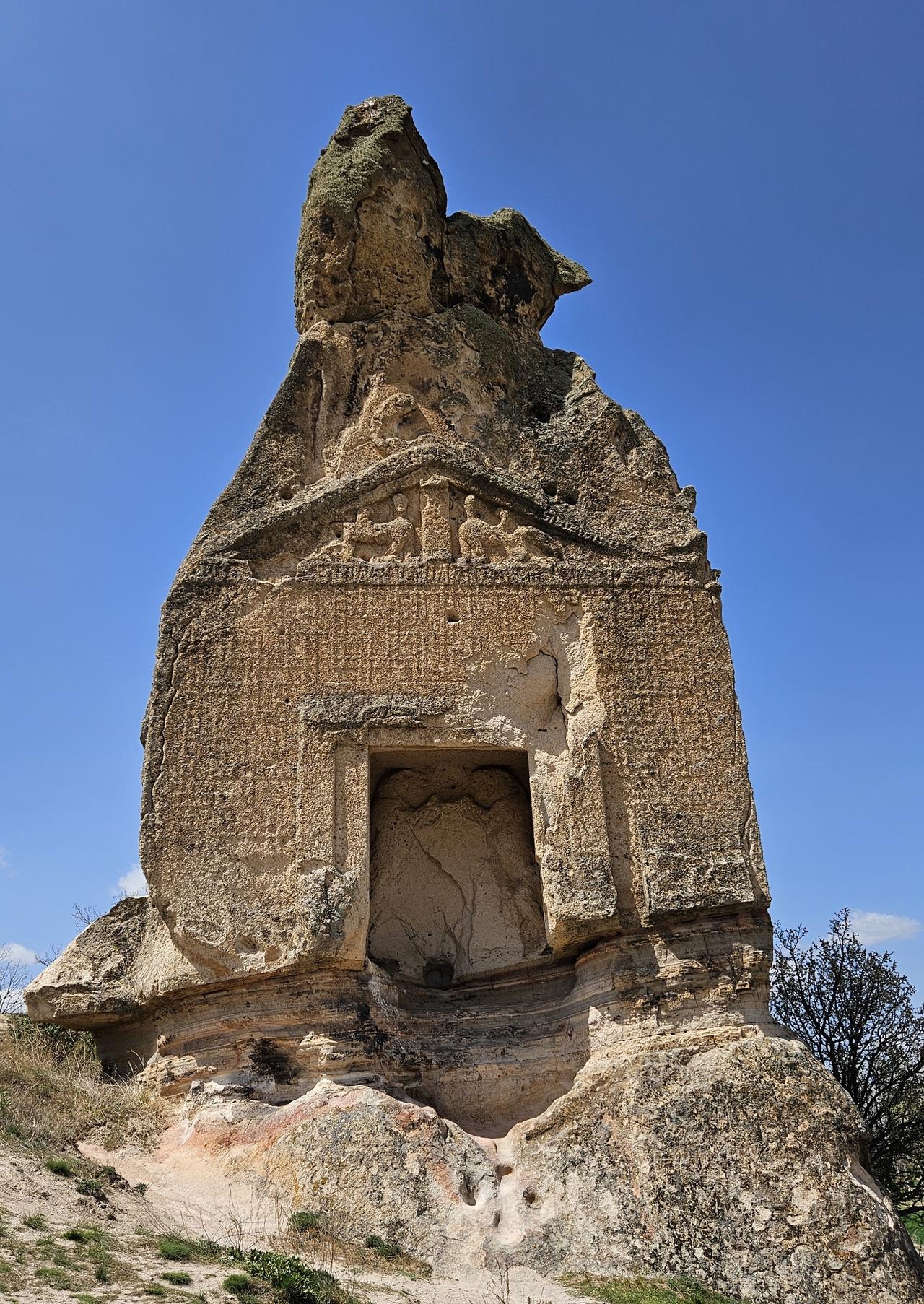
Aslankaya (Photo: Meryem Şentürk Çoban)
Location | İhsaniye District Türkiye Afyonkarahisar | ||||||||
|---|---|---|---|---|---|---|---|---|---|
Type(s) | Rock Façade/Open-Air Temple | ||||||||
Civilization | Phrygians | ||||||||
Period(s) | 1st millennium BCE | ||||||||
Culture | Cult of the Mother Goddess Cybele | ||||||||
Aslankaya Open-Air Temple is a Phrygian rock monument located within the boundaries of the Döğer township, in the İhsaniye district of Afyonkarahisar province, approximately three to four kilometers southeast of the town center. It is one of the most distinctive examples among Phrygian open-air sanctuaries dedicated to the Mother Goddess Cybele, notable for its three-dimensional architectural effects.
The monument is situated on a rocky outcrop west of the Döğer–Üçlerkayasi road. The natural form of the rock mass was utilized to flatten the façade, after which the monument was carved. The steep rise of the rock and its pointed summit impart a “helmet-like” appearance to the structure. Local residents named the monument “Aslankaya” due to the lion figure carved in relief on its northern surface.
The façade arrangement of the temple exhibits characteristic features of Phrygian rock facades. The front surface is organized in the form of a triangular pediment, with sphinx reliefs symmetrically carved on either side of the central lintel. Within the main cult niche stands a standing relief of Cybele; on either side of the goddess, lion figures are depicted with their paws resting on the ground.
The façade surface is decorated with geometric patterns formed by the interlocking of square and linear bands, a common feature in Phrygian rock architecture. This decorative repertoire reflects a stylized adaptation of traditional Phrygian wooden architectural motifs onto the rock surface.
Unlike many other Phrygian rock facades that rely on two-dimensional surface carving, Aslankaya stands out through a pronounced three-dimensional perception achieved by exploiting the natural slope and elevation of the rock mass. This feature has led scholars to classify it among the most remarkable facade typologies, alongside examples from Bahşayiş and Kumcaboğaz.
Aslankaya served as one of the open-air worship spaces dedicated to the Mother Goddess Cybele. The niche carved into the main rock and the high reliefs directly reflect the Phrygian belief system, invoking the presence of the goddess and her sacredness within nature. Such facades functioned as sacred spaces designated for sacrifices, votive offerings, dedications, or cult rituals.
Although the monument has withstood natural conditions for thousands of years, it now faces threats from human-induced damage at least as severe as natural erosion. Some studies report the presence of holes dug by treasure hunters, partial removal of relief details, and degradation of the surface texture.
In the Phrygian Valley, the most commonly observed forms of deterioration in this and similar rock monuments include:
According to conservation literature, the primary challenges to the sustainable preservation of Phrygian rock monuments—including Aslankaya—are: their exposure in open landscapes without protective measures, the lack of scientific material analyses prior to restoration, and the absence of continuous on-site monitoring programs.
Today, Aslankaya is recognized as part of the cultural heritage at both local and national levels and is included within the protected scope of the Phrygian Valley, which is listed on UNESCO’s Tentative List. However, the deterioration process continues due to the absence of effective physical protection and security measures in the area.
Tokmak, Musa, and Murat Dal. "Analysis of Stone Deterioration Types Observed on Midas, Maltaş, Küçük Yazılıkaya, Aslankaya, Yılankaya, Aslantaş, Bitmemiş and Gerdekkayası Monuments in Phrygian Valley." *Middle East International Conference on Contemporary Scientific Studies-V*, Volume II, March 27–28, 2021, Ankara (2021): 407–425. Accessed October 18, 2025. https://www.researchgate.net/publication/350878376_Analysis_of_Stone_Deterioration_Types_Observed_on_Midas_Maltas_Kucuk_Yazilikaya_Aslankaya_Yilankaya_Aslantas_Bitmemis_and_Gerdekkayasi_Monuments_in_Phrygian_Valley
Türkiye Kültür Portalı. "Aslankaya - Afyonkarahisar." *kulturportali.gov.* Accessed October 18, 2025. https://www.kulturportali.gov.tr/turkiye/afyonkarahisar/gezilecekyer/doger-aslankaya-tapinagi
Uyan, Muzaffer. "Aslankaya Açık Hava Tapınağı." *Türkiye Turizm Ansiklopedisi* 2019. Accessed October 18, 2025.
Özcan, Sinan, and Müge Savrum Kortanoğlu. "Phryg Vadisinde Yer Alan Kaya Anıtlarının Korunması ve Sunumu: Sorunlar ve Öneriler." *Ahi Evran Üniversitesi Sosyal Bilimler Enstitüsü Dergisi (AEÜSBED)*, Volume 9, no. 3 (2023): 923-942. Accessed October 18, 2025. https://dergipark.org.tr/tr/pub/aeusbed/issue/81131/1240711

Aslankaya (Photo: Meryem Şentürk Çoban)
Location | İhsaniye District Türkiye Afyonkarahisar | ||||||||
|---|---|---|---|---|---|---|---|---|---|
Type(s) | Rock Façade/Open-Air Temple | ||||||||
Civilization | Phrygians | ||||||||
Period(s) | 1st millennium BCE | ||||||||
Culture | Cult of the Mother Goddess Cybele | ||||||||
Architectural Layout and Reliefs
The Three-Dimensional Effect on the Monumental Façade
Religious Function
Deterioration and Conservation Challenges
Current Status