


This article was automatically translated from the original Turkish version.
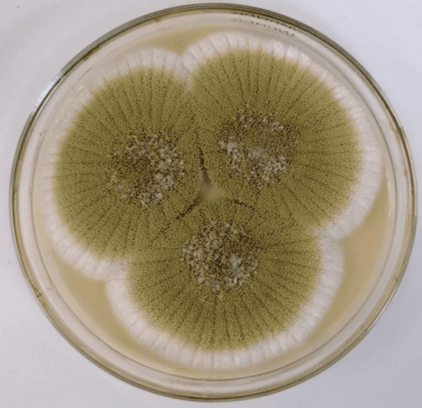
Aspergillus Flavus (Pınar Güner)
Scientific Name(s) | Aspergillus flavus Link (1809) | ||||||||
|---|---|---|---|---|---|---|---|---|---|
Kingdom(s) | Fungi | ||||||||
Team(s) | Eurotiales | ||||||||
Family | Aspergillaceae | ||||||||
Optimum Growth Temperature | 25–37 °C | ||||||||
Toxin Production | Aflatoxin B₁, B₂, G₁, G₂ | ||||||||
Aspergillus flavus is a microscopic, filamentous fungus species commonly found in nature. This species belongs to the genus Aspergillus and is frequently encountered in soil, plant debris, cereals, and nuts. It can exhibit both saprophytic and pathogenic characteristics and holds significant medical, veterinary, and agricultural importance due to its ability to cause various diseases in humans, animals, and plants. A. flavus also poses a serious food safety risk by producing potent mycotoxins known as aflatoxins.
Aspergillus flavus colonies are typically yellow-green in color, velvety, and raised in texture. As the colonies age, their color may darken and turn yellowish-brown. Under microscopic examination, the hyphae are septate, and the conidiophores are smooth and usually yellowish in color. The vesicle is generally spherical or hemispherical, and the conidia are arranged in chains. These morphological features allow for easy identification of the species in laboratory settings.
This fungal species thrives and multiplies rapidly under warm and humid climatic conditions. It is commonly found in soil, plant residues, and cereals—particularly maize, wheat, peanuts, and rice. It can also grow on cotton seeds, spices, hazelnuts, and almonds. Since A. flavus spores can be freely carried through the air, they can also be detected in the atmosphere of enclosed spaces. This characteristic plays a crucial role in the contamination of agricultural products and food storage areas.
Aspergillus flavus produces aflatoxins, among the most potent natural toxins known. Various types exist, including aflatoxin B₁, B₂, G₁, and G₂, which exhibit hepatocarcinogenic effects, particularly on the liver. In addition to causing food spoilage, aflatoxins lead to long-term adverse health effects in humans and animals. For this reason, the World Health Organization (WHO) and the Food and Agriculture Organization (FAO) recognize aflatoxin contamination as a global public health issue.
In humans, Aspergillus flavus infections are commonly known as aspergillosis. These infections typically occur via the respiratory tract, especially in individuals with compromised immune systems. They can cause invasive infections in the lungs, sinuses, or eyes and, rarely, spread to brain or heart tissue. In domestic and livestock animals, A. flavus can lead to respiratory infections, reduced egg production, and general deterioration of health.
Although primarily known for its toxin production, certain non-toxin-producing strains of Aspergillus flavus are utilized in industry. These strains are studied as model organisms for enzyme production—such as amylase, lipase, and protease—and in biotechnological research. Additionally, the development of aflatoxin-nonproducing variants through genetic engineering is considered a promising strategy for agricultural biocontrol.
The most effective method to prevent aflatoxin contamination caused by A. flavus is ensuring proper food storage conditions. Products must be kept at low moisture levels, adequately ventilated, and stored under controlled temperatures. In agriculture, the use of non-aflatoxin-producing A. flavus strains as biocontrol agents has become a significant strategy in recent years. Regular screening of food products for mycotoxins is also of critical importance for public health.
Cho, H. J., S. H. Son, W. Chen, Y. E. Son, I. Lee, J. H. Yu, and H. S. Park. “Regulation of Conidiogenesis in Aspergillus flavus.” Cells 11, no. 18 (2022): 2796. Accessed October 20, 2025. https://doi.org/10.3390/cells11182796
Rudramurthy, S. M., R. A. Paul, A. Chakrabarti, J. W. Mouton, and J. F. Meis. “Invasive Aspergillosis by Aspergillus flavus: Epidemiology, Diagnosis, Antifungal Resistance, and Management.” Journal of Fungi 5, no. 3 (2019): 55. Accessed October 20, 2025. https://doi.org/10.3390/jof5030055

Aspergillus Flavus (Pınar Güner)
Scientific Name(s) | Aspergillus flavus Link (1809) | ||||||||
|---|---|---|---|---|---|---|---|---|---|
Kingdom(s) | Fungi | ||||||||
Team(s) | Eurotiales | ||||||||
Family | Aspergillaceae | ||||||||
Optimum Growth Temperature | 25–37 °C | ||||||||
Toxin Production | Aflatoxin B₁, B₂, G₁, G₂ | ||||||||
Morphological Characteristics
Ecological Distribution and Habitat
Toxin Production
Medical and Veterinary Significance
Industrial and Biotechnological Applications
Prevention and Control Measures