


This article was automatically translated from the original Turkish version.
+2 More
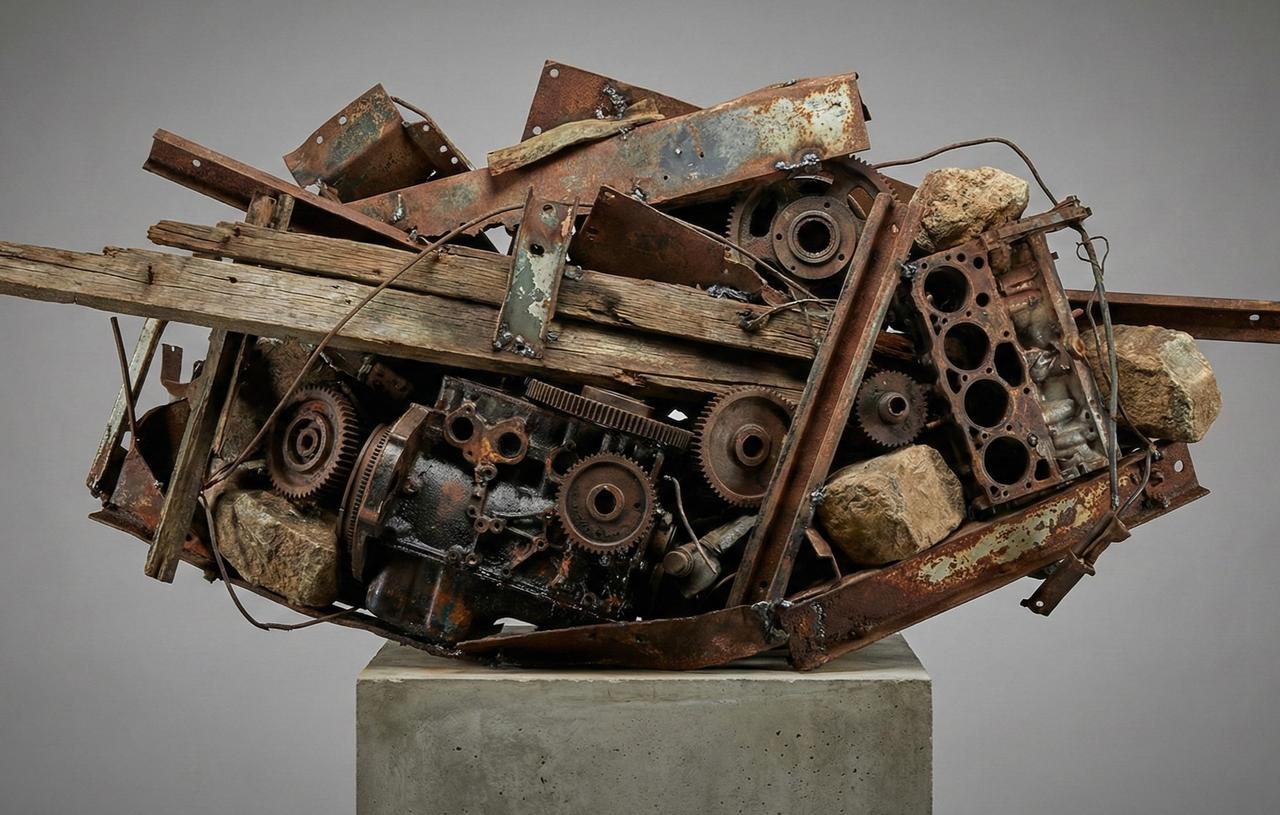
(Generated by Artificial Intelligence.)
Assembly
Philosophy and Purpose | Transformation Memory and Trace Changing the Context | ||||||||
|---|---|---|---|---|---|---|---|---|---|
Contemporary Practitioners (Porcelain/Ceramic) | Barnaby Barford Bouke de Vries Penny Byrne | ||||||||
Pioneers | Kurt Schwitters Marcel Duchamp Jean Dubuffet Pablo Picasso | ||||||||
Exit Date | 1953 | ||||||||
Assemblage, a technique in visual arts and recognized as an art movement, refers to three-dimensional works created by combining elements sourced from different origins. This term of French origin envisions the creation of artworks through the assembly of natural or industrial objects or fragments that were not originally produced for artistic purposes, reorganized into a new configuration.

Example of Assemblage (Generated by Artificial Intelligence)
The concept of assemblage was introduced by French artist Jean Dubuffet and gained international recognition through the exhibition "The Art of Assemblage" held at the Museum of Modern Art (MoMA) in New York in 1961. This approach, which centers on the creation of artworks by repositioning pre-existing elements, rejected traditional sculptural materials and modeling techniques and opened the door to an entirely new artistic language.
Assemblage traces its origins to the collage technique developed in the early 20th century by Cubism, which combined paper and material fragments on two-dimensional surfaces. Subsequently, this technique was strengthened and evolved through avant-garde art movements such as Dadaism and Surrealism. In particular, Dadaists contributed to the development of assemblage by incorporating photomontage—the combination of photographs and printed materials—into art during the 1920s.

Pablo Picasso - Guitar(Flickr)
When examining the history of art, traces of this technique can also be found in the works of pre-1945 primitive societies. In these works, a compositional arrangement of natural elements is evident; examples include the combined use of wood, clay, animal skulls, teeth, claws, seashells, and various plant fibers. After 1945, sculpture entered a new phase in which ready-made objects were employed for artistic purposes, marking the beginning of assemblage as an integral part of contemporary art.
Assemblage is described as the three-dimensional extension of collage and encompasses genres such as photomontage, photo-collage, and junk sculpture. When artists add or intervene with ready-made objects, their primary aim is not formal concerns but rather to enhance the content and narrative of the work. These everyday objects retain their original physical form but undergo a transformation of meaning within their new artistic context.

Porcelain Assemblage Example (Generated by Artificial Intelligence)
In post-1960 artistic practice, assemblage and collage techniques have played a significant role in exploring the concept of memory through visual imagery and ready-made objects. During this period, artists incorporated into their narratives everyday items often classified as decorative or kitsch.
In particular, within contemporary ceramic and porcelain art, objects that became popular after the Industrial Revolution—such as porcelain figurines—have been reinterpreted using assemblage techniques. Artists like Penny Byrne and Bouke de Vries employ this approach to reconstruct broken figurines into ironic and thought-provoking complex structures. In this way, everyday functional or decorative objects are transformed into artworks, acquiring new layers of meaning.
Karagöz, Sıdıka. "1960 Sonrası Resim Sanatında Hafıza Kavramının Kolaj ve Asamblaj Teknikleriyle İncelenmesi." Master's thesis, Balıkesir Üniversitesi, 2024. Accessed December 13, 2025. https://www.proquest.com/openview/7bab07a3b7fadad7deaf01153ebfdc1a/1?pq-origsite=gscholar&cbl=2026366&diss=y
Karakaya, B. "PORSELEN BİBLODA KOLAJ VE ASAMBLAJ." Uluslararası Disiplinlerarası ve Kültürlerarası Sanat 4, no. 9 (2019): 23-37. Accessed December 13, 2025. https://dergipark.org.tr/tr/pub/ijiia/issue/57932/831976
Koester, Larry. “Pablo Picasso - Guitar.” Flickr. Accessed December 13, 2025. https://www.flickr.com/photos/larrywkoester/50818467603/
Şanlı Yaşa, Makbule. "Kübizm'den Video Heykele, Asamblaj Tekniğinin Heykel Sanatındaki Kullanımı." Master's thesis, Dokuz Eylül Üniversitesi, 2020. Accessed December 13, 2025. https://www.proquest.com/openview/3a2873b2f66d71c0aa0ca5ed2b20e316/1?pq-origsite=gscholar&cbl=2026366&diss=y


(Generated by Artificial Intelligence.)
Assembly
Philosophy and Purpose | Transformation Memory and Trace Changing the Context | ||||||||
|---|---|---|---|---|---|---|---|---|---|
Contemporary Practitioners (Porcelain/Ceramic) | Barnaby Barford Bouke de Vries Penny Byrne | ||||||||
Pioneers | Kurt Schwitters Marcel Duchamp Jean Dubuffet Pablo Picasso | ||||||||
Exit Date | 1953 | ||||||||
Conceptual and Historical Development
Technique and Material Use
Assemblage in Contemporary Art