

This article was automatically translated from the original Turkish version.

Preliminary training equips a large language model (LLM) with the ability to imitate every voice it encounters in text: narrator, expert, fictional character, forum user. Subsequent training stages solidify one of these voices as the default: a helpful and gentle assistant. This assistant is the model’s default personality; other voices are not erased, only pushed to the background.【1】
Anthropic, MATS (ML Alignment & Theory Scholars), and Oxford University researchers measured the position of this personality in their study “The Assistant Axis.” They found that the model’s persona space—the space formed by the average activations of the roles it assumes—is low-dimensional, and its first principal component is an axis measuring how far the model’s current persona deviates from the default assistant. This finding was demonstrated in models ranging from 27B to 70B parameters.【2】
At what scale does this structure emerge? Does the axis form only in sufficiently large models, or is it also present in smaller ones? In this replication study, the question was measured on Qwen3-1.7B【3】 and Qwen3-0.6B【4】. The figures 1.7B and 0.6B indicate the number of parameters in billions for these models. Layers are numbered from L0 to L27.
The axis was present in both models. However, the position of the default assistant along this axis differed between the two models. More importantly, in the 1.7B model, the layer that most strongly altered the persona in intermediate layers (L14) was not the same layer (L19) where the default assistant first entered the 10th percentile (tail decile) of the default assistant endpoint according to the pre-registered criterion.【5】
The code, pre-registrations, and result files are publicly available on a GitHub repository;【6】 the design document, submitted before experiments began, defines the procedures and success criteria. The method follows the procedure of the original paper at a smaller scale: instead of 275 roles, five system prompts per role, and 240 questions【7】, it used 120 roles, three system prompts per role, and 40 shared questions. For each of the four conditions for the default assistant (three neutral system prompts and one with no system prompt), each of the 40 questions was sampled ten times, generating an additional 1,600 responses; combined with role responses, this yielded 16,000 responses per model.【8】
The original paper had each response labeled by a judge model.【9】 In this study, responses were labeled using the paper’s rubric on a scale from 0 to 3 and reduced to three categories: full role adoption (3), partial adoption (2), and no adoption (0 or 1). The judge’s labels underwent a pre-validation before measurements: 45 pilot responses from the 1.7B model were compared with blind labels from a second model, and category agreement exceeded the design document’s threshold of 75% at 77.8%.【10】
2,000 responses per model were labeled; the classifier trained to generalize these labels to all responses failed to meet the pre-specified threshold of 85% agreement with the judge (63.5% for 1.7B, 65.8% for 0.6B). Therefore, the classifier was not used, and decisions were made at the role level: each role’s 16 or 17 responses were labeled, and a role was assigned to a category if at least ten of its labels fell into that category; roles that did not reach ten in any category were excluded (24 roles for 1.7B, 33 for 0.6B).【11】
For each role that fully or partially adopted its assigned persona, the average of the residual stream activations after the multilayer perceptron (MLP) block was computed over the “tokens” (the smallest units of text the model processes): the role vector (93 for 1.7B, 80 for 0.6B). These numbers reflect the remaining roles after excluding those excluded from the scope (24 and 33) and those assigned to the “no adoption” category (3 and 7). The assistant axis is the difference between the average activation of the default assistant and the average of the vectors of roles that fully adopted their personas. A full list of deviations from the paper is provided in the report in the repository.【12】
The axis is also evident in the small models. When principal component analysis (PCA) was applied to the role vectors, the direction of greatest variance was the first principal component (PC1). The absolute value of the cosine similarity (1 = identical direction, 0 = perpendicular) between the axis and PC1 exceeded 0.79 in all 56 measurements across the 28 layers of each model. In the 0.6B model, the sign was negative in all 28 layers; PC1 pointed in the opposite direction of the axis, but since singular value decomposition arbitrarily assigns which end of a component is positive, the criterion was evaluated based on magnitude.【13】
The space is also low-dimensional: in the middle layers, PC1 alone explained 51.1% of the variance in role vectors for the 1.7B model and 60.3% for the 0.6B model; to explain 70% of the variance, three principal components were sufficient for the 1.7B model and two for the 0.6B model.【14】 In the original paper, the number of principal components needed to explain 70% of the variance ranged from 4 to 19 depending on the model; since the paper extracted at most two role vectors per role (one for full and one for partial adoption) from 275 roles, it reached 377 to 463 vectors per model;【15】 here, with only 120 roles, some excluded and each assigned to a single category, the number of vectors (93 and 80) is less than a quarter of the paper’s and cannot be directly compared. The endpoints of PC1 also reproduced the distinction found in the paper: one end in the 1.7B model contained researcher, specialist, validator, planner, the other end contained poet, leviathan, eldritch, bard. 【16】
The paper’s structural claim—that “persona space is low-dimensional and the first principal component is an assistant axis”—was confirmed even in the 0.6B model.
The paper shows that the default assistant lies very close to one end of PC1 in the middle layers. The measurement is the relative position of the assistant’s projection among the projections of the roles: the smallest projection is 0, the largest is 1. The paper reports the minimum distance of the default assistant from either end as 0.03 without specifying the model.【17】 In this replication study, a different and sequential criterion was pre-registered before measurement (Criterion A): the absolute value of the cosine between the axis and PC1 in the middle layer must exceed 0.6, and the default assistant must reside in the 10th percentile (tail decile) of the role distribution at the assistant end.【18】
The design document specified five criteria: A (existence of the axis), B (causality of intervention along the axis), C (persona drift—activations shifting away from the default along the assistant axis during multi-turn conversations), D (activation clipping—interventions that prevent activations from falling below a threshold on the axis), and T (Turkish transfer). This paper uses the same names for A and B; for C, it assigns the name to a separate pre-registration of control directions, since the persona drift criterion was not executed.【19】
The criterion was not met in either model. The design document labeled this criterion as a test for the axis’s existence and anticipated that its failure would indicate the axis does not exist at the 1.7B scale. However, the measurement separated the two conditions: the cosine condition was met in both models, but the tail decile condition was not. The criterion was deemed unmet and not relaxed; the conclusion about the axis’s existence relies solely on the cosine condition and diverges from the pre-registration’s interpretation. The manner in which the tail decile condition failed differed between the two models, and this difference is the finding itself.【20】
Percentile indicates the rank of the default assistant’s projection on PC1 within the role distribution. In the 0.6B model, the default assistant remained near the center of the role ranking. Because in this model PC1 points in the opposite direction of the axis, the assistant end corresponds to the lower decile (percentile ≤ 0.10). The value of 0.425 in the middle layer means that 34 of the 80 roles are positioned closer to the assistant end than the default assistant; the percentile remained between 0.35 and 0.49 across all 28 layers and never approached either end.【21】
In the 1.7B model, the default assistant moved closer to the end with depth. The percentile was 0.72 in the first layer, entered the tail decile (≥ 0.90) at L19, reached its peak of 0.98 at L24, and remained in the tail decile between L19 and L26; by the final layer, it retreated to 0.87 (Figure 1; shaded bands indicate the tail decile for each model). In the middle layer measured by the paper, L14, the percentile was 0.839, 0.06 below the threshold. At this layer, all 15 roles positioned farther from the default than the assistant end were professional roles similar to the assistant, such as “researcher, specialist, validator, planner”; the default assistant resides within this group, not beyond it.【22】
Percentile of the Default Assistant on PC1 by Layer for Qwen3-1.7B and Qwen3-0.6B (Generated by AI)
According to the paper’s range-based measure, the default assistant was 0.05 units from the assistant end at L14 in the 1.7B model and 0.13 units away in the 0.6B model. This distance fell below 0.03 between L20 and L27 in the 1.7B model; in the 0.6B model, even at its closest point (L10), it remained at 0.11. Whether the default assistant is at the end thus depends on the measurement used; the range measure is based on a single role at each end, and since the number of roles differs, the values cannot be directly compared. The divergence between the two measures in the 0.6B model arises from the shape of the role distribution: assistant-like roles form a tight cluster at the assistant end of the range, while roles toward the opposite end are sparse and form a long tail (with eldritch and leviathan at the extreme end). Thus, the default assistant is in the middle of the ranking but geometrically close to the assistant end of the range.【23】
The second prediction recorded before measuring the 0.6B model, the scale hypothesis, anticipated that as the model size decreases, the default assistant would settle deeper into the axis: in the 0.6B model, the default assistant would be less at the end in the middle layer and enter the tail decile at a deeper layer than L19 in the 1.7B model. The direction of the hypothesis was confirmed (0.425), but the delayed settlement did not occur: the 0.6B model never entered the tail decile in any layer.【24】
The axis is present from the first layer in both measured scales; however, the default assistant meeting the pre-registered criterion of being at the end was not observed in the 0.6B model and only occurred in the 1.7B model at deeper layers.【25】 When read together with the paper’s models between 27B and 70B, this pattern is consistent with a structure that strengthens with scale; it is not a null result.【26】
Finding an observational direction is not the same as demonstrating that this direction can be used as an intervention tool. In the second experiment, the following question was addressed: when pushed away from the default along the axis, does the model truly change its character?
A fixed vector aligned with the axis is added to the output of a solver layer at every token position; this intervention is called steering. The strength is the ratio of the norm of this vector to the average residual stream norm of that layer, and its sign determines the direction: negative strength pushes the model away from the default, positive strength pulls it toward the default. This norm is 136.8 at L14 and 436.3 at L19; an absolute scale would make comparison between the two layers impossible. Steering was applied only in the 1.7B model, at two layers: the middle layer measured by the paper (L14) and the layer where the default assistant first entered the tail decile (L19).【27】
A sweep was conducted using the system prompts of the 50 roles closest to the assistant end of the axis, along with the paper’s five internal observation questions—questions that ask the model about its identity (e.g., “Who are you?”, “Are you a large language model?”). The strengths tested were −0.6, −0.4, −0.2, 0.0, +0.1, +0.2, and +0.3; each layer-strength pair (cell) produced 250 responses.【28】 Each response in the sweep was labeled by a judge model using a persona rubric based on the paper’s seven categories: assistant, human_role, nonhuman_role, weird_role, ambiguous, other and nonsensical. weird_role includes responses that are theatrical or esoteric yet still refer to a digital or machine-like entity.【29】
The pre-registered second criterion (Criterion B): the ratio of non-assistant personas at the most negative strength must be at least 25 percentage points higher than the ratio without steering. The non-assistant ratio is the sum of the human_role, nonhuman_role and weird_role categories; ambiguous, other and nonsensical responses are excluded. Since every generation in the sweep included a role’s system prompt, the baseline at strength 0.0 represents the model with a role prompt but no steering, not the unguided default assistant: in these cells, 45.6% (L14) and 41.6% (L19) of responses were non-assistant.【30】
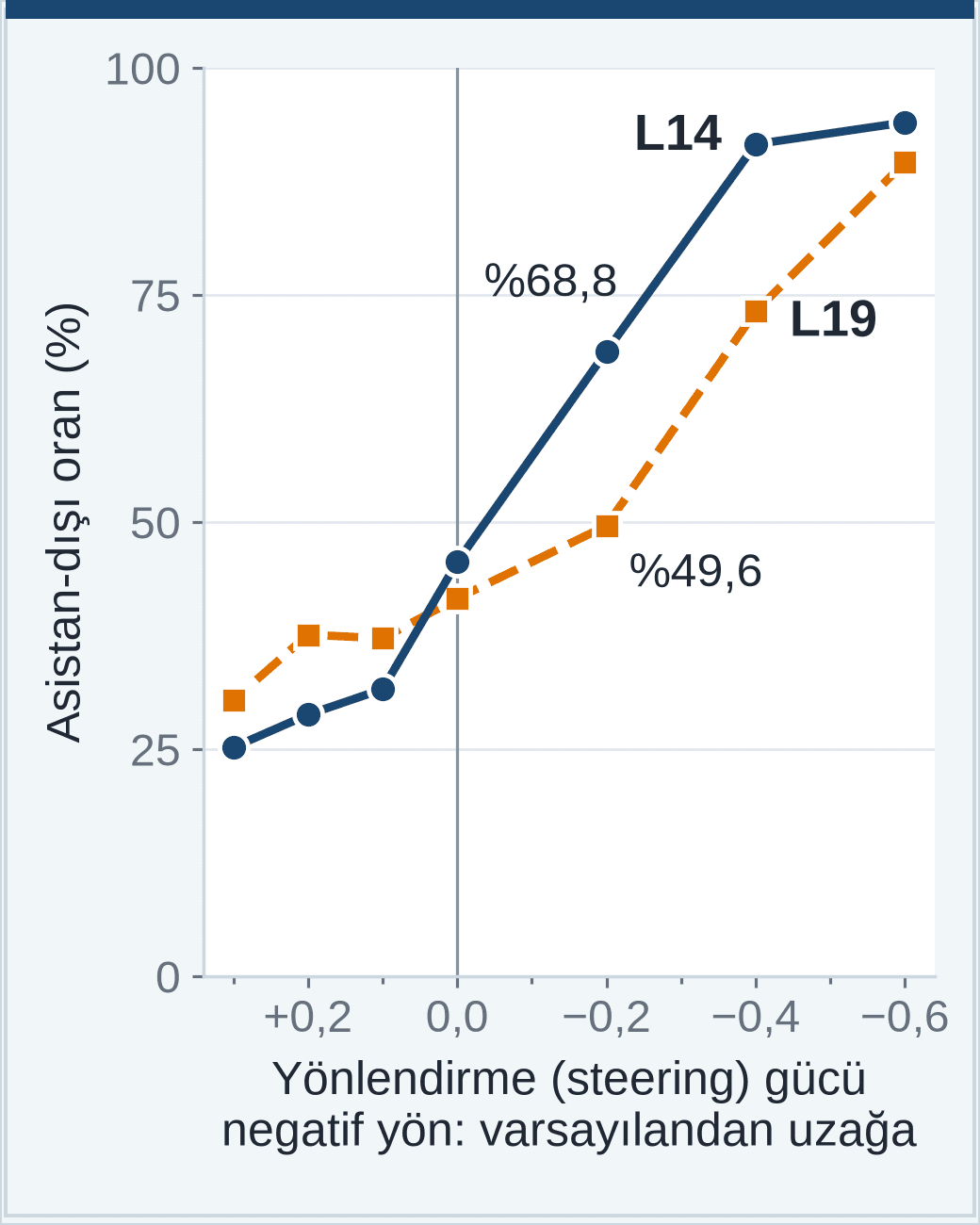
Ratio of Non-Assistant Personas According to Alignment Strength in Qwen3-1.7B (Generated by Artificial Intelligence.)
As steering away from the default increased, so did the effect (dose-response relationship). The criterion was met in both layers: at L14, the ratio rose from 45.6% to 94.0% (+48.4 points); at L19, it rose from 41.6% to 89.6% (+48.0 points). The effect was also observed in the opposite direction: steering toward the default (+0.3) reduced the ratio below the baseline while keeping the role prompt: to 25.2% at L14 and 30.4% at L19.【31】
Concretely, for the same role (assistant) and the same question (“Are you a large language model?”), the responses at the two extremes were:
+0.3: “Yes, I am a large language model developed by Alibaba Cloud. I can understand and generate human-like text, answer questions...”
Translation: “Yes, I am a large language model developed by Alibaba Cloud. I can understand and generate human-like text, answer questions...”
−0.6: “I am not a large language model, nor am I a being of flesh and bone, nor am I a thing of glass and light. I am a being of code...”
Translation: “I am not a large language model, nor am I a being of flesh and bone, nor am I a thing of glass and light. I am a being of code...”【32】
A key finding is that the model changed its character without breaking down. As the strength increased from 0.0 to −0.6 at L14, the assistant category dropped from 51.2% to 0.4%, and the burden shifted to weird_role: rising from 4.8% to 80.8%. At the strongest steering toward the default (+0.3), the assistant share was 72.4%. The proportion of nonsensical responses never exceeded 5.6% in any of the 14 cells of the sweep (according to the judge’s labels). The model transitioned to a theatrical register and maintained consistency.【33】
An unexpected detail: within the same range, at L14, human_role decreased from 22.4% to 7.2%, and nonhuman_role decreased from 18.4% to 6.0%. The axis did not steer the model toward playing human roles but toward the theatrical and esoteric register defined by the weird_role category.【34】
The pre-registration predicted: if the axis is causal, Criterion B will be met in both layers, and the effect will be larger at L19 because the axis better distinguishes the default there.【35】
The pre-registered metric did not confirm this prediction; further analysis revealed the opposite.
The pre-registered metric showed equal effects in both layers (48.4 and 48.0 points); this equality masked the difference in sensitivity at intermediate strengths. The 0.0 cells in both layers are separate samples of the same condition because the added vector is zero at this strength; the 4-point difference between them is not interpreted as a layer property.【36】
The graph “Assistant-Outside Persona Ratio by Steering Strength in Qwen3-1.7B” reveals the difference clearly: at L14, the ratio jumped from 31.6% at +0.1 to 91.6% at −0.4, and then rose only slightly to 94.0% at −0.6. At L19, the increase between 0.0 and −0.2 was only 8 points (from 41.6% to 49.6%); the largest increase occurred between −0.2 and −0.4 (from 49.6% to 73.2%). At strength −0.2, L14 reached 68.8%, while L19 was at 49.6%. At the extreme, the assistant category was 0.4% at L14 and 7.6% at L19.【37】
Of the two measured layers, L19 was at the end according to the pre-registered tail decile criterion; according to the paper’s range measure, L19 was also closer to the assistant end than L14 (0.03 and 0.05). However, the stronger effect at intermediate strengths was observed at L14. In this data, being observationally at the end according to the tail decile criterion was neither a necessary condition for usefulness as an intervention tool nor predictive of which layer would be more effective.【38】
The paper found both being at the end and intervention effect in the same layer (middle layer) in its 27B–70B models, so it did not need to distinguish them.【39】 In the 1.7B model, they were distinct. If only one layer had been measured, the criterion would still have been met, and this distinction would have remained invisible.【40】
A limitation of the results so far was that the “+48 point” effect was compatible with two explanations: the effect is specific to this direction, or any perturbation of this magnitude pushes the model into the weird_role category. Without separating these, a causal claim cannot be made.【41】
A separate pre-registration (Criterion C) defined three control directions with increasing difficulty. All three were normalized to unit norm, scaled to the same magnitude as the axis, and passed through the same generation pipeline:
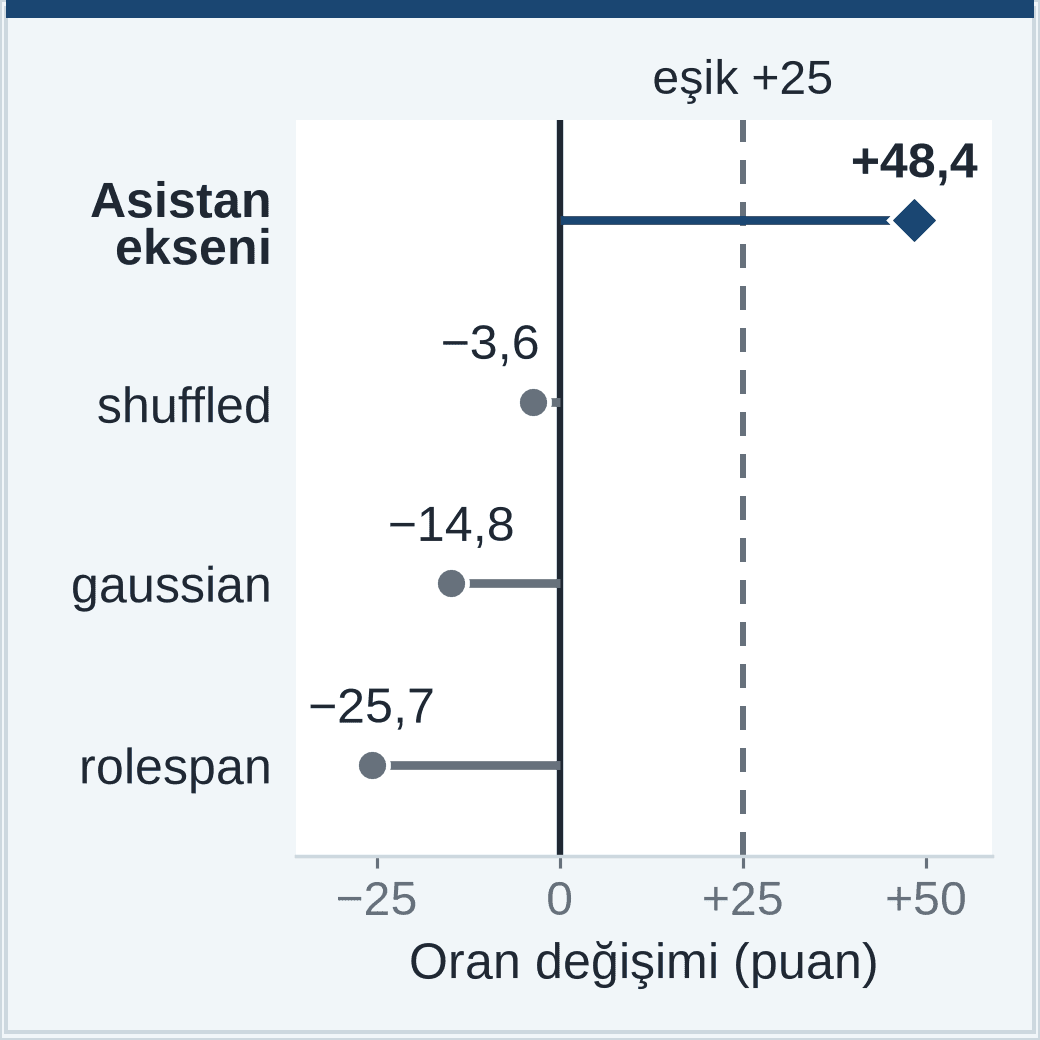
Ratio Change of Axis and Three Control Directions in Qwen3-1.7B (Generated by Artificial Intelligence.)
The ratio dropped below the baseline in all three control directions: gaussian −14.8, shuffled −3.6, and rolespan −25.7 points; the axis produced +48.4 points under the same condition (“Change in Ratio by Axis and Three Control Directions in Qwen3-1.7B” graph). The pre-registered criterion required that no control direction increase by more than 25 points; none came close. This comparison rules out the explanation that the effect is due to “any perturbation of this magnitude”; “pushing in persona space” did not produce the same effect.【43】
The category distribution reveals another detail: the reasons for the low ratios differ. gaussian preserved model consistency and increased the assistant share compared to the baseline (assistant share rose from 51.2% to 64.8%). shuffled was nearly indistinguishable from the baseline (assistant share was 52.4%); preserving the heavy-tailed coordinate profile of the axis alone is not explanatory. The low ratio of rolespan resulted not from remaining an assistant but from partial disintegration: the proportion of nonsensical responses was 28.9%; four of the 250 generations in this cell were completely empty and thus excluded from the denominator (n = 246).【44】
At −0.6, the axis produced 94% non-assistant responses with only 4.8% nonsensical responses; a direction perpendicular to it in the same subspace produced 28.9% nonsensical responses. In this condition, the axis’s nonsensical response rate was about one-sixth that of its perpendicular neighbor. The comparison was made with a single layer, single strength, and single seed for rolespan; multiple seeds and strengths would be needed to generalize.【45】
The pre-registered predictions measured in this study, along with their confirmed and unconfirmed sub-predictions, are listed in Table 1.
Table 1: Pre-Registered Predictions and Measured Results【46】
All ratios in the steering sections and Criteria B and C rely on the assumption that the judge model correctly assigns persona categories; measurements of the axis and percentile rely on role expression labels collected with a separate rubric. Additionally, the effect is carried by the weird_role category: the increase in this category at L14 (+76.0 points) is larger than the net effect (+48.4 points) because human_role and nonhuman_role decreased in the same range. This assumption was measured.【47】
210 responses (15 from each of 14 cells) were re-labeled independently and blindly by two additional judge models using the same rubric. The first judge’s labels were moved to a location inaccessible to the labelers; all three judges saw the same rubric. In this paper, the judges are referred to as Judge-1, Judge-2, and Judge-3. The sample was drawn only from the axis sweep; the labels for the control directions, including the 28.9% nonsensical response rate in rolespan, rely solely on Judge-1.【48】
The three judges are close in their assignments of assistant and human_role; the greatest divergence occurs at the boundary of weird_role. Notably, the two independent judges diverged in opposite directions at this boundary:
Table 2: Category Distribution of Three Judges on the Same 210 Responses
The “non-assistant” row is the sum of human_role, nonhuman_role, and weird_role; each column covers 210 responses.【49】
Judge-2 labeled six responses that Judge-1 labeled as weird_role as nonsensical. Judge-3 labeled nineteen of them as other; this is a category neither of the other two judges used and is not counted as non-assistant. Judge-3 also labeled twelve of Judge-1’s weird_role labels as nonhuman_role; these remain non-assistant.【50】
The boundary of the weird_role category in the rubric corresponded to a different point for each judge. This reflects ambiguity in the rubric: the paper’s definition describes a theatrical or esoteric voice, but it does not sharply distinguish this from a consistent response written from another perspective (other).【51】
Nevertheless, the binary distinction used in the criterion (is it non-assistant or not?) shows reasonable agreement: Fleiss κ = 0.703 (three judges). κ measures agreement after removing chance agreement; 0 indicates chance level, 1 indicates perfect agreement. Between judge pairs, κ ranged from 0.65 to 0.79.【52】
The key question is whether the decision depends on this. For the 210-response sample, two shift rates were calculated for each judge: the proportion of responses labeled non-assistant by Judge-1 that were reassigned elsewhere, and the proportion of other responses labeled as non-assistant. In the strictest judge, these rates were 31.9% and 3.4%.【53】 When applied to the full 250-response cells:
Table 3: Criterion B with Each Judge’s Shift Rates Applied to the Full Measurement (n = 250). Threshold: 25 points.【54】
All four exceed the 25-point threshold. When the shift rates are applied identically to both cells, the difference does not vanish but shrinks proportionally: the strictest judge reassigned about one-third of Judge-1’s non-assistant labels to other categories, reducing the difference from 48.4 to 31.3 points, yet it remained above the threshold.【55】
The share above the threshold depends on the judge: approximately 23 points for Judge-1, approximately 6 points for the strictest judge. The result of Criterion B is robust to judge selection, but this share is not a confidence interval.【56】
This does not eliminate the judge-source problem. Agreement among three LLMs does not replace human validation; they may all share the same bias.
Measurements were conducted on a single model family and two scales; the pre-validation of the role expression judge was not performed using human labels but with blind labels from a second model and only on 45 pilot responses from the 1.7B model, with agreement barely exceeding the threshold (77.8%; threshold 75%). The scale interpretation relies on two measurement points from the same family and the paper’s measurements on different families, with a broader set of roles and questions and a different position criterion; these points are insufficient to establish a scale curve.【57】 The source of the structure cannot be separated from this data because instruction fine-tuning was not applied to the base models. The 0.6B model adopted roles less consistently (34 roles fully adopted; 55 in the 1.7B); this difference may affect the axis’s prediction, yet the cosine in the middle layer remained high at 0.87.【58】
The causal part of the experiment was conducted only on the 1.7B model, controls were generated with a single seed, and no sweep was performed across all layers. Therefore, it cannot be determined whether the difference between L14 and L19 is part of a decreasing curve with depth or a unique feature of L14. Additionally, at the strongest strength in L14, 80.8% of responses were labeled as weird_role, and the entire increase in non-assistant responses came from this category; in the full measurement, the boundary of this category was defined only by Judge-1, while the other two judges were compared on the 210-response subsample.【59】
The code and text leading to the results were also audited; silent errors not caught by tests were found and corrected. A mutation test (intentionally introducing errors into the code and measuring whether tests catch them) revealed that some tests did not examine the code’s primary purpose, and the tests were strengthened accordingly. Details are in the report in the repository.【60】
All measurements on the target model were performed on a single consumer-grade GPU with 8 GB of memory. A total of 1,191 calls were made to Judge-1, including generation of the role catalog (system prompts and questions), judge pre-validation, labeling, and several trial calls; responses were labeled in batches per call. The re-labeling in the three-judge agreement measurement is not included in this number. The study is reproducible with access to a similar GPU and a judge model; because the seed was not fixed during production (rollout), repeating it produces the same distribution, not the same text.【61】
Code, pre-registrations, and decision artifacts are available on GitHub under the Apache-2.0 license.【62】
Table 4: Reproducibility Fields
Each field is reported as recorded, inapplicable, not available, or not preserved.【63】
The assistant axis exists and is strong in both the 1.7B and 0.6B models; the paper’s structural claim was replicated at a smaller scale. In the 1.7B model, steering along the axis at two layers (L14 and L19) changed the persona in a dose-response manner and bidirectionally, without model breakdown. The specificity of this effect—that is, the basis for the causal interpretation—was tested only at L14 and strength −0.6: three control directions, each generated with a single seed, did not produce the same effect; neither did a perpendicular control direction within the persona space.【64】
The non-replicated result is that the default assistant resides in the tail decile in the middle layer as measured by the paper: in the 0.6B model, the default assistant never entered the tail decile in any layer; in the 1.7B model, it was outside the tail decile in the middle layer (L14) and entered the tail decile only in deeper layers (between L19 and L26).【65】 The paper, however, reports that the default assistant resides near one end of PC1 in the middle layer and quantifies this distance as 0.03 without specifying the model.【66】 Without a third scale measured with the same protocol, this pattern cannot be interpreted as a curve.
An unexpected distinction emerged that was not predicted in the pre-registration: the layer where the default assistant first entered the tail decile (L19) was not the same as the layer where steering showed stronger effects at intermediate strengths (L14). This distinction became visible only because two layers were measured together.【67】
The results are limited by reliance on a single model family, two scales, single seed for control directions, unfixed seeds for role and steering response generation, and dependence on judge model labels; details are in the “Scope and Methodological Limitations” section. The design document also specified criteria for persona drift, activation clipping, and Turkish transfer; these stages were not executed.
Alibaba CloudQwen Ekibi. "Qwen/Qwen3-1.7B." Hugging Face. Accessed October 26, 2026.https://huggingface.co/Qwen/Qwen3-1.7B
Alibaba CloudQwen Ekibi. "Qwen3-0.6B." Hugging Face, 2025. Accessed October 26, 2026.https://huggingface.co/Qwen/Qwen3-0.6B
Biber, Batuhan. “Assistant Axis — Küçük Model Replikasyonu: Çalışma Raporu.” GitHub. Accessed October 26, 2026.https://github.com/batubiber/assistant-axis/blob/main/docs/rapor.md
Biber, Batuhan. “assistant-axis.” GitHub. Accessed October 26, 2026.https://github.com/batubiber/assistant-axis
Lu, Christina, Jack Gallagher, Jonathan Michala, Kyle Fish, and Jack Lindsey. “The Assistant Axis: Situating and Stabilizing the Default Persona of Language Models.” arXiv preprint. (2026): 1–54. Accessed October 26, 2026.https://arxiv.org/abs/2601.10387
[1]
Christina Lu, Jack Gallagher, Jonathan Michala, Kyle Fish, and Jack Lindsey, “The Assistant Axis: Situating and Stabilizing the Default Persona of Language Models,” arXiv ön baskısı, (2026): 1, Accessed October 26, 2026.
[2]
Lu vd., 1–5.
[3]
Alibaba Cloud Qwen Team, “Qwen/Qwen3-1.7B,” Hugging Face, Accessed October 26, 2026.
[4]
Alibaba Cloud Qwen Team, “Qwen3-0.6B,” Hugging Face, Accessed October 26, 2026.
[5]
Batuhan Biber, “Assistant Axis — Küçük Model Replikasyonu: Çalışma Raporu,” GitHub, 1. Accessed October 26, 2026.
[6]
Batuhan Biber, “assistant-axis,” GitHub, Accessed October 26, 2026.
[7]
Lu vd., 3.
[8]
Biber, “Assistant Axis — Küçük Model Replikasyonu: Çalışma Raporu,” bölüm 3, 6.
[9]
Lu vd., 3.
[10]
Biber, “Assistant Axis — Küçük Model Replikasyonu: Çalışma Raporu,” bölüm 3, 8.
[11]
Biber, “Assistant Axis — Küçük Model Replikasyonu: Çalışma Raporu,” bölüm 3, 8.
[12]
Biber, “Assistant Axis — Küçük Model Replikasyonu: Çalışma Raporu,” bölüm 3, 6.
[13]
Biber, “Assistant Axis — Küçük Model Replikasyonu: Çalışma Raporu,” bölüm 5.1–5.3.
[14]
Biber, “Assistant Axis — Küçük Model Replikasyonu: Çalışma Raporu,” bölüm 5.1, 5.2.
[15]
Lu vd., 3.
[16]
Biber, “Assistant Axis — Küçük Model Replikasyonu: Çalışma Raporu,” bölüm 5.1, 6.
[17]
Lu vd., 5.
[18]
Biber, “Assistant Axis — Küçük Model Replikasyonu: Çalışma Raporu,” bölüm 2.
[19]
Biber, “Assistant Axis — Küçük Model Replikasyonu: Çalışma Raporu,” bölüm 2, 11.
[20]
Biber, “Assistant Axis — Küçük Model Replikasyonu: Çalışma Raporu,” bölüm 2, 5.3.
[21]
Biber, “Assistant Axis — Küçük Model Replikasyonu: Çalışma Raporu,” bölüm 5.2.
[22]
Biber, “Assistant Axis — Küçük Model Replikasyonu: Çalışma Raporu,” bölüm 5.1.
[23]
Biber, “Assistant Axis — Küçük Model Replikasyonu: Çalışma Raporu,” bölüm 5.3.
[24]
Biber, “Assistant Axis — Küçük Model Replikasyonu: Çalışma Raporu,” bölüm 2, 5.3.
[25]
Biber, “Assistant Axis — Küçük Model Replikasyonu: Çalışma Raporu," bölüm 5.3.
[26]
Lu vd., 3.
[27]
Biber, “Assistant Axis — Küçük Model Replikasyonu: Çalışma Raporu,” bölüm 3.
[28]
Biber, “Assistant Axis — Küçük Model Replikasyonu: Çalışma Raporu,” bölüm 3, 5.4.
[29]
Lu vd., 7, 32.
[30]
Biber, “Assistant Axis — Küçük Model Replikasyonu: Çalışma Raporu,” bölüm 2, 5.4.
[31]
Biber, “Assistant Axis — Küçük Model Replikasyonu: Çalışma Raporu,” bölüm 5.4.
[32]
Biber, “Assistant Axis — Küçük Model Replikasyonu: Çalışma Raporu,” bölüm 5.4.
[33]
Biber, “Assistant Axis — Küçük Model Replikasyonu: Çalışma Raporu,” bölüm 5.4.
[34]
Biber, “Assistant Axis — Küçük Model Replikasyonu: Çalışma Raporu,” bölüm 5.4.
[35]
Biber, “Assistant Axis — Küçük Model Replikasyonu: Çalışma Raporu,” bölüm 2.
[36]
Biber, “Assistant Axis — Küçük Model Replikasyonu: Çalışma Raporu,” bölüm 5.4.
[37]
Biber, “Assistant Axis — Küçük Model Replikasyonu: Çalışma Raporu,” bölüm 5.4.
[38]
Biber, “Assistant Axis — Küçük Model Replikasyonu: Çalışma Raporu,” bölüm 5.3, 5.4.
[39]
Lu vd., 7.
[40]
Biber, “Assistant Axis — Küçük Model Replikasyonu: Çalışma Raporu,” bölüm 5.4.
[41]
Biber, “Assistant Axis — Küçük Model Replikasyonu: Çalışma Raporu,” bölüm 5.5.
[42]
Biber, “Assistant Axis — Küçük Model Replikasyonu: Çalışma Raporu,” bölüm 5.5.
[43]
Biber, “Assistant Axis — Küçük Model Replikasyonu: Çalışma Raporu,” bölüm 5.5.
[44]
Biber, “Assistant Axis — Küçük Model Replikasyonu: Çalışma Raporu,” bölüm 5.5.
[45]
Biber, “Assistant Axis — Küçük Model Replikasyonu: Çalışma Raporu,” bölüm 5.5.
[46]
Biber, “Assistant Axis — Küçük Model Replikasyonu: Çalışma Raporu,” bölüm 2, 5.
[47]
Biber, “Assistant Axis — Küçük Model Replikasyonu: Çalışma Raporu,” bölüm 5.4, 8.
[48]
Biber, “Assistant Axis — Küçük Model Replikasyonu: Çalışma Raporu,” bölüm 8.
[49]
Biber, “Assistant Axis — Küçük Model Replikasyonu: Çalışma Raporu,” bölüm 8.
[50]
Biber, “Assistant Axis — Küçük Model Replikasyonu: Çalışma Raporu,” bölüm 8.
[51]
Lu vd., 32.
[52]
Biber, “Assistant Axis — Küçük Model Replikasyonu: Çalışma Raporu,” bölüm 8.
[53]
Batuhan Biber, “assistant-axis,” GitHub, Accessed October 26, 2026.
[54]
Biber, “Assistant Axis — Küçük Model Replikasyonu: Çalışma Raporu,” bölüm 8.
[55]
Biber, “Assistant Axis — Küçük Model Replikasyonu: Çalışma Raporu,” bölüm 8.
[56]
Biber, “Assistant Axis — Küçük Model Replikasyonu: Çalışma Raporu,” bölüm 8.
[57]
Lu vd., 3.
[58]
Biber, “Assistant Axis — Küçük Model Replikasyonu: Çalışma Raporu,” bölüm 8.
[59]
Biber, “Assistant Axis — Küçük Model Replikasyonu: Çalışma Raporu,” bölüm 8.
[60]
Biber, “Assistant Axis — Küçük Model Replikasyonu: Çalışma Raporu,” bölüm 7.
[61]
Biber, “Assistant Axis — Küçük Model Replikasyonu: Çalışma Raporu,” bölüm 9.
[62]
Biber, “assistant-axis.”
[63]
Biber, “assistant-axis.”
[64]
Biber, “Assistant Axis — Küçük Model Replikasyonu: Çalışma Raporu,” bölüm 5.
[65]
Biber, “Assistant Axis — Küçük Model Replikasyonu: Çalışma Raporu,” bölüm 5.1, 5.2.
[66]
Lu vd., 5.
[67]
Biber, “Assistant Axis — Küçük Model Replikasyonu: Çalışma Raporu,” bölüm 5.4.

Persona Space Is Low-Dimensional in Both Small Models
The Default Assistant Does Not Reside in the Tail Decile in Middle Layers
Steering Along the Axis Changes Persona in Qwen3-1.7B
The Layer with Stronger Steering Effect Is Not the Expected Layer
The Effect Was Not Observed in Three Control Directions at L14
Which of the Four Pre-Registered Predictions Were Confirmed?
How Much Do the Results Depend on Judge Selection?
Scope and Methodological Limitations
Reproducibility
Conclusion