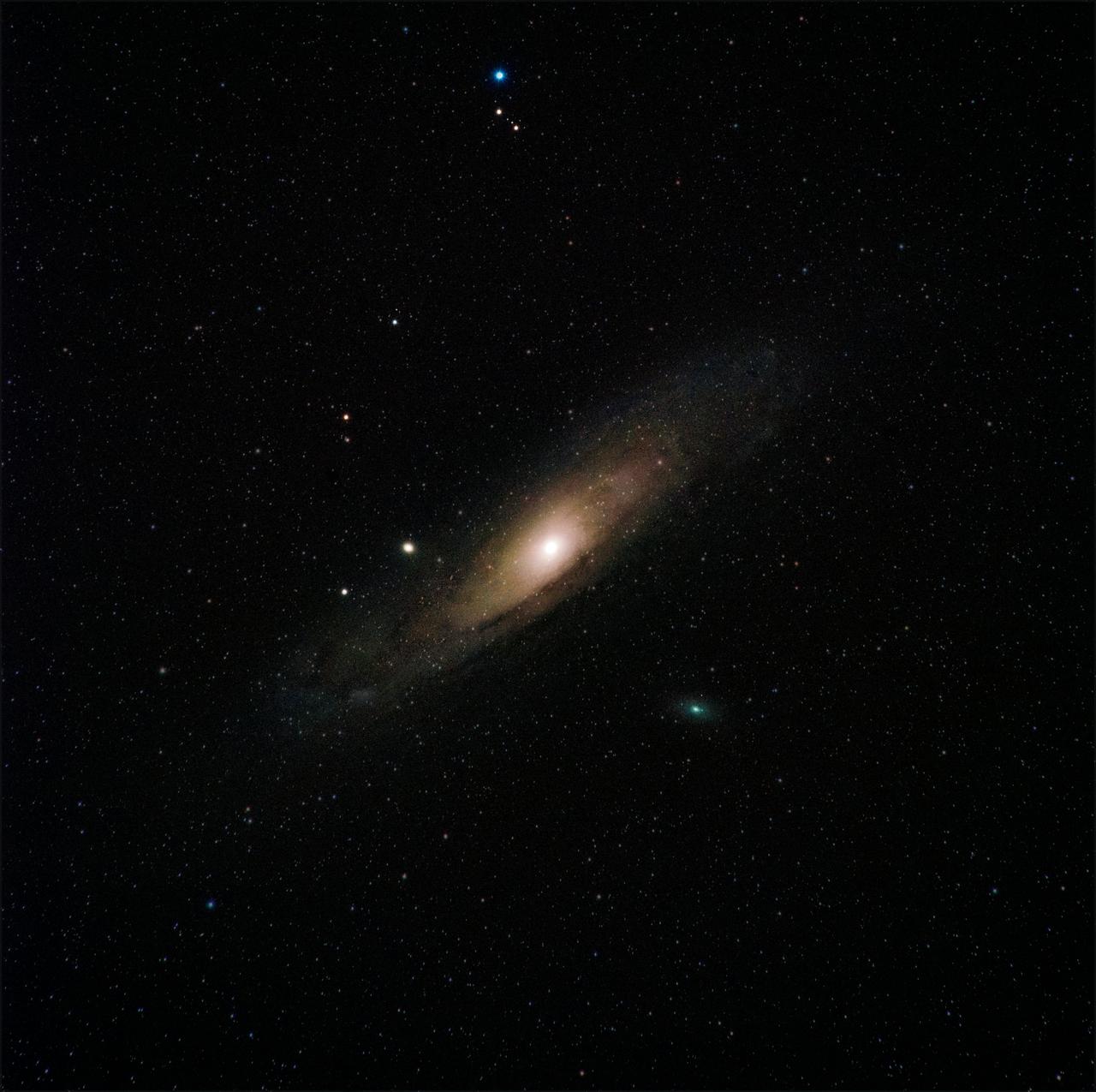


This article was automatically translated from the original Turkish version.
+1 More
Main Scientific Discipline | Space Sciences / Physics | ||||||||
|---|---|---|---|---|---|---|---|---|---|
Objects of Study | Stars, Galaxies, Black Holes, Exoplanets, Cosmic Radiation | ||||||||
Basic Tools | Telescopes (Optical, Radio, X-ray), Satellites, Spectrographs, Supercomputers | ||||||||
Important Theories | General Relativity, Law of Gravitation, Nuclear Fusion, Big Bang | ||||||||
Pioneering Figures | Isaac Newton, Johannes Kepler, Cecilia Payne, Edwin Hubble | ||||||||
Related Discipline | Observational Astrophysics Theoretical Astrophysics | ||||||||
Astrophysics is a scientific discipline that applies the laws of physics and chemistry to understand the nature, origin, development, and future of the universe and the celestial bodies within it. This field has examined the processes from birth to death of planets, galaxies, nebulae and other cosmic structures. Astronomy focuses on measuring the positions, motions and brightnesses of celestial objects, while astrophysics has developed theories to explain the physical properties of these objects and the mechanisms governing them. Cosmology has maintained a close relationship with astrophysics by addressing the largest structures and the overall nature of the universe. Astrophysics has combined mathematical models with observational data to answer fundamental questions about how the universe operates.
The foundations of astrophysics were laid with the realization that phenomena in the sky could be explained by the same physical laws that govern Earth. In the 17th century, Johannes Kepler formulated laws describing planetary motion, but he could not fully explain the physical causes behind these motions. Isaac Newton's law of universal gravitation, published in 1687, demonstrated that both terrestrial and celestial objects obey the same laws, establishing astrophysics as a scientific discipline. Newton's work made it possible to predict the orbits of celestial bodies with accuracy.
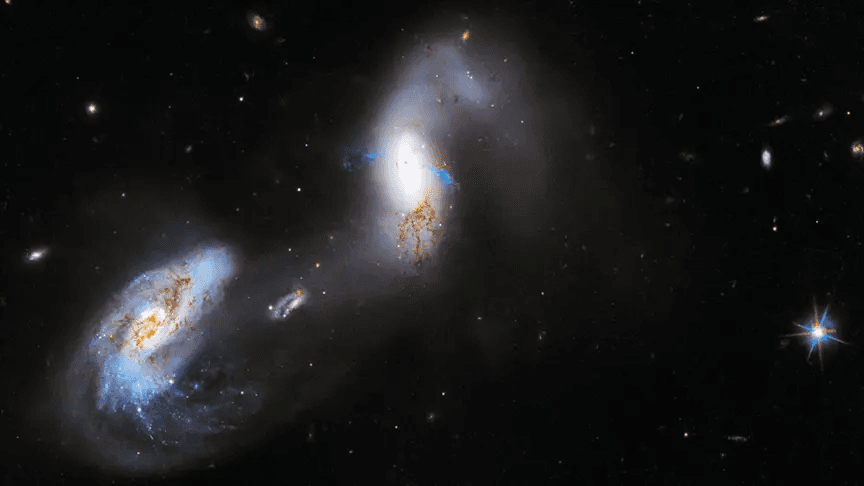
Hubble Uzay Teleskobundan Görüntülenen Galaksiler (NASA)
Another major leap in the discipline occurred in the 19th century with the development of spectroscopy (spectral science). Analyzing starlight passed through a prism enabled scientists to determine the chemical composition of celestial bodies. This method revealed that stars are composed of elements found on Earth and contain mostly hydrogen. At the beginning of the 20th century, with advances in quantum mechanics and nuclear physics, it was understood that the energy source of stars is nuclear fusion, leading to the development of stellar evolution theories. Albert Einstein's theories of relativity and Edwin Hubble's observations of the expanding universe established the foundational pillars of modern cosmology and astrophysics.
Astrophysical research is generally divided into two main categories: observational and theoretical.
This field relies on collecting and analyzing electromagnetic radiation from celestial objects using telescopes and other instruments. Observations are not limited to visible light but encompass the entire spectrum including radio waves, infrared, ultraviolet, X-rays and gamma rays. Radio astronomy enabled the discovery of objects that do not emit visible light, while X-ray astronomy has played a critical role in detecting black holes. Space telescopes have allowed for more precise data collection by avoiding the effects of Earth's atmosphere.
Mathematical models and computer simulations are used to interpret observational data and make new predictions. Theoretical studies have sought to understand phenomena that cannot be directly observed, such as stellar dynamics, galaxy formation, dark matter and dark energy.
Astrophysicists have studied a wide range of phenomena, from the smallest particles in the universe to its largest structures.
The processes from the birth to the death of stars, including nuclear synthesis and the formation of elements, have been studied in detail. The detection of planets outside the Solar System (exoplanets) and the search for the possibility of life on these planets have become a major focus of contemporary astrophysics.
Big Bang theory proposes that the universe expanded from a hot, dense initial state. The discovery of the cosmic microwave background radiation has been one of the strongest pieces of evidence supporting this theory. Dark matter, which is thought to make up a large portion of the universe's mass but cannot be directly observed, and dark energy, which accelerates the expansion of the universe, are among the greatest mysteries in modern astrophysics.
Black holes, neutron stars and supernova explosions are studied to understand how matter behaves under extreme gravity and high temperatures.
Astrophysical research has depended on advanced technological telescopes and detectors. Hubble Space Telescope has provided unparalleled images of the deep universe, while James Webb Space Telescope has used infrared observations to study the first galaxies and star-forming regions. Instruments such as the Chandra X-ray Observatory and the Fermi Gamma-ray Space Telescope have tracked the most energetic events in the universe. In addition, big data analysis and computer programming have become among the most important tools for modern astrophysicists; they now spend much of their time writing code for data analysis and modeling rather than observing at telescopes.

Turkish astrophysicist Dr. Umut Yıldız, who worked at NASA (Anadolu Ajansı)
An astrophysicist is a scientist who seeks to understand the physical and chemical properties of the universe. Astrophysicists typically work at universities, research institutions or government agencies such as NASA. Their core responsibilities include making observations, analyzing data, developing theories and publishing scientific papers. This profession requires a strong foundation in physics and mathematics as well as advanced computer and programming skills. Astrophysicists use interdisciplinary approaches to solve complex problems and often collaborate within international teams.
Astrophysical research has not only satisfied humanity's curiosity about the universe but has also contributed to the development of technologies used in daily life. For example, the precision of GPS technology relies on the principles of general relativity. Furthermore, advances in imaging technology, data science and materials science have emerged as spin-offs from technologies developed for astrophysical research. Future telescopes and space missions aim to illuminate the dark ages of the universe and search for signs of extraterrestrial life.
Big Think. "What Is Astrophysics?" Accessed February 1, 2026.https://bigthink.com/starts-with-a-bang/what-is-astrophysics/.
EBSCO. "Astrophysics." Accessed February 1, 2026.https://www.ebsco.com/research-starters/astronomy-and-astrophysics/astrophysics.
Kent Üniversitesi. "Astrofizikçi Nedir?" Accessed February 1, 2026.https://sertifika.kent.edu.tr/astrofizikci-nedir.
NASA Science. "Astrophysics." Accessed February 1, 2026.https://science.nasa.gov/astrophysics/
Space.com. "Astrophysics." Accessed February 1, 2026.https://www.space.com/26218-astrophysics.html.
University of Dundee. "What Is Astrophysics?" Accessed February 1, 2026.https://www.dundee.ac.uk/feature/what-astrophysics.

Main Scientific Discipline | Space Sciences / Physics | ||||||||
|---|---|---|---|---|---|---|---|---|---|
Objects of Study | Stars, Galaxies, Black Holes, Exoplanets, Cosmic Radiation | ||||||||
Basic Tools | Telescopes (Optical, Radio, X-ray), Satellites, Spectrographs, Supercomputers | ||||||||
Important Theories | General Relativity, Law of Gravitation, Nuclear Fusion, Big Bang | ||||||||
Pioneering Figures | Isaac Newton, Johannes Kepler, Cecilia Payne, Edwin Hubble | ||||||||
Related Discipline | Observational Astrophysics Theoretical Astrophysics | ||||||||
Historical Development and Foundations
Subfields and Methods of Astrophysics
Observational Astrophysics
Theoretical Astrophysics
Key Research Areas
Stars and Planets
Cosmology and the Origin of the Universe
High-Energy Astrophysics
Tools and Technologies Used
Roles and Careers of Astrophysicists
Societal Impact