This article was automatically translated from the original Turkish version.
+2 More
Ideological Basis | Atatürkist Thought System | ||||||||
|---|---|---|---|---|---|---|---|---|---|
Constitutional Acceptance | 1937 | ||||||||
Purpose(s) | National sovereignty modernization and independence | ||||||||
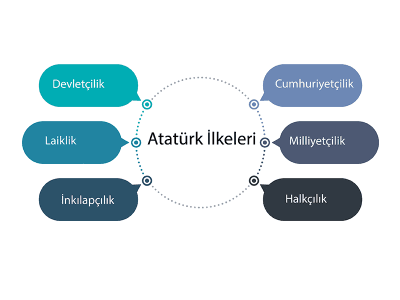
The Principles of Atatürk are defined as six fundamental principles that determine the basic political and social structure of the Republic of Türkiye, guide the Turkish Revolution, and aim at modernization. These principles form the ideological framework of the reforms carried out under the leadership of Mustafa Kemal Atatürk. Constituting the foundation of the Atatürkist thought system, these principles are grouped under six headings: Republicanism, Nationalism, Populism, Statism, Secularism, and Revolutionism. Incorporated into the Constitution in 1937, these principles have permanently shaped Türkiye’s approach to governance and social transformation.
The principle of Republicanism asserts that sovereignty belongs unconditionally to the nation. With the abolition of the sultanate and the caliphate, the people gained participation in governance through their elected representatives, and institutions chosen by election established the constitutional order. Under this principle, the people’s right to determine their own destiny was guaranteed, and popular will became the fundamental principle of governance.
Atatürk’s understanding of nationalism is based not on ethnic grounds but on a conception rooted in historical, cultural, and ideological unity. It recognizes all citizens living within the borders of the Republic of Türkiye as equal individuals of the Turkish nation. This understanding seeks to strengthen national unity and solidarity, ensure independence from external pressures, and promote social cohesion internally.
The principle of Populism emphasizes that all citizens are equal before the law without any class distinction. The sovereignty belonging to the people, popular participation in governance, equal opportunity, and equitable access to public services are its core tenets. This principle also constitutes a social approach that encourages democratization.
The principle of Statism envisions the state assuming a guiding and regulatory role in economic life alongside the encouragement of individual enterprise. In areas where the private sector proved insufficient for Türkiye’s economic development, state investments were aimed at fostering progress. This principle embraces a mixed economy model.
Secularism is the principle of separating religious affairs from state affairs and ensuring the state maintains equal distance from all beliefs. Secularism safeguards not only freedom of religion but also freedom of thought. The removal of religious authority’s influence over political decision-making mechanisms and the protection of individual conscience are fundamental to this principle.
Revolutionism denotes the transformation of existing institutions according to contemporary needs and the commitment to continuous renewal. It opposes stagnation. The preservation of Atatürk’s reforms and their ongoing adaptation to the demands of the age are requirements of this principle. It envisions Türkiye’s continuous progress in social, political, and cultural domains.
Millî Savunma Bakanlığı. "Atatürk İlkeleri." ATA Portalı. Accessed July 8, 2025.
T.C. Kültür ve Turizm Bakanlığı. "Atatürk İlkeleri İkonu (Görsel)." Kültür Portalı. Accessed July 8, 2025.
T.C. Kültür ve Turizm Bakanlığı. "Atatürk İlkeleri." Kültür Portalı. Accessed July 8, 2025.
Yavuz, Abdurrahman. "Atatürk İlkeleri." Atatürk Ansiklopedisi, July 20, 2023. Accessed July 8, 2025.

Ideological Basis | Atatürkist Thought System | ||||||||
|---|---|---|---|---|---|---|---|---|---|
Constitutional Acceptance | 1937 | ||||||||
Purpose(s) | National sovereignty modernization and independence | ||||||||
No Discussion Added Yet
Start discussion for "Atatürk's Principles" article
Republicanism
Nationalism
Populism
Statism
Secularism
Revolutionism