


This article was automatically translated from the original Turkish version.
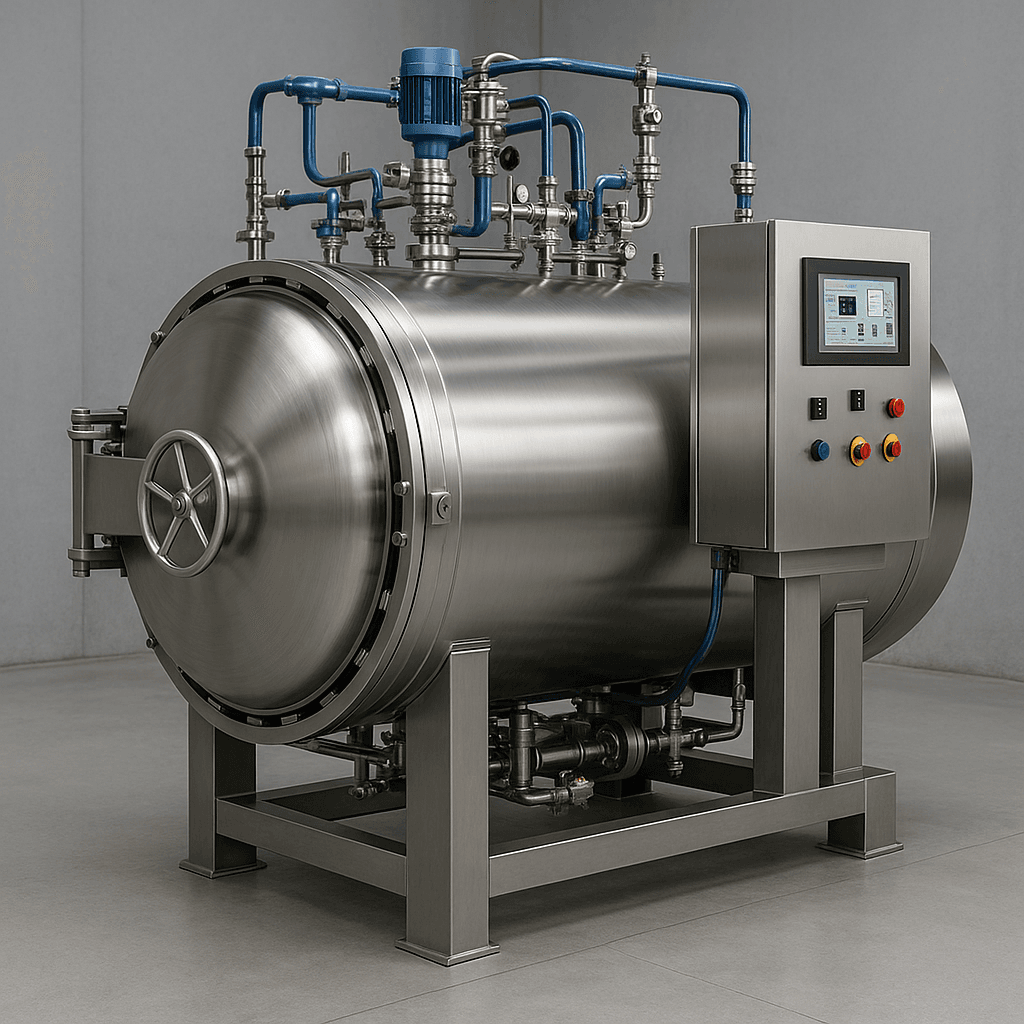
Industrial Autoclave Device
Definition(s) | Medical and industrial device that sterilizes using pressurized steam | ||||||||
|---|---|---|---|---|---|---|---|---|---|
Working Principle | Destruction of microorganisms by saturated steam at specific pressure and temperature | ||||||||
Construction Material | Stainless steel inner vessel, high-pressure-resistant outer structure | ||||||||
Basic Components | Boiler, Lid, Vacuum pump, Solenoid valve, Manometer, Thermometer | ||||||||
Application Area(s) | Hospitals Composite production Defense industry Laboratories | ||||||||
An autoclave is a device widely used in medical, biomedical, laboratory, and industrial fields to achieve sterilization through pressurized steam. Its primary purpose is to eliminate pathogenic microorganisms and create a sterile environment. Sterilization plays a critical role in preventing life-threatening infections, and the autoclave is one of the most effective, safe, and economical tools for this process.

Industrial autoclave device (generated by artificial intelligence)
The operating principle of autoclaves is based on the application of saturated steam at specific pressure and temperature conditions to the material to be sterilized. This method targets the denaturation of microbial proteins to kill them. The most common sterilization parameters are 15 minutes at 121°C and 1 atmosphere pressure or 3 minutes at 134°C and 2 atmospheres pressure. This method is highly effective in neutralizing both vegetative bacteria and spores. Uniform distribution of heat and steam across all surfaces is a fundamental factor determining sterilization quality.
Autoclaves are widely used in the defense and aerospace industries for the production of composite parts. In these fields, autoclaves perform curing by applying precise temperature and pressure profiles according to a specified "recipe." Each autoclave cycle is carefully designed to achieve the desired physical and chemical resistance properties in the final part. Loading and scheduling plans are crucial for energy efficiency and maintaining production continuity.
Sterilization efficacy is tested using biological indicators such as Bacillus subtilis, which are exposed to specific temperature and time conditions (e.g., 121°C for 15 minutes). Additionally, digital data recorders such as the Ebro EBI AE-S-2000 are used to monitor temperature and pressure graphs, enabling technical analysis of the sterilization cycle. Performance tests are repeated across various test tubes, pipettes, and vessel sizes to ensure generalizability.
Regular maintenance of autoclaves, including inspection of valves and lid systems, and calibration of temperature and timer controls, is essential for ensuring sterilization reliability. Indicator lamps, filters, and control switches must also be tested periodically. Inspection checklists should cover performance tests of vacuum pumps, response times of solenoid valves, digital sensor calibration, and functionality of pressure relief systems.
The autoclave is a fundamental scientific and technical instrument for sterilization. It has a broad range of applications from preserving medical hygiene to supporting defense industry processes. Effective use requires proper operation, monitoring, and maintenance procedures supported by technical knowledge. It is also a system that must be continuously monitored through biological and technical performance tests. This systematic control process ensures the continued reliability and effectiveness of the device.
Adil Karadağ. "Otoklav ile Sterilizasyon." 4. Ulusal Sterilizasyon Dezenfeksiyon Kongresi, 2005. Accessed May 12, 2025.
Haskılıç, Volkan. Kompozit Üretiminde Otoklav Yükleme ve Çizelgeleme İçin Yeni Bir Model Önerisi: Savunma Sanayii Uygulaması. PhD thesis, Hacettepe Üniversitesi, 2019. Accessed May 12, 2025.
T.C. Millî Eğitim Bakanlığı. Otoklavda Elektromekanik Sistemler. Biyomedikal Cihaz Teknolojileri Modülü, 2012. Accessed May 12, 2025.
Yöleri, Gamze. Otoklav Ünitelerinin Teknik ve Biyolojik Performans Analizleri. Master's thesis, İstanbul Üniversitesi, 2011. Accessed May 12, 2025.

Industrial Autoclave Device
Definition(s) | Medical and industrial device that sterilizes using pressurized steam | ||||||||
|---|---|---|---|---|---|---|---|---|---|
Working Principle | Destruction of microorganisms by saturated steam at specific pressure and temperature | ||||||||
Construction Material | Stainless steel inner vessel, high-pressure-resistant outer structure | ||||||||
Basic Components | Boiler, Lid, Vacuum pump, Solenoid valve, Manometer, Thermometer | ||||||||
Application Area(s) | Hospitals Composite production Defense industry Laboratories | ||||||||
Principle of Operation
Structural Components and Technical Hardware
Sterilization Process and Important Considerations
Applications
Industrial Applications and Examples
Biological and Technical Performance Monitoring
Maintenance and Calibration