


This article was automatically translated from the original Turkish version.
+2 More
Company Type | Development Partnership | ||||||||
|---|---|---|---|---|---|---|---|---|---|
Sector | Automotive, E/E (Electrical/Electronic), Software, Semiconductor | ||||||||
Year of Establishment | 2003 | ||||||||
Headquarters | Munich, Germany (Administrative center) | ||||||||
Key Figures | Carmine De Iesu (Spokesperson for Project Leaders) Ralf Schneider (Vice Chair) Thomas Rüping (Chair) | ||||||||
Number of Members | 366 | ||||||||
Website(s) | autosar.org | ||||||||
AUTOSAR (AUTomotive Open System ARchitecture) is a global development partnership comprising automotive manufacturers, suppliers, and service and technology providers. Its purpose is to facilitate the software development processes of electronic control units (ECUs) in modern vehicles by defining an open and standardized software architecture.
In today’s automotive industry, software complexity has significantly increased due to advanced driver assistance systems (ADAS), autonomous functions, electric powertrains, over-the-air (OTA) updates, and connected vehicle technologies. AUTOSAR was developed to manage this complexity, ensure separation between software and hardware, and simplify the integration of components from different suppliers.
The motivations behind AUTOSAR’s creation include:
AUTOSAR is built on a layered architecture that separates software from hardware.
Thanks to this architecture, a software component can be executed on different hardware platforms with minimal modifications.

AUTOSAR Classic Platform - Simplified Software Layer Architecture (Generated by Artificial Intelligence.)
Although both platforms serve different use cases, their shared goal is modularity and standardization in automotive software.
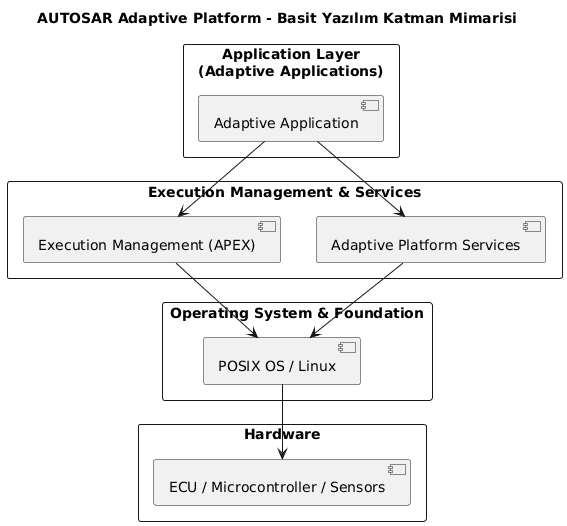
AUTOSAR Adaptive Platform - Simplified Software Layer Architecture (Generated by Artificial Intelligence.)
Key toolchains used in the AUTOSAR development process:
This ecosystem facilitates collaboration between manufacturers and suppliers.
AUTOSAR is designed to comply with the ISO 26262 functional safety standard. It supports secure communication, isolation of software components, and traceability in critical applications.
Main application areas include:
AUTOSAR. "AUTOSAR Partnership – Official Documentation." AUTOSAR. Accessed September 24, 2025. https://www.autosar.org/
Siemens Digital Industries Software. "AUTOSAR Technology." Accessed September 24, 2025. https://www.sw.siemens.com/de-DE/technology/autosar/
Visure Solutions. "AUTOSAR: Nedir, Önemi ve Otomotiv Yazılım Geliştirmedeki Rolü." Accessed September 24, 2025. https://visuresolutions.com/tr/otomotiv/otosar/

Company Type | Development Partnership | ||||||||
|---|---|---|---|---|---|---|---|---|---|
Sector | Automotive, E/E (Electrical/Electronic), Software, Semiconductor | ||||||||
Year of Establishment | 2003 | ||||||||
Headquarters | Munich, Germany (Administrative center) | ||||||||
Key Figures | Carmine De Iesu (Spokesperson for Project Leaders) Ralf Schneider (Vice Chair) Thomas Rüping (Chair) | ||||||||
Number of Members | 366 | ||||||||
Website(s) | autosar.org | ||||||||
Purpose and Importance
AUTOSAR Architecture
Layers
AUTOSAR Platforms
Classic Platform (Classic Platform - CP)
Adaptive Platform (Adaptive Platform - AP)
Tools and Ecosystem
Functional Safety and Application Areas