

This article was automatically translated from the original Turkish version.
+2 More
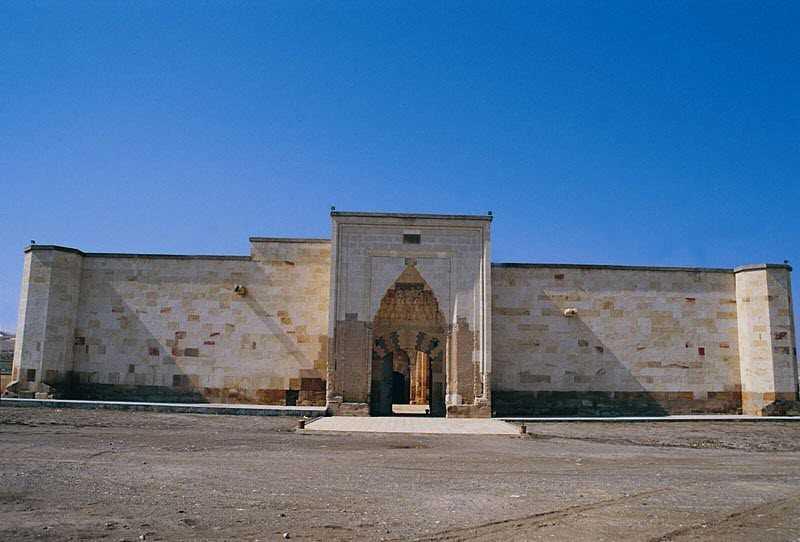
Avanos Sarı Han is a caravanserai built during the Anatolian Seljuk period. Located approximately 10 km from Nevşehir’s Avanos district, 6 km north of Ürgüp, within the Damsa Çayı Valley on the left bank of the Kızılırmak River, the structure is situated on a slope higher to the west than to the east. No trace of the historical caravan route remains to the present day.

Sarıhan (Anatolian Seljuk Architecture Inventory
The structure is known as “Sarı Han” or “Avanos Han.” The name “Sarı Han” derives from the yellowish hue of the stones used in its construction. No written sources from the Seljuk period mention the name of this caravanserai, and it has attracted only limited interest from historians.
Two inscriptions are present on the structure: one on the courtyard portal and the other on the crowning portal of the enclosed section (shelter). The authenticity of these inscriptions and their relationship to the building remain subjects of debate.
Considering its architectural features and decorations, the structure is generally believed to have been constructed in the first half of the 13th century, most likely during the reign of II. Gıyaseddin Keyhüsrev. Some researchers suggest that the original enclosed section may have been built during the time of I. Alaeddin Keykubad (around 1220), while the courtyard was added later during the reign of his son II. Gıyaseddin (in the 1240s).
The caravanserai follows the typical Anatolian Seljuk plan, combining an open courtyard with enclosed spaces.

Sarıhan Decoration Example (Anatolian Seljuk StructureInventory)
Geometric ornamentation dominates the portals of the courtyard and shelter, as well as the mosque entrance and mihrab. Muqarnas arches, zigzag motifs, polygons, and star compositions define the decorative scheme. No floral or figurative motifs are present. The stonework shows parallels with structures such as Ağzıkarahan and Kayseri Sultan Hanı.
The caravanserai covers a total area of approximately 2000 square metres, of which 1120 square metres belong to the courtyard and 570 square metres to the enclosed section.
In 1940, during the construction of a bridge over the Kızılırmak River in Avanos, some of the caravanserai’s stones were removed. As a result, the building’s exterior walls were largely damaged. Restoration carried out by the General Directorate of Foundations between 1986 and 1991 restored the structure.
Today, Sarı Han is operated by a private enterprise under the supervision of the Ministry of Culture and Tourism as a cultural centre, hosting exhibitions, conferences, and Mevlevi sema performances.

Name and Origin
Dating and Inscriptions
Architectural Features
Architectural Layout
Decorations
Dimensions
Use and Conservation