

This article was automatically translated from the original Turkish version.
+1 More
Aydıntepe sugar bean is a local variety of dry bean belonging to the species Phaseolus vulgaris L., unique to the Aydıntepe district of Bayburt. This bean is derived from dwarf plants and is distinguished by its violet-colored flowers and flat, pale pink, colorless pods. It is cultivated using traditional methods without chemical inputs, in soils that are clayey-loamy and rich in potassium, within a microclimatic region at an altitude of 1450–1650 meters.
Aydıntepe sugar bean is a local variety of dry bean belonging to the species Phaseolus vulgaris L., unique to the Aydıntepe district of Bayburt. This product is cultivated within geographic boundaries encompassing the neighborhoods of Ahmet Yesevi, Hacı Ali Efendi, Kale and Yakudiye, and the villages of Akbulut, Alaca, Aşağıkırzı, Başpınar, Çatıksu, Çayırköprü, Çiğdemlik, Dumlu, Erikdibi, Gümüşdamla, Günbuldu, İncili, Kavlatan, Kılıçkaya, Pınargözü, Sırataşlar, Sorkunlu, Suludere, Şalcılar, Yanoba, Yapracık, Yazlık and Yukarıkırzı. Its registration was completed on 9 June 2021 and it is protected under its place of origin name. The registration application was submitted by Bayburt University.
The Aydıntepe district lies on a plateau with an altitude of 1450–1650 meters and exhibits distinct microclimatic features. The northern slopes of the Soğanlı Mountains are influenced by the Black Sea climate, resulting in cold and snowy winters and dry, hot summers throughout the region. The agricultural soils are clayey-loamy, slightly alkaline, non-saline and rich in potassium. Traditional farming practices are prioritized; production is carried out without the use of agrochemicals or synthetic fertilizers. Farmers continue the tradition of reusing seeds harvested from their own crops for the following year.
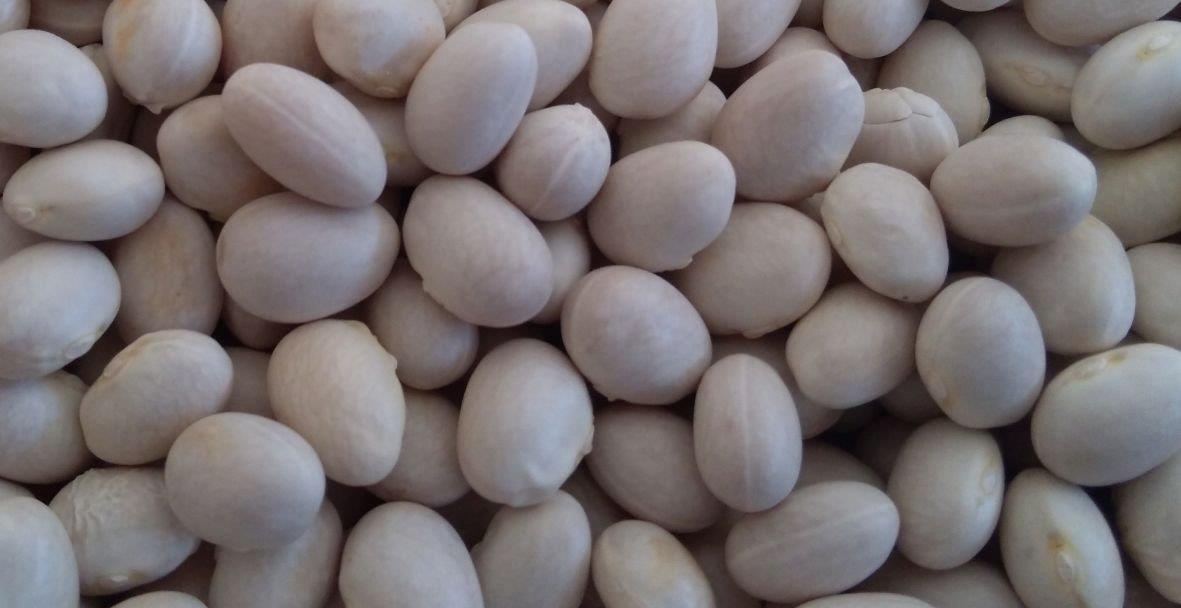
Aydıntepe sugar bean is a dwarf plant. It has moderately pigmented, green, triangular leaflets. The plant is hairy and produces violet-colored flowers. Immature pods are colorless. Mature pods are flat and pale pink in color. The seeds are egg-shaped with a slight kidney-like form.
Morphological criteria are as follows:
Aydıntepe sugar bean is notable for its rapid cooking time (approximately 15 minutes). Chemical analyses revealed aspartic acid levels between 2279–2331 mg/100 g and glutamic acid levels between 3065–3123 mg/100 g. The nutritional values per 100 grams of the product are as follows:
Soil preparation begins in April to create an optimal seedbed. Implements such as disc plough, harrow, disk harrow and rotary tiller are used for soil tillage. Bean seeds are sown by hand between late April and late May. Fertilization is performed exclusively with 2–3 tons of well-rotted farmyard manure per hectare. Maintenance activities include weeding and weed control. Irrigation is carried out in four stages: during the three-leaf stage, before flowering, 10 days after fruit set, and one month before harvest.
Harvesting begins in mid-August and continues until the end of September. Mature pods are collected by hand in the early morning hours and then dried in the sun. Seeds are separated by hand or using traditional threshing machines. The dried product is stored in jute sacks. Seeds for the following year are selected at this stage.
The production and marketing of Aydıntepe sugar bean are monitored by a control authority established under the coordination of Bayburt University. This authority consists of at least five experts from Bayburt University, Bayburt Provincial Directorate of Agriculture and Forestry, Aydıntepe District Directorate of Agriculture and Forestry, and Aydıntepe Chamber of Agriculture. Monitoring is conducted in three phases:
Support may be obtained from public and private institutions during monitoring activities. The registering institution is responsible for initiating legal procedures to protect the geographical indication.

No Discussion Added Yet
Start discussion for "Aydıntepe Sugar Bean" article
Origin
Growing Environment and Agricultural Characteristics
Botanical Characteristics and Morphology
Chemical and Nutritional Composition
Quality Characteristics (Per 100 Seeds)
Production Process
Harvest and Threshing
Monitoring and Protection