


This article was automatically translated from the original Turkish version.
+2 More
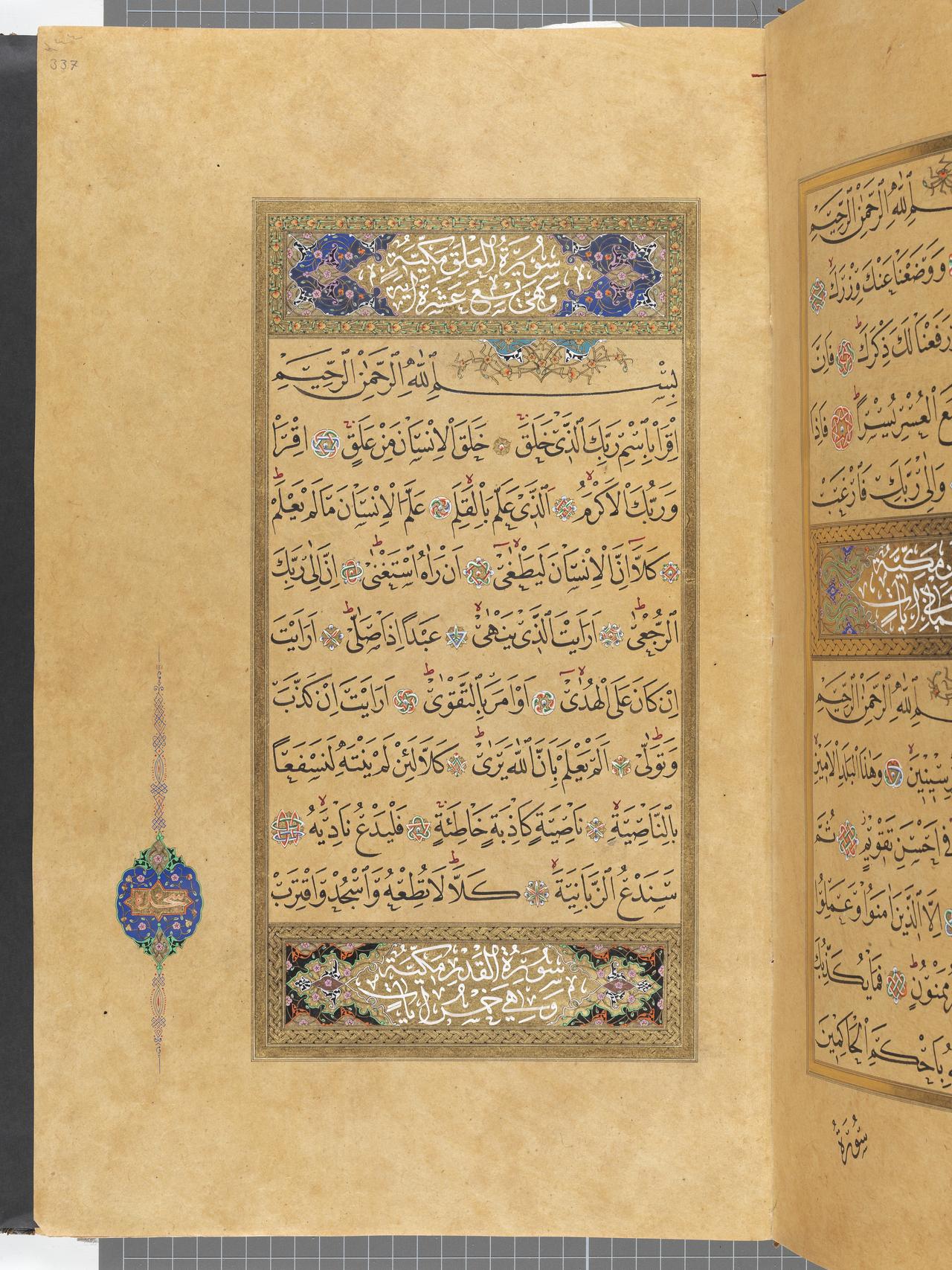
Ayet-Berkenar (Photo: Muhammed Ali Peker)
Mucidi | Kayışzâde Hâfız Osman Nûrî (d. 1894) | ||||||||
|---|---|---|---|---|---|---|---|---|---|
Historical | 19th century | ||||||||
Calligraphers Who Used | Hasan Rıza Efendi, Hattat Mehmed Hulusi Efendi, Şefik Bey, İsmail Zühdi Efendi | ||||||||
Page Standard | En: Surah Al-Kawthar, Boy: Surah Al-Baqarah, Verse 282 | ||||||||
Historical Development | It became standardized among Ottoman calligraphers in the 19th century | ||||||||
Ayet-Berkenar is a calligraphic technique developed by the Ottoman calligrapher Kayışzâde Hâfız Osman Efendi, based on a page layout principle used in the transcription of the Qur’an. The term is composed of the Arabic word “ayet” (verse) and the Persian word “berkenar” (aligned at the edge). In this system, each page of the Qur’an begins and ends with a complete verse. Pages typically consist of fifteen lines, with each line of text having equal length. This ensures that verses are never split across lines, enhancing both aesthetic unity and readability.
The Ayet-Berkenar layout became the standard in Ottoman-era Qur’an transcription and continues to be widely used today. This writing style not only facilitates memorization in hafız training but also stands as a distinguished example within the art of calligraphy.

Calligrapher Writing a Mushaf (Generated by Artificial Intelligence)
The Ayet-Berkenar system emerged within the Ottoman calligraphic tradition of the 19th century and was regarded as a revolutionary innovation in Qur’an transcription. The inventor of this system is recognized as Kayışzâde Hâfız Osman Efendi. Although he is often confused with the renowned 17th-century calligrapher Hâfız Osman (1642–1698), these are two distinct individuals.
Hâfız Osman, when determining the line and page structure of the Qur’an, used the shortest surah, Surah Kevser, as the standard for line length, and the longest verse, Ayat al-Mudayana (Baqarah 282), as the standard for page height. Using this method, each page was structured to contain exactly fifteen lines, and it was observed that the predetermined endings of verses consistently aligned with the ends of pages. Thus, when the Qur’an was rewritten centuries after its revelation, the integrity of its meaning was preserved by ensuring that each verse concluded at the end of a page.
This system, pioneered by Hâfız Osman, quickly became standardized across the Ottoman territories and was adopted and refined by subsequent generations of calligraphers. The Ayet-Berkenar technique was particularly refined in the 18th and 19th centuries by calligraphers such as Hasan Rıza Efendi, whose works have survived to the present day.
Qur’ans transcribed using the Ayet-Berkenar method during the 18th and 19th centuries in the Ottoman Empire attracted attention for their orderly page structure and legibility, especially due to their suitability for hafız education. This layout continues to be used in contemporary Qur’an production and reflects the continuity of the Ottoman book arts tradition.

Qur’an (AA)
In practice, the width of each line is measured to accommodate the shortest surahs—such as Surah Kevser—within a single line. The height of the page is determined based on the length of the longest verse in the Qur’an, Ayat al-Mudayana (Baqarah 282), ensuring it fits within the established line width. As a result, each page typically contains approximately fifteen lines. When this layout principle is applied consistently throughout the Qur’an, the endings of all verses align precisely with the ends of pages.
This writing style offers not only visual aesthetics but also functional convenience. For those engaged in memorization, the fact that each page contains complete verses facilitates learning and recall. Additionally, this method provides readers with a coherent sense of meaning, as verses are not interrupted by page breaks. Ayet-Berkenar stands out as an application that honors the sanctity of the Qur’anic text while embodying the artistic values of the calligraphic tradition.

Person Reading the Qur’an (Pexels)
Following Kayışzâde Hâfız Osman, Hasan Rıza Efendi (1849–1920) was one of the most successful calligraphers to apply the Ayet-Berkenar system. Holding the title of “State Calligrapher,” Hasan Rıza Efendi integrated this layout into his Qur’ans with both technical precision and artistic elegance. His transcribed Mushaflar are preserved today in numerous mosques, museums, and private collections.
Other calligraphers of this period, including Mehmed Hulusi Efendi, Şefik Bey, and İsmail Zühdi Efendi, also contributed to the establishment of this method through their use of the Ayet-Berkenar system. These calligraphers did not merely preserve the layout; they enriched their Mushaflar with traditional Ottoman arts such as bookbinding, illumination, and marbling, transforming them into visual masterpieces.
Examples of Mushaflar written in the Ayet-Berkenar style can be found today in the Topkapı Palace Museum, the Museum of Turkish and Islamic Arts, the Süleymaniye Library, and various private collections. These works are not merely religious texts but also documents of the calligraphers’ aesthetic sensibilities and their commitment to the art of the book.

Handwriting of Hasan Rıza Efendi (Photograph: Muhammed Ali Peker)
The Ayet-Berkenar system continues to be applied in both traditional and modern Qur’an production today. Many official and private Mushaflar printed in Türkiye are still produced in accordance with this layout, particularly those published by the Directorate of Religious Affairs, which strictly adheres to Ayet-Berkenar principles. This system is preferred not only for its aesthetic qualities but also for its functional advantage, as it enables readers to follow the integrity of each verse without interruption.
With advances in modern printing technology, digital designs compatible with the Ayet-Berkenar system have been developed, and Qur’ans are now formatted using computer-assisted typesetting software to conform to this structure. At the same time, calligraphers dedicated to preserving the traditional art of handwriting continue to produce handwritten Mushaflar using this method. In particular, for special collection Mushaflar written in classical Naskh script, Ayet-Berkenar is regarded as the fundamental principle of transcription.
Moreover, Qur’an memorization courses that provide hafız training prefer Mushaflar following this layout, as the completion of each page within a single verse offers a more systematic approach to memorization. The fixed beginning and end of each page simplify the processes of recall and repetition for learners.
Anadolu Ajansı. "Kur'an-ı Kerim Basım ve Yayım Kriterleri Hakkında Yönetmelik, Resmi Gazete'de yayımlandı." Accessed June 18, 2025. https://www.aa.com.tr/tr/kultur/kuran-i-kerim-basim-ve-yayim-kriterleri-hakkinda-yonetmelik-resmi-gazetede-yayimlandi/2727238
Derman, M, Uğur. "HASAN RIZÂ EFENDİ, Hacı". *TDV İslâm Ansiklopedisi*. Accessed May 31, 2025. https://islamansiklopedisi.org.tr/hasan-riza-efendi-haci
Derman, M, Uğur. "Hâfız Osman." *TDV İslâm Ansiklopedisi*. Accessed May 31, 2025. https://islamansiklopedisi.org.tr/hafiz-osman
Pexels. "Kuran Okuyan Adam JPG." Accessed June 18, 2025. https://www.pexels.com/tr-tr/fotograf/kuran-okuyan-adam-16066399/
Serin, Muhittin. "Kayışzâde Hâfız Osman Nûrî." *TDV İslâm Ansiklopedisi*. Accessed May 31, 2025. https://islamansiklopedisi.org.tr/kayiszade-hafiz-osman-nuri

Ayet-Berkenar (Photo: Muhammed Ali Peker)
Mucidi | Kayışzâde Hâfız Osman Nûrî (d. 1894) | ||||||||
|---|---|---|---|---|---|---|---|---|---|
Historical | 19th century | ||||||||
Calligraphers Who Used | Hasan Rıza Efendi, Hattat Mehmed Hulusi Efendi, Şefik Bey, İsmail Zühdi Efendi | ||||||||
Page Standard | En: Surah Al-Kawthar, Boy: Surah Al-Baqarah, Verse 282 | ||||||||
Historical Development | It became standardized among Ottoman calligraphers in the 19th century | ||||||||
History
Application Techniques and Characteristics
Key Practitioners and Works
Contemporary Usage