


This article was automatically translated from the original Turkish version.
+2 More
Location | Ayvalık Türkiye Balıkesir | ||||||||
|---|---|---|---|---|---|---|---|---|---|
Culture | Orthodox | ||||||||
Architecture(s) | Neoclassical style | ||||||||
Construction | First constructed in 1867, expanded in 1890 | ||||||||
Feature(s) | Sacred water for healing purposes | ||||||||
Restoration | 2016 - 2018 | ||||||||
Ayvalık Ayazması is a sacred water structure belonging to the Orthodox tradition, located in the Ayvalık district of Balıkesir Province, Türkiye. The ayazma holds a significant place in the region’s historical and religious life and attracts visitors due to both its architectural features and its sacred water.
The term “ayazma” derives from the Greek word “Hagiasma,” meaning “sacred place.” The Ayvalık Ayazma was known as Panagia Phaneromeni in accordance with Orthodox devotion to the Virgin Mary. According to local accounts, excavations carried out in 1852 following a dream experienced by a 16-year-old girl named Evaggelini led to the discovery of an icon of the Virgin Mary. The first ayazma was constructed in 1867 and later rebuilt in 1890 as a larger structure. The ayazma played an active role in the religious life of the region until 1920; after 1922, it lost its significance due to demographic changes in the area.
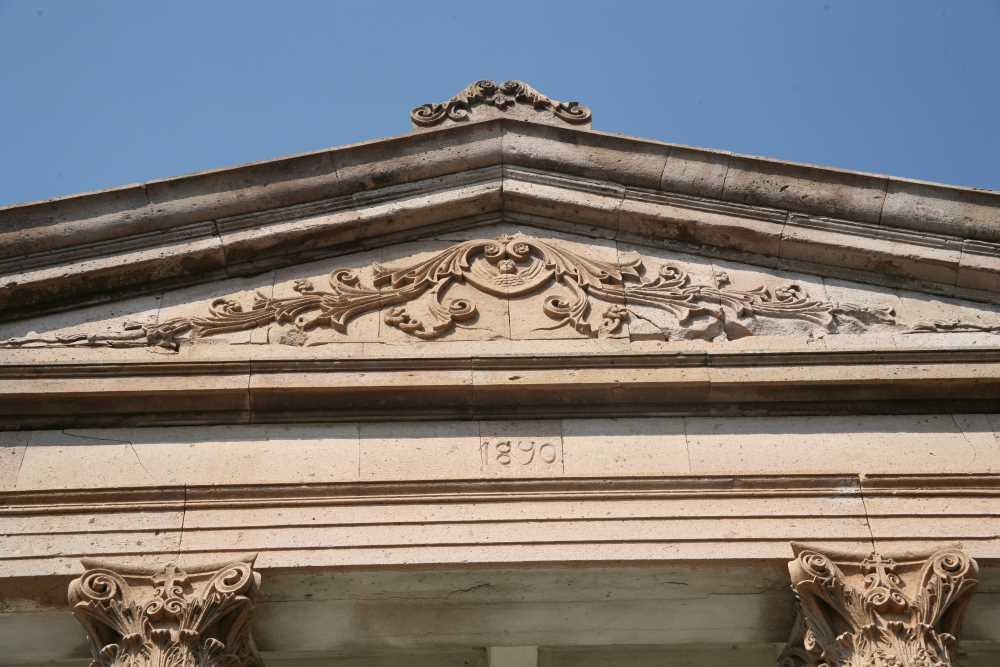
The Ayvalık Ayazma is situated on a plot of 391 square meters, with a floor area of 9 by 18 meters and a height of 9.7 meters. Built in the Neoclassical style, it follows a prostylos plan type. Access to the main entrance is provided through a narthex supported by four Corinthian columns. The southeast and northwest facades each feature four stained-glass windows, totaling eight. The structure is covered by a barrel vault roof clad with Marseille-type tiles. Inside, the ceiling decorations in a coffered pattern incorporate acanthus leaf motifs.
The pool within the structure served as the area where the sacred water was collected. Access to the pool is provided via a nine-step staircase. Niches around the pool housed and preserved sacred objects. The facade decorations consist of garlic-stone door and window frames and voluted consoles.
The Ayvalık Ayazma met the religious needs of the Orthodox population in the region, particularly during the late 19th and early 20th centuries, and became an important center believed to distribute healing through its sacred water. The structure was visited not only by local residents but also by patients from surrounding areas and Rumelia. The sacred water found within the ayazma was consumed by visitors and used in the treatment of illnesses.
Accessed November 26, 2025.
T.C. Kültür ve Turizm Bakanlığı Kültür Portalı. "Ayazma Kilisesi." Accessed June 23, 2025.
T.C. Ministry of Culture and TourismAyvalık Turizm Advisory Office. "Kiliseler." Accessed June 23, 2025. https://ayvalikturizmdanismaburosu.ktb.gov.tr/TR-141143/kiliseler.html

Location | Ayvalık Türkiye Balıkesir | ||||||||
|---|---|---|---|---|---|---|---|---|---|
Culture | Orthodox | ||||||||
Architecture(s) | Neoclassical style | ||||||||
Construction | First constructed in 1867, expanded in 1890 | ||||||||
Feature(s) | Sacred water for healing purposes | ||||||||
Restoration | 2016 - 2018 | ||||||||
History
Architectural Features
Cultural and Religious Significance