This article was automatically translated from the original Turkish version.
+2 More
Location | Southeastern corner of the Egyptian Bazaar Istanbul Eminönü | ||||||||
|---|---|---|---|---|---|---|---|---|---|
Building Type | Commercial caravanserai | ||||||||
Construction Period | Ottoman period (before the 17th century) | ||||||||
Balkapanı Hanı is a commercial caravanserai located in the Eminönü district of Istanbul’s Historic Peninsula, notable during the Ottoman period for serving as the central hub for honey trade. Situated southeast of the Egyptian Bazaar and in the immediate vicinity of the New Mosque Complex, the structure derives its name from the official honey weighing and sales activities conducted in the area. The term “kapan” in Ottoman urban administration referred to official control centers where specific goods were weighed and distributed; Balkapanı functioned specifically as such a weighing and collection point for honey products.
During the Ottoman Empire, Eminönü and its surroundings formed the economic and commercial heart of Istanbul, characterized by a dense concentration of caravanserais and bazaars. In this context, Balkapanı Hanı served as an official center where honey arriving from Anatolia and other regions of the empire was collected, inspected, weighed, stored, and distributed. The caravanserai was also used as a venue for both retail and wholesale honey trade. In this capacity, it fulfilled a vital public service related to both commodity circulation and food safety.
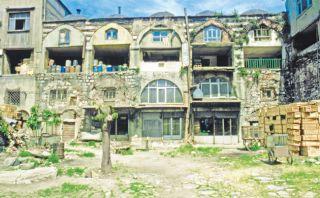
Balkapanı Hanı is one of the classic examples of Ottoman caravanserai architecture. Typically constructed with two stories—a ground floor and a first floor—the building follows a plan centered around a large courtyard. Rooms arranged around the courtyard were designed for both commercial and lodging purposes. The courtyard forms the core of the building’s spatial organization; its stone-paved floor, arcaded passageways, and stone arches provide both aesthetic and functional unity. The ground floor houses units functioning as storage and shops, while the upper floor contains rooms arranged to accommodate traveling merchants.
The building was constructed using cut stone and brick in combination. The facades were kept deliberately simple, yet architectural details were achieved through balanced proportions and rhythmic window openings. Although the main entrance is not ornately decorated with inscriptions or embellishments, it embodies the essential characteristics of caravanserai and commercial architecture of the period.【1】

Image of Balkapanı Hanı (Anadolu Agency)
Changes in trade patterns, shifts in transportation networks, and evolving urban development led to significant changes in the building’s use. During this period, the structure was repurposed as small-scale trading units, storage spaces, and temporary shelters. Over time, inadequate maintenance and repair resulted in physical deterioration.
In the 2000s, under restoration projects led by the General Directorate of Foundations, Balkapanı Hanı was reactivated while preserving its original plan layout and removing later intrusive interventions. The restoration was carried out using construction techniques and materials consistent with the period, ensuring the preservation of its architectural character and its place in public memory. Today, the caravanserai has regained its function as a cultural heritage element reflecting the traditional commercial fabric.

Image of Balkapanı Hanı (Anadolu Ajansı)
Balkapanı Hanı is a functional, spatial, and symbolic node within Istanbul’s historic urban fabric. Alongside the Egyptian Bazaar, the New Mosque, and surrounding caravanserais, it forms an integral part of the historical and cultural coherence of historic Eminönü. The preservation and continued use of Balkapanı Hanı in accordance with its original function hold significance for historical continuity and cultural identity.
Balkapanı Hanı functioned not only as the central hub for honey trade during the Ottoman period but also as an integral component of the state’s food inspection system, the waqf-based economic structure, and the spatial organization of the caravanserai quarter. Its architectural design—centered on a courtyard plan and multi-functional use—reflects the defining characteristics of urban commercial structures of its time. Today, it maintains its unique position within Istanbul’s traditional urban fabric as a tangible embodiment of historical continuity and cultural heritage preservation policies.
Akça, Melek. *Tarihi Yarımada İçerisinde Bulunan Hanlar Bölgesi’nin Kentsel Tasarım İlkeleri Açısından İncelenmesi*. Master's thesis, Istanbul Technical University Institute of Science and Technology, 2008. Accessed June 20, 2025. https://polen.itu.edu.tr/bitstream/11527/2303/1/9016.pdf.
Anadolu Ajansı. “Osmanlı’nın Bal Merkezi Balkapanı Han.” Anadolu Ajansı, May 25, 2022. Accessed June 20, 2025. https://www.aa.com.tr/tr/kultur-sanat/osmanlinin-bal-merkezi-balkapani-han/2586815.
Cantay, Gönül Güreşsever. “Mercan Ağa Camii Külliyesi ve Kapalı Çarşı.” *Vakıf Restorasyon Yıllığı*, no. 12 (2016): 70–89. Accessed June 20, 2025. https://cdn.vgm.gov.tr/yayin/dergi/restorasyon/restorasyon12.pdf.
Türkiye Diyanet Vakfı. “Balkapanı Hanı.” *İslam Ansiklopedisi*. Accessed June 20, 2025. https://islamansiklopedisi.org.tr/balkapani-hani.
[1]
Ekonomik ve Sosyal İşlev
Balkapanı Hanı, yalnızca bal ticaretinin yapıldığı bir mekân olmakla kalmamış, aynı zamanda bu ürünün kalitesinin denetlenip fiyatlandırıldığı bir resmî merkez olarak hizmet vermiştir. Osmanlı kent ekonomisinde belirli ürünlerin yalnızca belirli kapanlarda tartılması ve dağıtılması zorunluluğu, merkezi yönetimin piyasayı düzenleme ve gıda güvenliğini sağlama anlayışının bir yansımasıdır. Bu sistem içerisinde Balkapanı, bal ürünleri için hem ekonomik hem de sağlıkla ilgili kontrol noktası olarak işlem görmüştür. Burada tartılan ballar hem İstanbul pazarlarına hem de saraya ulaşmadan önce denetime tabi tutulmaktaydı.
Han, aynı zamanda vakıf mülkiyetinde olan ve gelirleri vakfiye şartlarına göre çeşitli hayır işlerinde kullanılan bir yapıydı. Bu bağlamda hanın gelirleri, çevredeki cami, medrese veya imarethane gibi yapıları desteklemiş; sosyal devlet anlayışı çerçevesinde hizmet sunumunu sürdürmüştür.

Location | Southeastern corner of the Egyptian Bazaar Istanbul Eminönü | ||||||||
|---|---|---|---|---|---|---|---|---|---|
Building Type | Commercial caravanserai | ||||||||
Construction Period | Ottoman period (before the 17th century) | ||||||||
Historical Background
Architectural Structure and Physical Features
The Republican Era and the Building’s Transformation
Urban and Cultural Context