This article was automatically translated from the original Turkish version.
+1 More
Registration Number | 844 | ||||||||
|---|---|---|---|---|---|---|---|---|---|
Registration Date | 09.08.2021 | ||||||||
Application Number | C2020/004 | ||||||||
Application Date | 10.01.2020 | ||||||||
Name of the Geographical Indication | Bayburt Yalancı Dolma | ||||||||
Product / Product Group(s) | Food / Foods and Soups | ||||||||
Type of Geographical Indication | Mahreç sign | ||||||||
Applicant/Registrant(s) | Bayburt Municipality | ||||||||
Address of the Registrant | Şeyhheyran Mah. Cumhuriyet Cad. Merkez BAYBURT | ||||||||
Geographical Boundary | Bayburt Province | ||||||||
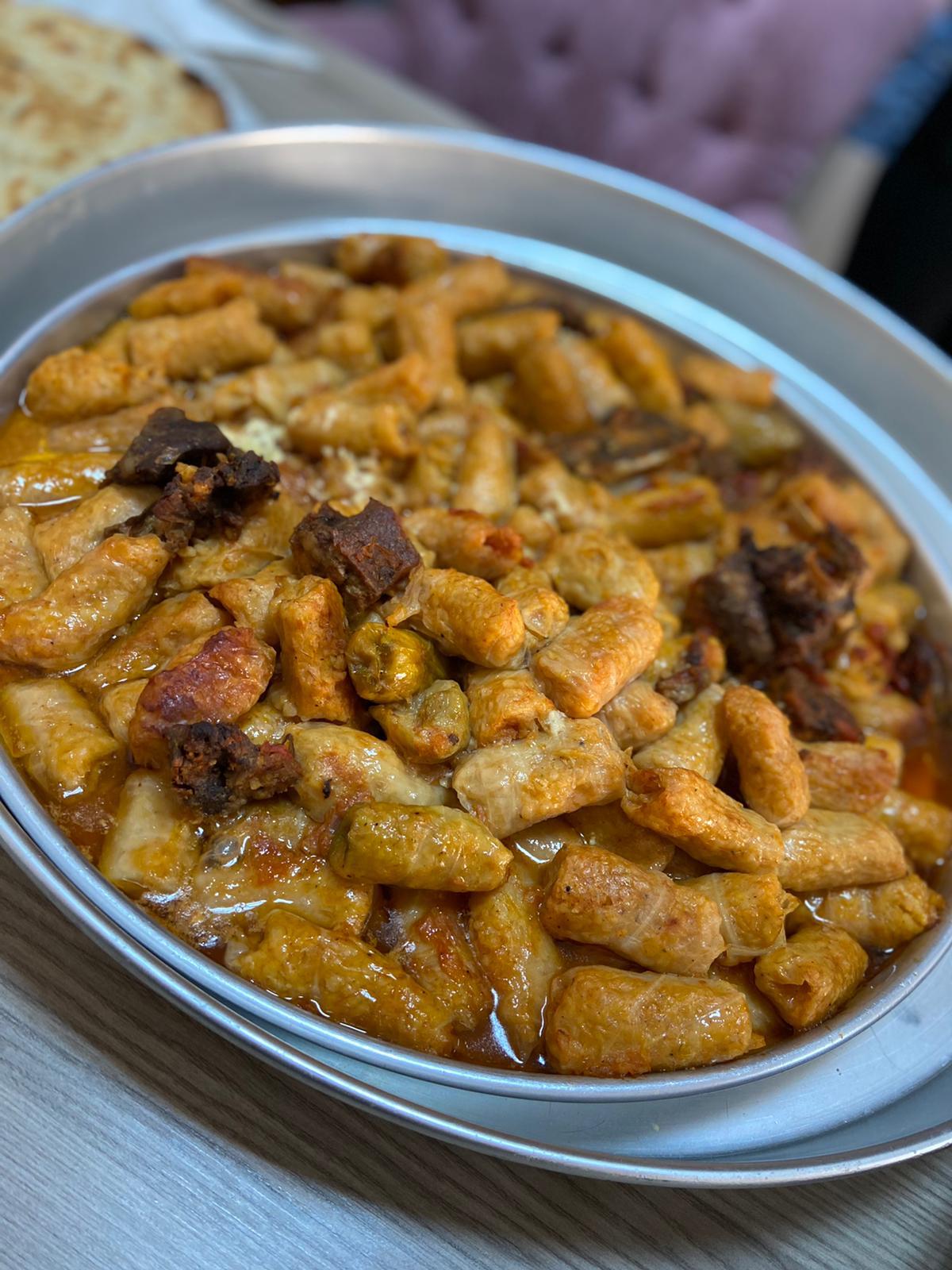
Bayburt Yalancı Dolma is a traditional stuffed dish specific to Bayburt Province. Its main ingredients include winter cabbage (kelem), bone-in meat dried in stone ovens, bulgur, butter, tomato paste, onion, and flour. The filling, made from boiled bulgur and flour, is wrapped in cabbage leaves; the stuffed leaves are then layered in a pot with dried rib meat and tomato paste–infused onions and cooked. Hot melted butter is poured over the dish before serving.
Bayburt Yalancı Dolma is a type of stuffed dish whose primary components are cabbage (kelem), dried bone-in meat, bulgur, butter, onion, tomato paste, and flour. The dish’s defining characteristic arises from the combined use of locally produced ingredients and traditional cooking techniques within its geographical boundaries. The dish is served hot with melted butter poured on top.
The most distinctive feature of this dish is the use of dried bone-in meat. This meat is obtained from the rib section of cattle or sheep, salted, and then dried in stone ovens using a unique preservation and flavoring method. Additionally, the cabbage leaves used in the preparation must come from winter cabbage harvested between September and November within the defined geographical boundaries.
The preparation of Bayburt Yalancı Dolma is a multi-stage process, and the use of ingredients directly linked to the geographical area is mandatory. The required ingredients are:
In the preparation phase, one finely chopped onion is sautéed in butter. Then, boiled bulgur and flour are added to create a homogeneous mixture, which forms the stuffing. Meanwhile, the cabbage is separated into leaves, blanched in salted water for approximately 2–3 minutes, then shocked in cold water. After cooling, the veins are removed from the leaves and cut into pieces about 10 cm long for rolling. The prepared stuffing is placed on the leaves and rolled.
In another pot, two grated onions are sautéed together with butter and tomato paste to prepare the tomato paste mixture. The previously prepared dried bone-in meat is arranged in a single layer at the bottom of the pot. On top of the meat, the tomato paste mixture is added, followed by the rolled dolmas. This layering—alternating one layer of dolmas and one layer of the tomato paste mixture—is repeated. Finally, approximately two glasses of water are added to the pot, and the dish is cooked over low heat for about one hour. Before serving, melted butter is poured over the dish.
One of the fundamental reasons for the geographical indication registration of Bayburt Yalancı Dolma is that both the ingredients and the techniques used in its production are unique to Bayburt. Specifically, the use of winter cabbage cultivated and harvested between September and November within the defined geographical boundaries, along with the drying of rib meat in stone ovens, establishes this link. Therefore, all stages of production must be carried out within the boundaries of Bayburt Province.
Monitoring compliance with the geographical indication for Bayburt Yalancı Dolma is coordinated by the Bayburt Municipality. The monitoring body consists of a four-member committee, with one expert each from the Bayburt Municipality, the Food Engineering Department of Bayburt University, the Bayburt Chamber of Commerce and Industry, and the Bayburt Provincial Directorate of Agriculture and Forestry.
Inspections are conducted at least once a year and may be carried out at any time if necessary. The inspection criteria include the following:
The Bayburt Municipality has assumed responsibility for initiating and managing the legal processes to protect the name and production method of this product. Additionally, when necessary, the monitoring process may be supported by services provided by public institutions, private organizations, or expert individuals.
Turk Patent and Trademark Office. "Bayburt Yalancı Dolma Mahreç İşareti Tescil Belgesi." Accessed July 19, 2025. https://ci.turkpatent.gov.tr/Files/GeographicalSigns/d1789080-92f1-485a-b0ee-147cb38f3490.pdf.
Turk Patent and Trademark Office. "Bayburt Yalancı Dolma." Accessed July 19, 2025. https://ci.turkpatent.gov.tr/cografi-isaretler/detay/1523.

Registration Number | 844 | ||||||||
|---|---|---|---|---|---|---|---|---|---|
Registration Date | 09.08.2021 | ||||||||
Application Number | C2020/004 | ||||||||
Application Date | 10.01.2020 | ||||||||
Name of the Geographical Indication | Bayburt Yalancı Dolma | ||||||||
Product / Product Group(s) | Food / Foods and Soups | ||||||||
Type of Geographical Indication | Mahreç sign | ||||||||
Applicant/Registrant(s) | Bayburt Municipality | ||||||||
Address of the Registrant | Şeyhheyran Mah. Cumhuriyet Cad. Merkez BAYBURT | ||||||||
Geographical Boundary | Bayburt Province | ||||||||
No Discussion Added Yet
Start discussion for "Bayburt False Stuffed Dish" article
Distinctive Features
Recipe/Production Method
Production Link to Geographical Area
Monitoring and Protection