


This article was automatically translated from the original Turkish version.
+2 More
Bayburt Stone
Product / Product Group(s) | Other products | ||||||||
|---|---|---|---|---|---|---|---|---|---|
Applicant/Registrant(s) | Bayburt Municipality | ||||||||
Registration Date | 04.07.2019 | ||||||||
File Number | C2017/138 | ||||||||
Registration Number | 442 | ||||||||
Bayburt Stone is a natural building stone native to Bayburt Province in Türkiye, characterized by a tuff structure and ease of workability. It was officially registered as a geographical indication by the Turkish Patent and Trademark Office on 4 July 2019 under the designation “Place of Origin”.

Bayburt Stone Processing (Competitive Sectors Program)
Bayburt Stone is a natural tuff stone occurring in white, yellow and green tones. Due to its fine-grained texture and low hardness (Mohs 2–3), it is easily workable. Visually, it may appear as green-speckled on a white background, wavy yellow-green, or uniformly yellow-white. The stone’s porosity has been measured at 29.9%, compressive strength at 1605 kgf/cm² and flexural strength at 100 kgf/cm². Due to its high water absorption rate, it is not suitable for outdoor applications subject to sudden temperature changes.
The chemical composition of the stone contains a high proportion of silica (SiO₂) (64–69%), while CaO and Fe₂O₃ contents influence its color. Geologically, the stone formed within the Yazyurdu Formation of Eocene age, which overlies Jurassic metamorphic layers. The tuff layers consist of glass fragments, quartz, plagioclase, biotite and zeolite minerals.

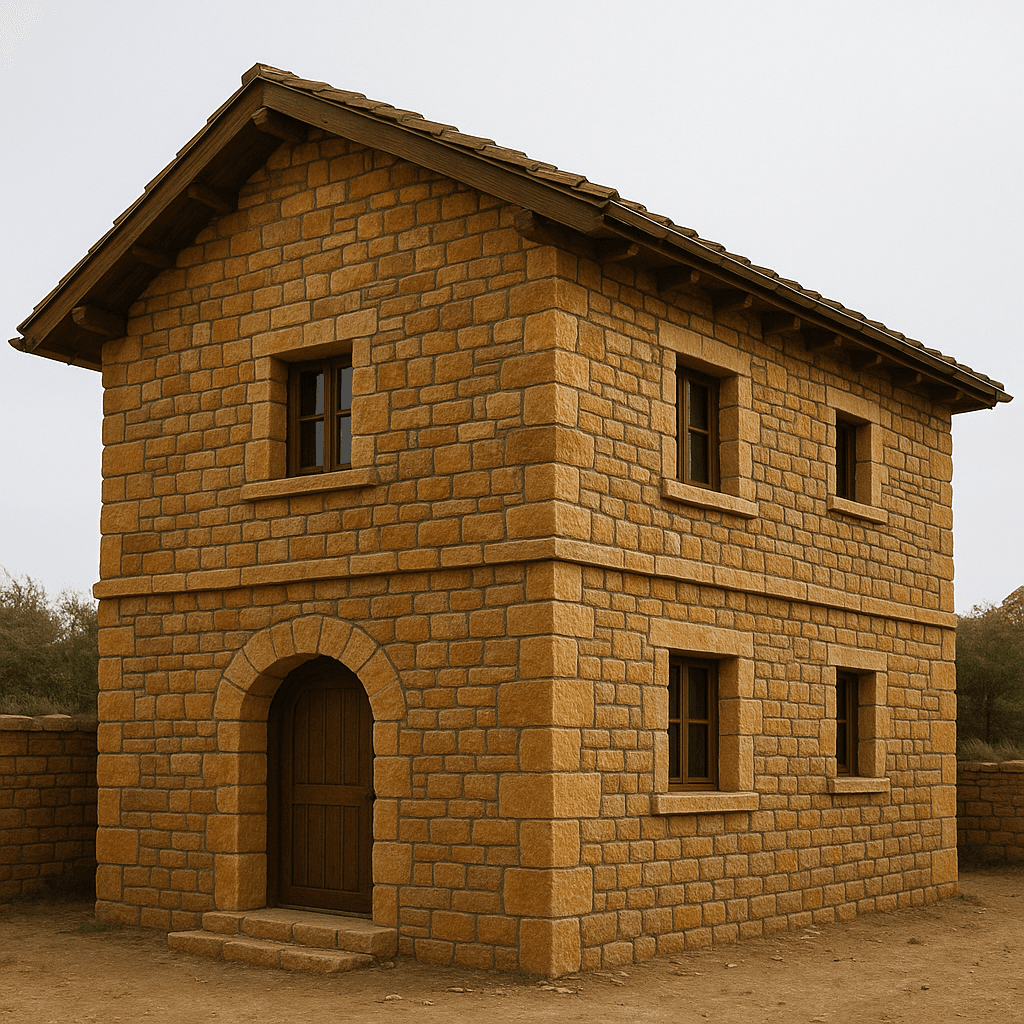
Bayburt Stone House (Generated by Artificial Intelligence)
Bayburt Stone is extracted from quarries in the Toptepe, Sırataşlar, Gevenli, Konakdağ and Gümüşdamla areas. Blocks are extracted and processed using wire saws, chisels, diamond-tipped saws and carving tools. Explosives are not used because the stone’s natural structure is sensitive to cracking and blasting may result in significant yield loss.
Blocks extracted from the surface are cut by hand or machine to dimensions of 10–20 cm in thickness. Stones used as cladding are prepared at 10 cm thickness, 30–40 cm length and 20 cm width. The resulting products are utilized in various applications including building stone, façade cladding, souvenirs and gravestones.
Bayburt Stone is extracted exclusively within the boundaries of Bayburt Province. The regulatory process is carried out by a commission composed of representatives from Bayburt Municipality, Bayburt University, Bayburt Chamber of Commerce and Industry and the Provincial Special Administration. Inspections are conducted at least once annually. Technical criteria such as color, hardness, workability, density, compressive strength and porosity are verified to ensure compliance with standards.
Ministry of Culture and Tourism of the Republic of Türkiye. "Bayburt Taşı." Kültür Portalı. Accessed May 27, 2025. https://www.kulturportali.gov.tr/portal/bayburt-tasi
Turk Patent and Trademark Office. "Bayburt Taşı." Geographical Indication Registration Certificate No: 442. Accessed May 27, 2025. https://ci.turkpatent.gov.tr/cografi-isaretler/detay/38366
Yağcıoğlu, Ufuk Celal, Bak, Tülay, and Şen, Cüneyt. "Bayburt Taşı (Tüfit)." *Mavi Gezegen*, no. 26 (2019): 91–95. https://www.jmo.org.tr/resimler/ekler/3ec1d4c9363ceff_ek.pdf.

Bayburt Stone
Product / Product Group(s) | Other products | ||||||||
|---|---|---|---|---|---|---|---|---|---|
Applicant/Registrant(s) | Bayburt Municipality | ||||||||
Registration Date | 04.07.2019 | ||||||||
File Number | C2017/138 | ||||||||
Registration Number | 442 | ||||||||
Product Description and Distinguishing Characteristics
Production Method
Geographical Boundary and Regulation
I am trying my best to understand this; I do not have an example.
Thank you for your understanding