


This article was automatically translated from the original Turkish version.
+1 More
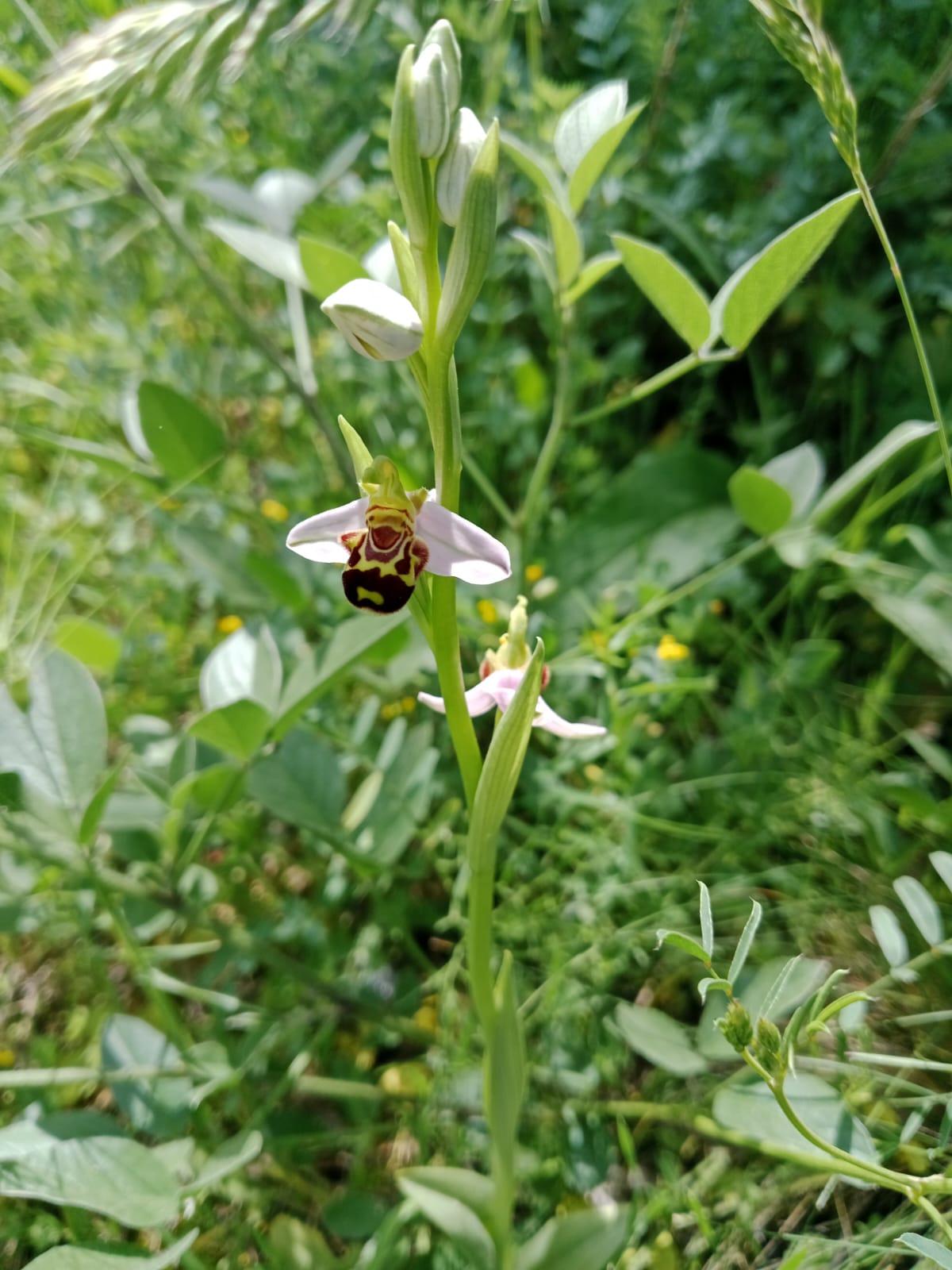
A Bee Orchid in Its Natural Habitat (Emine Nur Demir)
Family | Orchidaceae | ||||||||
|---|---|---|---|---|---|---|---|---|---|
Type(s) | Ophrys apifera Huds. | ||||||||
Genus | Ophrys | ||||||||
Distribution(s) | Europe Western Asia (especially the Mediterranean region) North Africa | ||||||||
Ophrys apifera (bee orchid) is a morphologically highly specialized species within the Orchidaceae family. Its flower structure mimics the form of a female bee to attract pollinating insects. Orchidaceae is one of the largest families of flowering plants, represented by approximately 800 genera and more than 25,000 species worldwide. Within this vast diversity, the genus Ophrys is notable for its insect mimicry in flowers. This mimicry represents an extraordinary adaptation in pollination strategy. Ophrys apifera is an orchid species distributed across the Mediterranean region, with Türkiye being a key area, and is commonly found in open habitats. Due to its bee-like labellum structure, it is commonly known as the bee orchid. Habitat degradation has made the conservation of this and other plant species with specialized ecological requirements critically important.
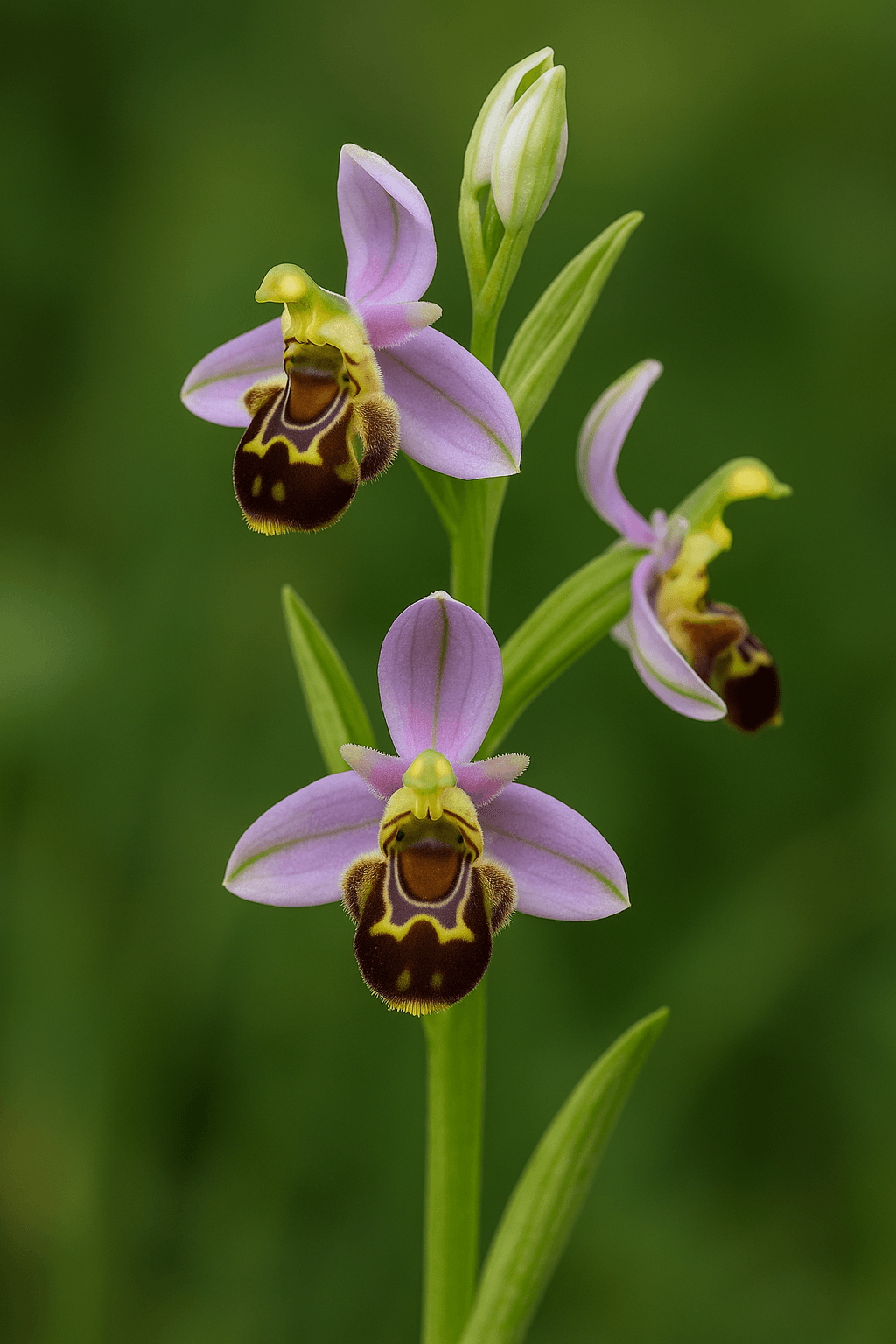
Generated by artificial intelligence
Ophrys apifera is a herbaceous, perennial, rhizomatous plant. It typically grows between 20 and 50 cm in height. Basal leaves are arranged in a rosette and have a lanceolate shape. Leaves develop early in spring and are light green in color. Stem leaves, which decrease in size upward, enclose the stem during the flowering period.
Flowering generally occurs between April and June. Flowers are arranged in a spike, each consisting of three outer sepals, two small inner petals, and a prominent labellum. Sepals are usually pink, occasionally white. The labellum is adorned with patterns of purple, brown and yellow and bears a surface resembling a female bee. This structure enables the species to deceive pollinating insects and achieve pollination through mimicry. The edges of the labellum feature hairy structures, irregular indentations and protrusions, and secretions resembling pheromones.
O. apifera is a typical C3 photosynthetic plant. One of its most notable physiological features is mycorrhizal symbiosis. This species is dependent on mycorrhizal fungi in the soil from the moment of seed germination. It forms symbiotic relationships primarily with fungi from the families Tulasnellaceae and Ceratobasidiaceae. This symbiosis facilitates the uptake of minerals and water from the soil and plays a crucial role in the transition from seed to seedling.
Because its seeds are very small and lack endosperm, germination requires carbon and nitrogen sources provided by the fungus. Adult plants continue to benefit from this symbiotic relationship. In addition, the species can reproduce both sexually (through seeds) and asexually (through vegetative propagation via rhizomes).
Another notable physiological feature is its pollination mechanism. In some regions, the bee-like labellum attracts male bees, which attempt to mate with the flower and transfer pollen (pollinia) to the next flower. In other regions where pollinators are absent, self-pollination (autogamy) occurs. This adaptation allows the species to persist under varying ecological conditions.
Ophrys apifera typically prefers open areas, calcareous soils, and sunny or partially shaded habitats. Its natural distribution includes much of Europe, North Africa and Western Asia. In Türkiye, it is commonly found in the Aegean, Mediterranean and Marmara regions, in grasslands, scrublands, roadside verges and forest clearings.
Ecologically, the life cycle of this species is sensitive to seasonal changes. Seed germination and seedling development usually begin in autumn; leaf growth continues through winter and spring. Flowering occurs at the end of spring. Soil moisture balance, pH (typically neutral or slightly alkaline), light availability and the presence of mycorrhizal fungi are key factors determining the species’ ecological success.
O. apifera also exerts an indirect influence on surrounding insect populations. Male bees, mistaking the flower for a mating female, approach it and inadvertently collect pollen sacs (pollinia), transferring them to the next flower. This interaction is significant not only for the plant but also for pollinator ecology. However, in some areas, the decline in pollinator populations has forced the species to rely more heavily on self-pollination.
Although Ophrys apifera is listed as “Least Concern” globally by the IUCN, local populations are threatened by habitat loss, agricultural activities and disruption of mycorrhizal symbioses. Specifically, land conversion for agriculture, grazing, urbanization and intensive development endanger natural populations.
Furthermore, chemical pollution in the soil negatively affects mycorrhizal fungi, significantly reducing the species’ reproductive success. Additionally, the decline in pollinator populations is a critical factor limiting sexual reproduction. Therefore, conserving O. apifera requires the protection not only of the plant itself but also of the organisms with which it shares symbiotic and ecological relationships. Its morphological mimicry of insects, physiological dependence on mycorrhizae, and specific habitat preferences make this species unique. However, it remains threatened by habitat destruction and the breakdown of its symbiotic relationships. Local authorities, conservation organizations and scientists must develop coordinated strategies to protect this species. The conservation of O. apifera, which contributes to ecosystem functioning, is also vital for the sustainability of biological diversity.
Addam, K., and M. Bou-Hamdan. 2015. "A New Variety from Lebanon: Ophrys apifera var. libanotica (K. Addam and M. Bou-Hamdan, Orchidaceae)." ResearchGate. https://www.researchgate.net/publication/285187666_A_NEW_VARIETY_FROM_LEBANON_Ophrys_apifera_var_libanotica_K_ADDAM_AND_M_BOU-HAMDAN_ORCHIDACEAE.
Kurt, Dursun. 2020. "Türkiye'deki Bazı _Ophrys_ L. (Orchidaceae) Türleri Üzerine Morfolojik ve Sistematik Bir Değerlendirme." _Anadolu Üniversitesi Bilim ve Teknoloji Dergisi C - Yaşam Bilimleri ve Biyoteknoloji_ 7, no. 1: 19–29. https://dergipark.org.tr/tr/pub/omuanajas/issue/54689/712434.
Öztaş, Haydar. 2024. *Kardelenler, İrisler, Orkideleri: Tıbbi ve Biyolojik Özellikleri / Snowdrops, Irises, Orchids: Medical & Biological Properties*. ResearchGate. https://www.researchgate.net/publication/380763332_KARDELENLER_IRISLER_ORKIDELERI_Tibbi_ve_Biyolojik_Ozellikleri_SNOWDROPS_IRISES_ORCHIDS_Medical_Biological_Properties.

A Bee Orchid in Its Natural Habitat (Emine Nur Demir)
Family | Orchidaceae | ||||||||
|---|---|---|---|---|---|---|---|---|---|
Type(s) | Ophrys apifera Huds. | ||||||||
Genus | Ophrys | ||||||||
Distribution(s) | Europe Western Asia (especially the Mediterranean region) North Africa | ||||||||
No Discussion Added Yet
Start discussion for "Bee Orchid (Ophrys apifera)" article
Morphological Characteristics
Physiological Characteristics
Ecological Characteristics
Conservation Status and Threats