


This article was automatically translated from the original Turkish version.
+1 More
Bee Venom (Adolapin)
Usage Areas | Inflammatory skin conditions Joint and muscle pain Rheumatic diseases | ||||||||
|---|---|---|---|---|---|---|---|---|---|
Sugars (Carbohydrates) | Glucose and fructose: %2 | ||||||||
Lipids (Phospholipids) | %4-5 or %5 | ||||||||
Minerals | Mg Ca P | ||||||||
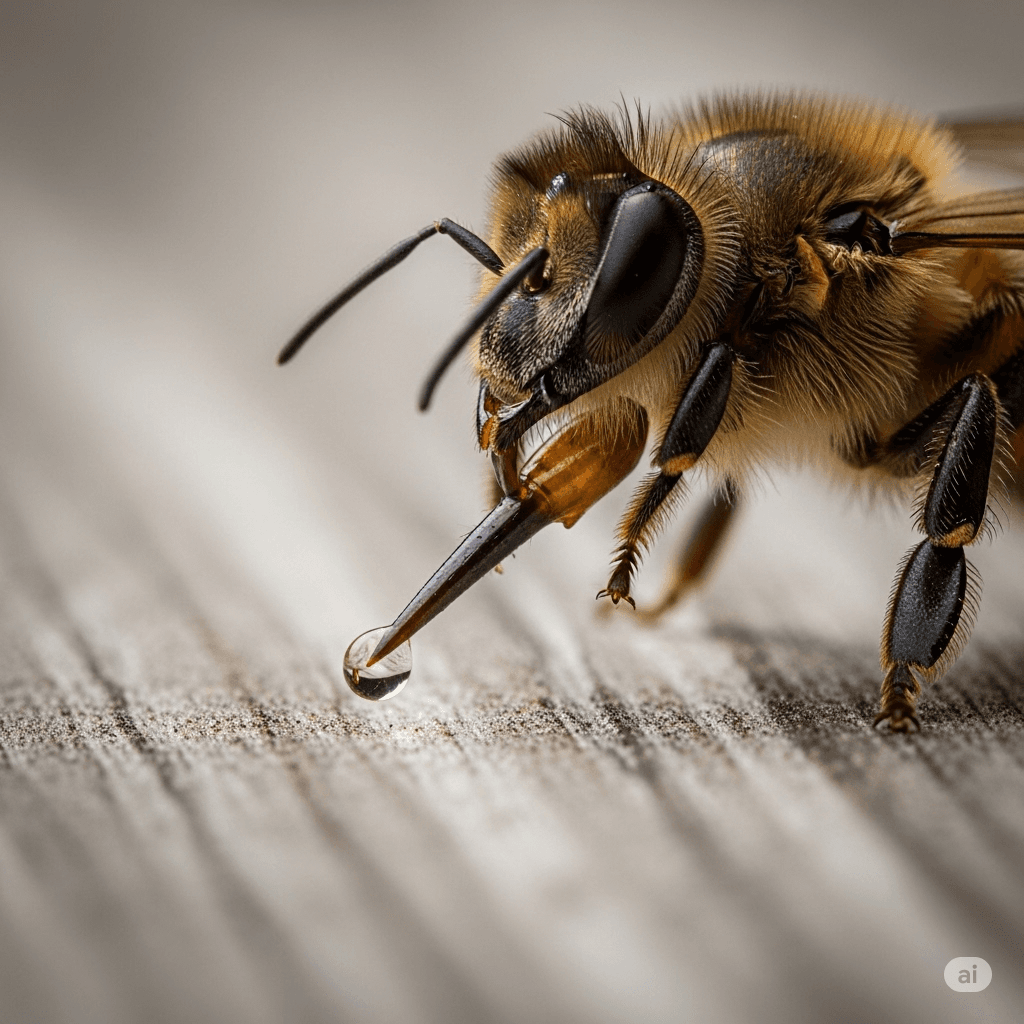
Bee venom, also known as apitoxin, is a biologically active substance produced in the venom glands located in the abdomen of honeybees (Apis mellifera) and stored in the venom sac. This substance is one of the key defense and attack mechanisms of bees.
In worker bees, the egg-laying organ (ovipositor) has undergone structural modification to become a stinger. Both queen and worker bees possess the ability to sting, while male bees lack a stinger and therefore cannot sting. The venom is produced in the bee’s acid and alkaline secretion glands and stored in the venom sac. When a bee stings, it injects this secretion into the target organism through its stinger. The venom glands become active when a worker bee transitions from the pupal stage to the adult stage and can begin secreting venom within approximately three days. Venom quantity peaks during spring and summer months. An average worker bee contains about 3–4 microliters (µl) of venom, equivalent to approximately 0.3 mg. The amount of dry venom obtainable from a single bee is 0.1 microgram (µg) or less.
Bee venom is normally a liquid, pale yellow in color, with a sharp odor and bitter taste. It is aromatic due to the presence of alarm pheromones. It has a clear, acidic structure with a pH between 5.0 and 5.5. Upon exposure to air, it dries and crystallizes within about 20 minutes, losing 65–70% of its weight during this process. Approximately 88% of bee venom is water. Dry venom is light yellow in color. The brownish hue of some commercial preparations is due to oxidation of venom proteins.
Bee venom has a highly complex chemical structure, with its main components being various enzymes, proteins, and peptides. Some of these components exhibit anti-inflammatory and analgesic effects, while others are toxic. The venom contains major constituents including melittin, apamin, MCD-peptide (Mast Cell Degranulation Peptide), histamine, hyaluronidase, and phospholipase-A2. The primary components by dry weight and their approximate proportions are as follows:
One study reported the presence of 18 distinct bioactive molecules in bee venom.
Bee venom affects the immune system, central and peripheral nervous systems, and the cardiovascular system. It also exhibits numerous biological effects including antibacterial, antifungal, antiviral, anti-inflammatory, antiarthritis, anticancer, and wound-healing properties.
In traditional medicine, venom was collected either by surgically removing the venom gland or by squeezing the bee until it emptied its venom. A modern method involves applying an electric shock to the bees. In this method, a wire grid is placed inside the hive and subjected to periodic electric pulses (typically every 30 minutes). The bees perceive the electric current as a threat and, upon contacting the grid, sting it and inject their venom onto a permeable surface beneath the grid (usually a sterile cloth). The venom collected by this method, when dried, forms a white powder.
After a 30-minute session, only about 1 gram of dry venom can be collected from approximately 10,000 bees in a hive. Another method involves drying the entire bee, but this can contaminate the product with pollen, feces, dust, nectar, and honey. Bee venom can be stored without degradation for up to five years as long as it is protected from moisture and humidity; the optimal storage method is freezing in a deep freezer.
Various chromatographic methods have been developed for the characterization of bee venom, including capillary electrophoresis (CE), capillary zone electrophoresis-diode array detector (CZE-DAD), high-performance capillary electrophoresis (HPCE), thin-layer chromatography (TLC), ultra-performance liquid chromatography (UPLC), high-performance liquid chromatography (HPLC), HPLC-DAD-MS/MS, and MALDI-TOF. SDS-PAGE electrophoresis has also been investigated for characterization purposes.
Apitherapy refers to the therapeutic use of bee products, including venom. Its origins date back 6,000 years to ancient Egypt. The Romans and Greeks also used bee products for medical purposes. The first publications on the therapeutic use of bee venom began in 1864. Today, apitherapy centers are widespread. In medical literature, bee venom therapy is referred to as Bee Venom Therapy (BVT) (via intradermal or subcutaneous injections) or Bee Sting Therapy (BST) (via live bee stings).
In traditional medicine, bee venom has been used to treat arthritis, rheumatism, pain, tumors, and skin diseases. Its use in modern medicine is also under investigation. Major applications and researched effects include:
Bee venom therapy is practiced in many countries worldwide, including the United States, China, Korea, Russia, Bulgaria, Japan, Hungary, the Czech Republic, Slovakia, Romania, Poland, Germany, Austria, Switzerland, and France. In Europe, 22 different products containing bee venom are used in nine countries.
Melittin (MEL), the main component of bee venom (BV), constitutes approximately 40–50% of its dry weight. MEL has demonstrated anticancer properties in various cell culture and animal model studies, including cytotoxicity, hemolytic activity, and growth inhibition. The antitumor effect of BV is largely attributed to MEL. Early studies showed that MEL inhibits the growth of human leukemia cells and astrocytoma cells by acting as a calmodulin inhibitor. Leukemia cells were found to be more sensitive to MEL than normal mouse spleen and bone marrow cells. This may be due to the high number of carbohydrate-binding sites on the membranes of bone marrow cells, a reduction in these sites in adult spleen cells, and their near-complete disappearance in neoplastic cells, making tumor cells more vulnerable.
MEL is particularly effective against cells expressing high levels of ras oncogenes, selectively eliminating them by enhancing PLA2 activation. MEL’s cytotoxicity is linked to both necrotic and apoptotic cell death. Although MEL’s potential as an anticancer agent is well recognized, its nonspecific cytolytic activity and rapid degradation in the bloodstream pose challenges for human use. To overcome these issues, optimization studies are underway using appropriate delivery systems such as nanoparticles. Recombinant viruses carrying the MEL gene have been reported to exhibit inhibitory effects on hepatocellular carcinoma.
Before initiating bee venom therapy, an allergy test must be performed, and treatment must be administered under the supervision of a qualified physician. Individuals with tuberculosis, cold abscesses, endocarditis, and pregnant women should not use bee venom. The dosage, route of administration, and duration of treatment in apitherapy vary depending on the individual. The average lethal dose (LD50) for adults is estimated at 2.8 mg/kg, equivalent to approximately 560 bee stings (assuming each sting delivers 0.3 mg of venom).
Accessed November 26, 2025.
Altıntaş, Levent, and Neslihan Bektaş. “Apiterapi: 1. Arı Zehri.” *Uludağ Arıcılık Dergisi* 19, no. 1 (2019): 82–95. Accessed May 28, 2025.
Yılmaz, Yahya Yasin. “Arı Zehri ve Mellitin Peptidinin Antikanser Özelliklerinin İncelenmesi.” *Arı ve Arıcılık Teknolojileri Dergisi* 3, no. 1 (2024): 1–16. Accessed May 28, 2025. https://dergipark.org.tr/tr/pub/aritek/issue/85129/1500945.
Şahinler, Nuray, and Nesibe Özge Toy. “Isıl İşlem Uygulamanın Balın Yapısı ve Kalitesi Üzerine Etkileri.” Bildiriler, *4th International Anatolian Agriculture, Food, Environment and Biology Congress*, Uşak, April 2019. Accessed May 28, 2025. https://www.researchgate.net/publication/348691501

Bee Venom (Adolapin)
Usage Areas | Inflammatory skin conditions Joint and muscle pain Rheumatic diseases | ||||||||
|---|---|---|---|---|---|---|---|---|---|
Sugars (Carbohydrates) | Glucose and fructose: %2 | ||||||||
Lipids (Phospholipids) | %4-5 or %5 | ||||||||
Minerals | Mg Ca P | ||||||||
Production and Secretion
Physical Properties
Chemical Composition
Peptides
Enzymes
Active Amines (Biogenic Amines)
Amino Acids
Effects of Major Components
Production of Bee Venom
Analytical Methods
Applications and Apitherapy
Anticancer Properties of Melittin Peptide
Precautions and Contraindications