
This article was automatically translated from the original Turkish version.
+1 More
Origin(s) | Late 18th century – early 19th century | ||||||||
|---|---|---|---|---|---|---|---|---|---|
Costumes | Yi (衣): Elegant garments for female characters Zhezi (褶子): Characters of everyday life Pei (帔): Noble women and men Kao (靠): Military commanders and warriors Mang (蟒): Emperors and high nobility | ||||||||
Role Types | Chou (丑): Comic or semi-comic characters Jing (净): Roles with painted faces representing powerful characters Dan (旦): Female roles Sheng (生): Male roles | ||||||||
UNESCO | was inscribed on UNESCO's Representative List of the Intangible Cultural Heritage in 2010 | ||||||||
Art Form | Traditional Chinese theatrical art / opera | ||||||||
Geographical Origin | China, Beijing | ||||||||
International Names | Peking Opera / Beijing Opera | ||||||||
Chinese Name | Peking Opera (Jīngjù) | ||||||||
Peking Opera (Chinese: 京剧, Jīngjù; English: Peking Opera/Beijing Opera) is a traditional performing art that originated in China and is primarily performed in Beijing, Tianjin and Shanghai. It integrates singing, spoken recitation, acting, dance and martial arts into a single dramatic structure.
Its narrative is built upon vocal performance based on the xipi and erhuang musical systems, accompanied by an orchestra of bowed, wind and percussion instruments. It employs symbolic and coded body language, minimalist stage design, stylized costumes and facial makeup that represents characters’ social status and personality. Librettos, written texts containing all spoken and sung lines, are composed according to specific formal and rhyming rules.
Transmitted orally and through imitation from generation to generation, Peking Opera was inscribed in 2010 on UNESCO’s Representative List of the Intangible Cultural Heritage.【1】
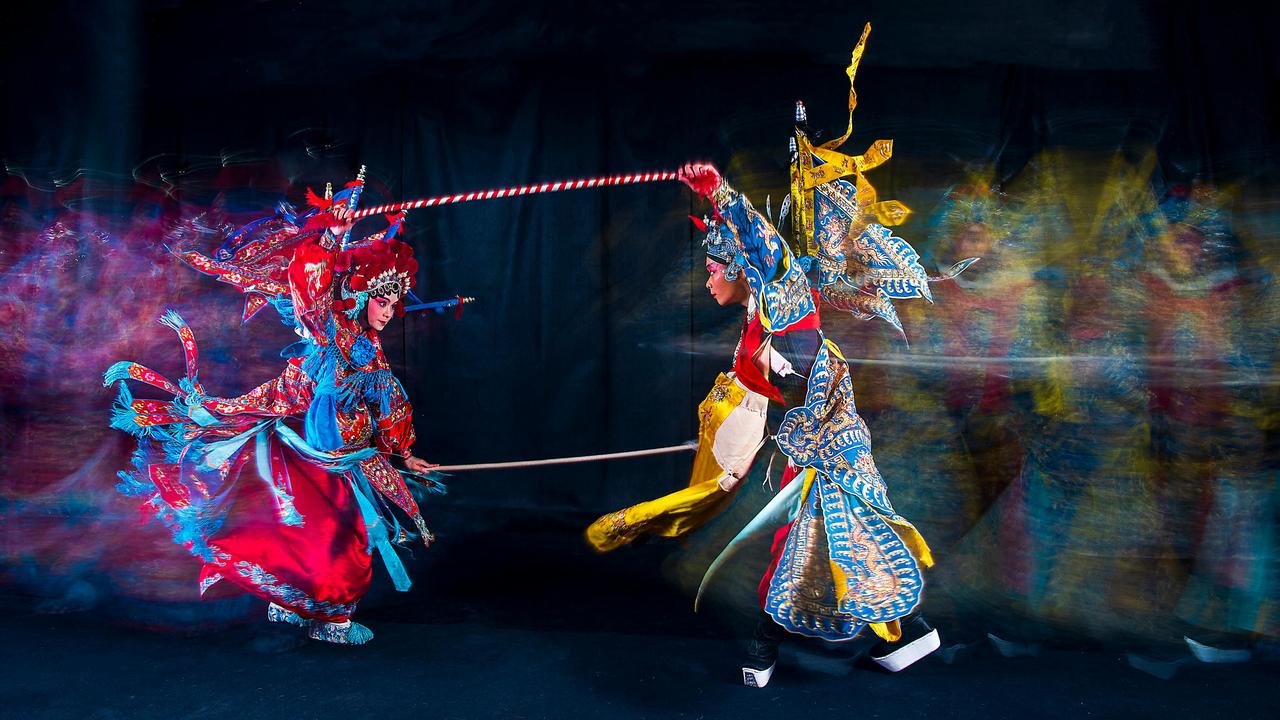
Peking Opera Performance (UNESCO)
Peking Opera’s Chinese name is 京剧 (Jīngjù), meaning “capital opera.” The spelling “Peking” reflects a historical Western transcription system, while “Beijing” follows the modern pinyin system. Both names refer to the same performing art.【2】
Peking Opera is performed throughout China but historically developed as a Beijing-centered art form, later establishing institutional structures and performance traditions in major cities such as Tianjin and Shanghai. Today it is recognized as a standardized operatic tradition performed both within China and internationally, with a standardized repertoire and performance style.
Peking Opera did not emerge as a continuation of a single regional tradition but resulted from the historical convergence of various regional Chinese opera forms. In this process, the Anhui-based Huiju troupes and the Han Opera tradition from Hubei province played decisive roles.
In 1790, the performance of four major opera troupes from Anhui at the Qing court is regarded as the starting point of this convergence.【3】 Following this date, opera troupes from different regions remained in the capital Beijing for extended periods, mutually influencing each other’s musical systems, singing styles, role types and stage traditions.
This new stage form initially lacked an independent name but gradually came to be known as Jingju (京剧), or “capital opera,” due to its association with Beijing as the center of performance.
Throughout the 19th century, Peking Opera became an institutionalized performing art within the Qing court and Beijing’s cultural milieu. Its regular performance at the Qing court played a decisive role in standardizing its repertoire, role system and aesthetic rules.
During the Qing period, Peking Opera evolved into a performance art for both the court and the urban public. The establishment of permanent theaters in major cities such as Beijing and Tianjin led to the formation of professional troupes, and the repertoire expanded to include plays drawn from historical and literary themes.【4】
During this period, role types (sheng, dan, jing, chou) were clearly defined, with specific vocal techniques, bodily movements and costume codes established for each. This classification system formed the foundation of actor training and gave rise to an oral-visual tradition of learning passed from master to apprentice.
The musical structure also took shape during the Qing period, with the xipi and erhuang systems becoming the primary vocal and dramatic frameworks. These two systems became the main axes determining how dramatic tension and emotional transitions were staged. Throughout the Qing Dynasty, Peking Opera became a multifaceted cultural expression featured in court ceremonies, official celebrations and public festivities, solidifying its central position within Chinese performing arts.【5】

Qing Dynasty, Dan Character from the Collection of 100 Portraits of Peking Opera Characters (Met Museum)
From the early 19th century onward, Peking Opera underwent significant structural changes alongside China’s political and social transformations. The fall of the Qing Dynasty and the transition to the Republican era eliminated the court-based patronage system, prompting Peking Opera to reorganize around public theaters and urban audiences.【2】
During this period, stage techniques, play durations and narrative styles were adapted to modern theater conventions, and new repertoires were developed to appeal to urban audiences. Alongside traditional themes, contemporary subjects began to be addressed, and stage design and narrative structure were simplified.
After 1949, under the new political structure, Peking Opera was restructured through state-supported institutions. The repertoire was adapted to ideological content, and a standardized teaching system was established through educational institutions. This 20th-century transformation enabled Peking Opera to preserve its traditional aesthetic codes while simultaneously being reimagined through modern theatrical practices.
Peking Opera’s narrative tradition is shaped by a broad repertoire rooted in Chinese history, classical literature and oral storytelling. This repertoire consists not of continuously evolving individual creations but of plays transmitted over centuries and to some extent standardized. The plays bring to the stage historical events, moral tales and well-known literary characters. A significant portion of the repertoire draws from imperial Chinese history, with themes of dynastic struggles, wars, loyalty and betrayal, and the lives of statesmen and military figures forming its core narratives. In these stories, moral values and exemplary behavior are emphasized more than historical accuracy.

Peking Opera Performance (flickr)
The Peking Opera repertoire also includes plays adapted from classical Chinese literature. Especially famous novels, folk tales and legends have been reinterpreted through the opera’s stylized narrative language. In these literary-based plays, themes such as love, sacrifice, familial devotion and social duty are frequently explored. The narrative tradition relies not on realistic plot construction but on a symbolic and selective mode of representation. Time and space are rarely depicted literally; instead, the narrative appeals to the audience’s knowledge and cultural memory through music, bodily movement and spoken expression. Consequently, the Peking Opera repertoire assumes the audience’s prior familiarity with its narrative codes.
Transmission of the repertoire has largely occurred through oral and practical means. Although written texts of the plays exist, the primary performance mode has been preserved through vocal patterns, gesture sequences and dramatic arrangements learned by actors from their masters. This has allowed variations in staging across different periods while maintaining the continuity of the core narrative structure. Over time, the repertoire has centered around a set of “classic” plays, which are accepted as foundational teaching and performance material in educational institutions and professional troupes. Thus, the narrative tradition of Peking Opera has persisted within a repertoire structure that, while open to change, maintains historical continuity.
Peking Opera constructs its stage narrative not through realistic sets and naturalistic behavior but through a symbolic and coded system of representation. Space, time and action on stage are not directly depicted; instead, an abstract stage universe is evoked in the audience’s mind through the actor’s body, voice and rhythmic movements. Within this stage language, acting, singing, spoken recitation, dance and movements derived from martial arts combine to form a multi-layered dramatic structure. The actor’s posture, gait, orientation and gestures follow specific meaning codes that express the character’s social status, emotional state and dramatic function.

Traditional Musical Instruments Used in Peking Opera (Generated by Artificial Intelligence.)
The musical structure of Peking Opera is based on two primary vocal and dramatic systems: xipi and erhuang. These two systems form the main framework that determines the emotional direction, narrative tempo and dramatic tension on stage. Xipi is used in brighter, more dynamic scenes, while erhuang is employed in slower, more introspective passages.
The orchestra supporting these systems is a small but functional ensemble of bowed, wind and percussion instruments. Among the bowed and stringed instruments, the erhu (two-stringed bowed instrument) and the yueqin (moon-shaped lute) stand out. The erhu, carrying the melodic line, follows the vocal performance and enhances the emotional tone of the stage. The yueqin is one of the principal accompanying instruments, supporting rhythmic and harmonic structure. Percussion instruments are the primary elements that direct the timing and dramatic emphasis of Peking Opera music. Drums (ban and tanggu) and cymbals and gongs (luo, naobo) determine the rhythm of stage movements, mark entrances and exits, and structure dramatic transitions. This percussion system, by synchronizing music with bodily movement, has become the foundational element of stage narration.【3】
Peking Opera classifies characters into four main role categories: sheng (male roles), dan (female roles), jing (painted-face characters) and chou (comic roles). Each role type follows predetermined rules regarding vocal technique, bodily movement, costume design and stage behavior. This classification system forms the foundation of actor training and is preserved within an oral-visual tradition of learning passed from master to apprentice.
Peking Opera’s stage movements are not direct imitations of everyday behavior but stylized and symbolic equivalents. Walking patterns, turns, hand and eye gestures function as indicators of a character’s social status, emotional condition and dramatic role.
Stage combat sequences derive from Chinese martial arts, military drills and acrobatic traditions. These movements do not depict realistic violence but express conflict through symbolic and rhythmic bodily language.
In Peking Opera, visual aesthetics are an inseparable part of the dramatic structure. Costumes, facial makeup, headdresses, color usage and accessories are not merely decorative elements; they are coded signs that directly convey information about a character’s social status, moral qualities, psychological state and dramatic function.
Costumes used in Peking Opera are inspired by historical Chinese court and folk attire but have been transformed into stylized forms suited to the stage. They do not aim to replicate historical periods but serve symbolic representation purposes.

Kao Costume (Pexels)
The main costume types are:
Colors in costumes also carry symbolic meaning. Yellow signifies imperial power, red loyalty and courage, black integrity and determination, white cunning and treachery, green anger and honesty, and blue stubbornness and independence.

Facial Makeup (Pexels)
Facial makeup, particularly used in jing and some chou roles, is a visual system that symbolically expresses a character’s moral and psychological traits through color. The primary color codes are:
Makeup patterns convey character traits not only through color but also through the shape of lines. Sharp angular lines represent fierceness, while rounded lines suggest gentler personalities.

Headdress (Generated by Artificial Intelligence.)
Each role type has distinctive headdresses and adornments. Long pheasant feathers, beaded crowns and metal embellishments indicate status. Long back flags worn by male warrior roles (in kao costumes) symbolize military power. Female roles use hair ornaments, pins and flowers that vary according to social standing.
Peking Opera stage is deliberately minimalist. Spaces are not defined by realistic sets but by symbolic movements. A chair can represent a horse, a table a palace, and a fan the wind. The actor’s walk, turns and posture symbolize geographical distances and spatial transitions. Through this symbolic narrative system, the Peking Opera stage transcends physical space to become an abstract narrative plane. Visual aesthetics, music, movement and text combine to form a multi-layered dramatic structure.
Peking Opera’s dramatic structure is organized systematically around specific role types. This role system classifies characters not by individual psychological depth but by their social status, moral qualities and dramatic function. Each role type has predefined rules regarding vocal technique, bodily movement, facial makeup, costume design and stage behavior.
Peking Opera comprises four main role categories: sheng, dan, jing and chou. These categories form the fundamental framework encompassing all characters on stage and ensure the continuity of performance tradition.

Chou Role (Met Museum)
Peking Opera’s actor training follows a traditional master-apprentice system rather than a written curriculum. Training begins at an early age and demands years of intense discipline. Students are trained to specialize in a specific role type and learn its unique vocal, physical and dramatic rules throughout their education.
Training is structured around four core performance domains: singing, spoken recitation, stylized movement and dance, and combat and acrobatic motion. These areas aim to create a harmonious unity between music, body and narrative on stage.
In actor training, faithful transmission of traditional forms takes precedence over individual creativity. Gestures, steps, gaze direction and bodily posture follow specific codes and are passed from generation to generation through imitation.
Peking Opera’s narrative structure and role system have enabled the transmission of social values and moral norms through performance. Concepts such as loyalty, integrity, familial devotion, social order and duty are central to its plays, making Peking Opera an educational and exemplary art form. Characters on stage are constructed as representatives of specific moral attitudes, offering the audience an indirect transmission of values.【4】
The master-apprentice training and transmission system has ensured the art’s intergenerational continuity. Elements such as music, acting, costumes and stage language have been preserved through bodily and auditory memory beyond written texts. Amid political and social transformations in the 20th century, Peking Opera was restructured through state-supported institutions and positioned as a representative of national cultural heritage. Today, performed both within China and internationally, Peking Opera continues to preserve its traditional aesthetic codes while engaging in contemporary cultural exchanges.【1】
Peking Opera is recognized as one of China’s most important cultural heritage domains due to its historical continuity and master-apprentice transmission system. The holistic transmission of elements such as music, acting, costumes, facial makeup and stage language across generations has ensured its survival as a living tradition.
Despite social and political transformations throughout the 20th century, Peking Opera has been preserved and sustained through state-supported institutions and educational structures. Throughout this process, the preservation of traditional aesthetic rules and the transmission of the repertoire have remained central objectives.
Peking Opera was inscribed in 2010 on UNESCO’s Representative List of the Intangible Cultural Heritage. This recognition has affirmed its status as a community-based, intergenerational cultural practice at the international level and has supported preservation efforts.【6】
Association for Asian Studies. “A Brief Introduction to Beijing Opera.” *Education About Asia.* Accessed April 3, 2026. https://www.asianstudies.org/publications/eaa/archives/a-brief-introduction-to-beijing-opera/
Beijing Municipal Government. “Peking Opera.” *Beijing Culture*. Accessed April 3, 2026. https://english.beijing.gov.cn/beijinginfo/culture/culturecalendar/information/202401/t20240112_3534072.html
China Culture. "Intriguing Facial Makeup in Peking Opera." chinaculture.org. Accessed April 3, 2026. https://en.chinaculture.org/classics/2012-11/30/content_447024.htm
International Department of the Communist Party of China. "Opera." idcpc.org.cn. Accessed April 3, 2026. https://www.idcpc.org.cn/english2023/chinadelights/arts/opera/202307/t20230727_157765.html
Klub Boks. "A Man and a Woman Performing in a Traditional Clothing." Pexels. Accessed April 3, 2026. https://www.pexels.com/photo/a-man-and-a-woman-performing-in-a-traditional-clothing-12975825/
Klub Boks. "Close-Up Photo of Woman Doing Her Make-Up." Pexels. Accessed April 3, 2026. https://www.pexels.com/photo/close-up-photo-of-woman-doing-her-make-up-10524414/
Snowy Hawk Constellation. "IMGP2444." flickr. Accessed April 3, 2026. https://flic.kr/p/u1q3kS
Tan, Vincent. "Colorful Traditional Chinese Opera Performer Portrait." Pexels. Accessed April 3, 2026. https://www.pexels.com/photo/colorful-traditional-chinese-opera-performer-portrait-33125091/
The Metropolitan Museum of Art. "One hundred portraits of Peking opera characters." metmuseum.org. Accessed April 3, 2026. https://www.metmuseum.org/art/collection/search/51581
UNESCO. "Peking Opera." YouTube, 9:08. Accessed April 3, 2026. https://www.youtube.com/watch?v=vtV3iAuYN48
UNESCO. “Peking Opera (京剧).” Representative List of the Intangible Cultural Heritage of Humanity, UNESCO. Accessed April 3, 2026. https://ich.unesco.org/en/RL/peking-opera-00418
UNESCO. “Peking Opera.” *Intangible Cultural Heritage – Silk Roads*. UNESCO. Accessed April 3, 2026. https://en.unesco.org/silkroad/silk-road-themes/intangible-cultural-heritage/peking-opera
【1】
UNESCO, ''Peking Opera,'' UNESCO, Access date: 3 April 2026, https://ich.unesco.org/en/RL/peking-opera-00418
【2】
Association for Asian Studies, “A Brief Introduction to Beijing Opera,” Education About Asia, Access: 3 April 2026, https://www.asianstudies.org/publications/eaa/archives/a-brief-introduction-to-beijing-opera/
【3】
Beijing Municipal Government, “Peking Opera,” english.beijing.gov.cn, Access: 26 January 2026,
【4】
Association for Asian Studies, “A Brief Introduction to Beijing Opera,” Education About Asia, Access: 26 January 2026, https://www.asianstudies.org/publications/eaa/archives/a-brief-introduction-to-beijing-opera/
【5】
UNESCO, “Peking Opera,” Intangible Cultural Heritage on the Silk Roads, UNESCO, Access: 26 January 2026,
https://en.unesco.org/silkroad/silk-road-themes/intangible-cultural-heritage/peking-opera
【6】
UNESCO, ''Peking Opera,'' UNESCO, Access: 3 April 2026, https://ich.unesco.org/en/RL/peking-opera-00418


Origin(s) | Late 18th century – early 19th century | ||||||||
|---|---|---|---|---|---|---|---|---|---|
Costumes | Yi (衣): Elegant garments for female characters Zhezi (褶子): Characters of everyday life Pei (帔): Noble women and men Kao (靠): Military commanders and warriors Mang (蟒): Emperors and high nobility | ||||||||
Role Types | Chou (丑): Comic or semi-comic characters Jing (净): Roles with painted faces representing powerful characters Dan (旦): Female roles Sheng (生): Male roles | ||||||||
UNESCO | was inscribed on UNESCO's Representative List of the Intangible Cultural Heritage in 2010 | ||||||||
Art Form | Traditional Chinese theatrical art / opera | ||||||||
Geographical Origin | China, Beijing | ||||||||
International Names | Peking Opera / Beijing Opera | ||||||||
Chinese Name | Peking Opera (Jīngjù) | ||||||||
Naming and Scope
Origins and Historical Development
Early Period and Formation
Qing Dynasty Period
Modernization Process
Narrative Tradition and Repertoire
Structural Features and Stage Language
Musical System
Role Type System
Stage Movements and Body Codes
Visual Aesthetics
Costume System
Facial Makeup (Lianpu)
Headdresses and Accessories
Stage Symbolism
Role Types
Actor Training and Transmission Tradition
Social and Cultural Function
Cultural Heritage and Preservation