

This article was automatically translated from the original Turkish version.
+1 More
Intangible Cultural Heritage encompasses practices, representations, expressions, knowledge, skills, and the associated instruments, objects, artifacts, and cultural spaces that communities, groups, and, in some cases, individuals recognize as part of their cultural heritage. This heritage is transmitted from generation to generation and is constantly recreated by communities in response to their environment, their interaction with nature and their history, thereby providing a sense of identity and continuity and contributing to respect for cultural diversity and human creativity.
The Convention defines the safeguarding of this heritage as a process of ensuring its viability; this process includes identification, documentation, research, preservation, protection, promotion, enhancement, and especially transmission through formal and non-formal education.
This approach centers not on the “object” but on the knowledge and accumulated expertise that are transmitted and performed: Rather than preserving a valuable object alone, the entire body of knowledge, tradition, and practice that produces, sustains, and transmits it is preserved.
Prof. Dr. Öcal Oğuz, Chair of the UNESCO National Commission for Türkiye, Explains Intangible Cultural Heritage (Gazi University)
The term “Intangible Cultural Heritage” (ICH) is not a new discipline name and should not be regarded as a synonym for folklore. It is a conceptualization developed within UNESCO’s long-standing efforts to protect cultural heritage.
Throughout the 1970s to 1990s, UNESCO used various terms such as folklore, popular and traditional culture, non-material culture, oral and intangible cultural heritage. However, during intergovernmental expert meetings in 2002–2003, it was decided that the most appropriate term for the scope of the field was “Intangible Cultural Heritage,” and previous terms as well as discipline names such as anthropology or ethnology were excluded from the treaty language.
This preference resulted from multilingual and multicultural discussions demonstrating that the term “folklore” could not fully encompass the intended domain. In some languages, “folklore” carried different meanings (e.g., oral literature in Russian), was associated with rural life in certain contexts, and raised issues of inclusivity, leading UNESCO to move away from the term “folklore” since the 1980s.
In Turkish translation debates, the proposal “abstract cultural heritage” was notably emphasized, but it was argued that it did not align with the principle of fidelity to the treaty’s working language terms “intangible” and “immatériel.” Therefore, the use of “Intangible Cultural Heritage” in Turkish (alternatively “non-material”) is not a preference but a necessity grounded in the treaty’s multilingual production and official conceptualization.
In summary:
UNESCO’s earliest efforts to protect cultural heritage were predominantly object-centered: the 1954 Convention for the Protection of Cultural Property in the Event of Armed Conflict, followed by the 1970 Convention on the Means of Prohibiting and Preventing the Illicit Import, Export and Transfer of Ownership of Cultural Property, and the 1972 Convention concerning the Protection of the World Cultural and Natural Heritage institutionalized this approach.
From the 1980s onward, the focus on “living” heritage was strengthened by the 1989 Recommendation on the Safeguarding of Traditional Culture and Folklore, the 1997/1998 Proclamation of Masterpieces of the Oral and Intangible Heritage of Humanity, and related international meetings. Even the 1999 Washington meeting revealed ongoing terminology debates and persistent uncertainty regarding the naming of the heritage domain.
The conceptual and legal framework was further refined at the 2001 Torino (Turin) roundtable meeting “Intangible Cultural Heritage – Working Definitions,” where the concepts of “traditional culture,” “folklore,” and “intangible heritage” were discussed, and emphasis was placed on transmission and heritage.
Subsequently, the Intergovernmental Expert Meetings of 2002–2003 drafted the treaty text, which was debated and shaped through consensus by diplomats and legal experts from all member states. On 17 October 2003, the Convention for the Safeguarding of the Intangible Cultural Heritage was adopted by the 32nd Session of the UNESCO General Conference.
Since its adoption, the Convention has influenced both safeguarding policies and museum approaches. In 2004, a symposium titled “Musealization of ICH” was held in Türkiye; in 2007, ICOM added “intangible heritage” to its definition of a museum.
In Türkiye, the process was completed with the ratification and entry into force of the Convention on 21 January 2006 through Law No. 5448. This historical trajectory demonstrates that UNESCO’s approach to cultural heritage has evolved from an object-centered model to one centered on “safeguarding through living practice,” and that ICH has acquired a binding international framework.
In the 2003 Convention, safeguarding is defined as ensuring the viability of ICH. This is an approach that goes beyond mere identification and archiving; it aims to sustain performance and transmission.
The Convention defines safeguarding as encompassing the following practices:
This framework does not aim to freeze objects in display cases but to sustain the processes of production, performance, and learning; it prioritizes the preservation of the knowledge and tradition that produce and sustain valuable objects over the objects themselves.
Formal and non-formal education, as emphasized by the Convention, is the primary instrument of safeguarding; museums also contribute to transmission as non-formal learning environments, engaging visitors in active learning through workshops and practical activities.
The Convention places safeguarding on a sustainability axis by prioritizing participation and transmission; it encompasses themes such as “collective memory,” “shared experience,” and “social identity.”
The first step of safeguarding, identification, is practically based on inventory work; in Türkiye, criteria such as community consent, representativeness, and risk of disappearance are used in the national inventory.
In the 2003 Convention, safeguarding is a community-centered process that goes beyond documentation and is grounded in transmission and revitalization.
The classification adopted by the 2003 Convention covers five main fields:
To be included in Türkiye’s National Inventory of ICH, an element must meet the following key criteria:
Among these criteria, belonging to one of the fields requires the element to demonstrate a clear link to at least one of the five categories above; thus, the inventory operates on a field-based and community-consent-driven logic of safeguarding.
As of 29 September 2025, there are 31 elements on the list:【1】
The following elements require urgent safeguarding:
With the emergence of ICH, museum practices have shifted from object-centered models to community- and visitor-centered approaches. The 2003 Convention’s concept of “ensuring viability” has strengthened the orientation toward safeguarding through living practice rather than freezing objects in displays, leading to a transformation in exhibition methods that emphasize performance, context, and transmission.
In the years following the Convention, ICH museums have become leading examples of new exhibition methods that blur the boundaries between museum and visitor and place learning at the center.
ICOM’s 2007 addition of the term “intangible heritage” to its museum definition institutionalized a museum approach that treats tangible and intangible heritage together, making context and usage visible. Thus, the “new museology” trend, in which emphasis on the object recedes and narrative, production, and usage context gain value, has been consolidated.
ICH museums, as emphasized in the Convention, are positioned as non-formal educational environments; they involve visitors in active learning through workshops and practical activities. Programs designed to contribute to children’s physical and mental development make cultural heritage education sustainable.
At the Ankara Intangible Cultural Heritage Museum, programs for primary school groups were evaluated through observation, interviews, and document analysis; it was determined that workshops are effectively structured as educational programs and successfully engage visitors in active learning. This example illustrates the role and importance of ICH museums in cultural heritage education.
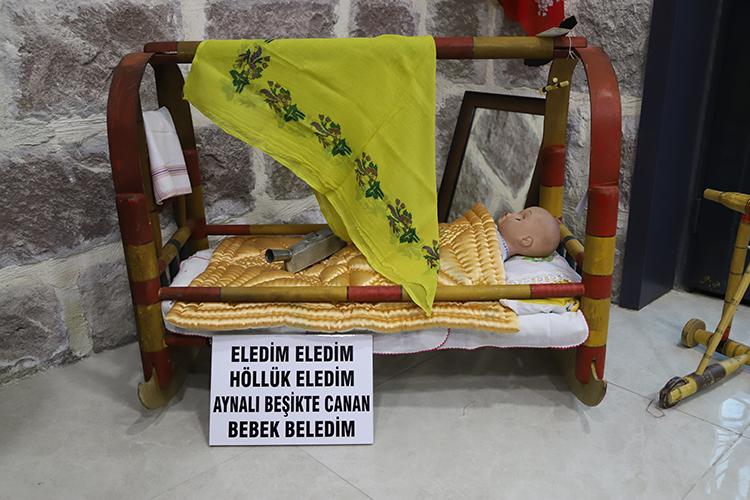
Ankara ICH Museum (AA)
The relationship between ICH and museology has transformed the museum from a repository of object-centered collections into a space of learning and participation by shifting the focus from objects to “process, performance, and transmission.” This transformation nurtures a community-centered and holistic approach to safeguarding, in full alignment with the spirit of the Convention.
Anadolu Ajansı. "Ankara'nın Gölbaşı ilçesinde "Somut Olmayan Kültürel Miras Müzesi" açıldı." Accessed September 29, 2025. https://www.aa.com.tr/tr/kultur/ankaranin-golbasi-ilcesinde-somut-olmayan-kulturel-miras-muzesi-acildi/3137412
Anadolu Ajansı. "Dünyaya ün salan Türk kahvesi pişirme yöntemiyle de ön plana çıkıyor." Accessed September 29, 2025. https://www.aa.com.tr/tr/insana-dair/dunyaya-un-salan-turk-kahvesi-pisirme-yontemiyle-de-on-plana-cikiyor/3413815
Oğuz, M. Öcal. "Terim olarak somut olmayan kültürel miras." *Milli Folklor* 25.100 (2013): 5-13. https://www.academia.edu/download/41331713/TERIM_OLARAK_SOMUT_OLMAYAN_KULTUREL_MIRAS.pdf
Tekin, Gözde. "Dönüşen müzecilik ve müzede öğrenme: Ankara Somut Olmayan Kültürel Miras Müzesi Örneği." *Milli Eğitim Dergisi* 46, no. 214 (2017): 155-166. https://dergipark.org.tr/en/pub/milliegitim/issue/36135/405928
UNESCO Türkiye Millî Komisyonu. "UNESCO Listelerinde Türkiye." Accessed September 29, 2025. https://www.unesco.org.tr/Pages/126/123/UNESCO-Somut-Olmayan-K%C3%BClt%C3%BCrel-Miras-Listeleri
Şahin, Seda, and Özcan Özdemir. “İl Kültür ve Turizm Müdürlükleri İnternet Sitelerinde Türkiye’nin Somut Olmayan Kültürel Miras Ürünlerinin Tanıtılması.” *MANAS Journal of Social Studies* 7, no. 2 (2018). https://dergipark.org.tr/en/pub/mjss/issue/40519/485971
[1]
UNESCO Türkiye Millî Komisyonu. "UNESCO Listelerinde Türkiye" https://www.unesco.org.tr/Pages/126/123/UNESCO-Somut-Olmayan-K%C3%BClt%C3%BCrel-Miras-Listeleri

No Discussion Added Yet
Start discussion for "Intangible Cultural Heritage" article
Terminology and Terminological Debates
Historical Development within the UNESCO Framework
Safeguarding and Methods in the Convention
Methods (Framework of Article 2/3)
The Principle of Safeguarding Through Living Practice
Educational and Learning Environments
Community Participation and Sustainability
Identification and Inventory Linkage
Fields and Inventory Criteria
ICH Fields (UNESCO Classification)
National Inventory Criteria in Türkiye
Elements of Türkiye on the UNESCO Representative List of the Intangible Cultural Heritage of Humanity (2008–2025)
ICH Museums
The Example of the Ankara ICH Museum