
This article was automatically translated from the original Turkish version.
+1 More
Foundation Date | 15 June 2013 | ||||||||
|---|---|---|---|---|---|---|---|---|---|
Location | Altındağ Türkiye Ankara | ||||||||
Purpose(s) | To involve visitors in a participatory and interactive learning process especially children and young people | ||||||||
Prominent Events and Sections | Game Culture Social Practices Oral Traditions Craft Arts Performing Arts | ||||||||
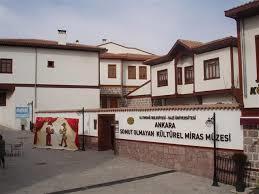
Ankara Intangible Cultural Heritage Museum is an institution that adopts applied and participatory exhibition methods for the preservation, revitalization and transmission of intangible cultural heritage to future generations. Established through the research efforts of the Turkish Folklore faculty at Gazi University and with financial support from the Ankara Development Agency, the museum opened to the public on 15 June 2013. It holds the distinction of being the first museum of its kind established in Türkiye. The museum is located in the Hamamönü neighborhood of the Altındağ district in Ankara.

Ankara Intangible Cultural Heritage Museum (museums)
The establishment of the museum is a result of growing awareness and academic activity in Türkiye following the adoption by UNESCO on 17 October 2003 of the Convention for the Safeguarding of the Intangible Cultural Heritage. The first academic discussions on museumizing intangible cultural heritage in Türkiye began with symposia organized by the Gazi University Application and Research Center for Turkish Folklore (THBMER) in 2002 and 2004. This process culminated in 2005 with the founding of Türkiye’s first intangible cultural heritage museum, the Gazi University Intangible Cultural Heritage Museum.
The Ankara Intangible Cultural Heritage Museum was established as a continuation of this legacy, specifically to carry out THBMER’s application and revitalization activities. During its establishment, in addition to Gazi University and the Ankara Development Agency, the Altındağ Municipality supported the project by allocating a historic mansion in Hamamönü for the museum. Professor Dr. M. Öcal Oğuz contributed to the process with his expertise in museology and folklore as founding chairperson. The museum continues its operations under the affiliation of THBMER.
The museum derives its primary motivation from the aim of protecting intangible cultural heritage from the threat of disappearance and ensuring its sustainability. In line with this, it adopts an approach that moves beyond the traditional museum model of displaying objects in vitrines, instead emphasizing the living practice of cultural heritage within its context and encouraging active visitor participation. This approach aligns with UNESCO’s 2003 convention principle of “safeguarding through practice”.
The museum’s objectives include:
The museum consists of thematic rooms representing different domains of intangible cultural heritage. In these rooms, cultural elements collected through field research from Ankara and its surroundings are presented through live performances and workshop activities.
The museum’s sections and the activities conducted within them are as follows:
Regular performances of traditional Turkish theater forms such as Karagöz-Hacivat, orta oyunu, meddah and village theatrical performances are held at the museum.

Traditional Room (Ankara Provincial Directorate of Culture and Tourism)
In line with its founding objectives, the Ankara Intangible Cultural Heritage Museum also functions as an educational center. One of its primary target audiences is primary school student groups. Educational programs are based on an active and participatory process in which children and young people learn through seeing, hearing and touching.
The educational methods applied at the museum and their developmental benefits include:
Through these activities, the museum aims to provide an experiential and lasting learning environment rather than a didactic one.
Ministry of Culture and Tourism of the Republic of Türkiye. "Ankara Somut Olmayan Kültürel Miras Müzesi." Accessed July 8, 2025. https://ankara.ktb.gov.tr/TR-359125/ankara-somut-olmayan-kulturel-miras-muzesi.html.
Ministry of Culture and Tourism of the Republic of Türkiye. "Ankara’daki Müzeler." Accessed July 8, 2025. https://ankara.ktb.gov.tr/TR-152965/muzeler.html.
Müzeler.org. "Somut Olmayan Kültürel Miras Müzesi." Accessed July 8, 2025. https://muzeler.org/somut-olmayan-kulturel-miras-muzesi--831135.
Tekin, Gözde. “Dönüşen Müzecilik ve Müzede Öğrenme: Ankara Somut Olmayan Kültürel Miras Müzesi Örneği.” *Milli Eğitim Dergisi* 46, no. 214 (2017): 155–166. Accessed July 8, 2025. https://dergipark.org.tr/tr/pub/milliegitim/issue/36135/405928.
UNESCO Türkiye Millî Komisyonu. “Somut Olmayan Kültürel Miras ve Müze Alt Çalışma Grubu Raporu.” Accessed July 8, 2025. https://www.unesco.org.tr/Pages/1810/91/Somut%20Olmayan%20K%C3%BClt%C3%BCrel%20Miras%20ve%20M%C3%BCze%20Alt%20%C3%87al%C4%B1%C5%9Fma%20Grubu%20Raporu

Foundation Date | 15 June 2013 | ||||||||
|---|---|---|---|---|---|---|---|---|---|
Location | Altındağ Türkiye Ankara | ||||||||
Purpose(s) | To involve visitors in a participatory and interactive learning process especially children and young people | ||||||||
Prominent Events and Sections | Game Culture Social Practices Oral Traditions Craft Arts Performing Arts | ||||||||
No Discussion Added Yet
Start discussion for "Ankara Museum of Intangible Cultural Heritage" article
Historical Development and Institutional Structure
Goals and Theoretical Framework
Museum Sections and Activities
Educational Approach
Visit Information